

PROTECT YOURSELF with Orgo-Life® QUANTUM TECHNOLOGY
Orgo-Life the new way to the future Advertising by Adpathway Bennu looked far different up close than scientists expected, and that mismatch led to a deeper investigation into how asteroid surfaces behave. What researchers found in returned samples helped resolve a long-standing mystery, offering new insight into how this small world stores and releases heat. Credit: NASA’s Goddard Space Flight Center/CI Lab
A close look inside Bennu’s rocks revealed an unexpected clue that changed the story.
One of the most unexpected findings of NASA’s OSIRIS-REx mission was the true nature of Bennu. Instead of showing many smooth areas, as earlier Earth-based observations had suggested, the asteroid turned out to be a harsh, uneven world littered with large boulders.
“When OSIRIS-REx got to Bennu in 2018, we were surprised by what we saw,” said Andrew Ryan, a scientist with the University of Arizona Lunar and Planetary Laboratory, who led the mission’s sample physical and thermal analysis working group. “We expected some boulders, but we anticipated at least some large regions with smoother, finer regolith that would be easy to collect. Instead, it looked like it was all boulders, and we were scratching our heads for a while.”
Another mystery came from data gathered in 2007 by NASA’s Spitzer Space Telescope. Those observations showed low thermal inertia, meaning Bennu’s surface seemed to heat up and cool down quickly as it moved into and out of sunlight, much like sand on a beach. That did not match what OSIRIS-REx saw when it arrived. Large boulders should hold heat more like concrete and stay warm well after sunset.
Clues From Bennu’s Samples
Measurements collected by OSIRIS-REx during its survey of Bennu pointed to one possible answer: the boulders might be far more porous than expected. After the samples reached Earth, scientists were finally able to test that idea directly.
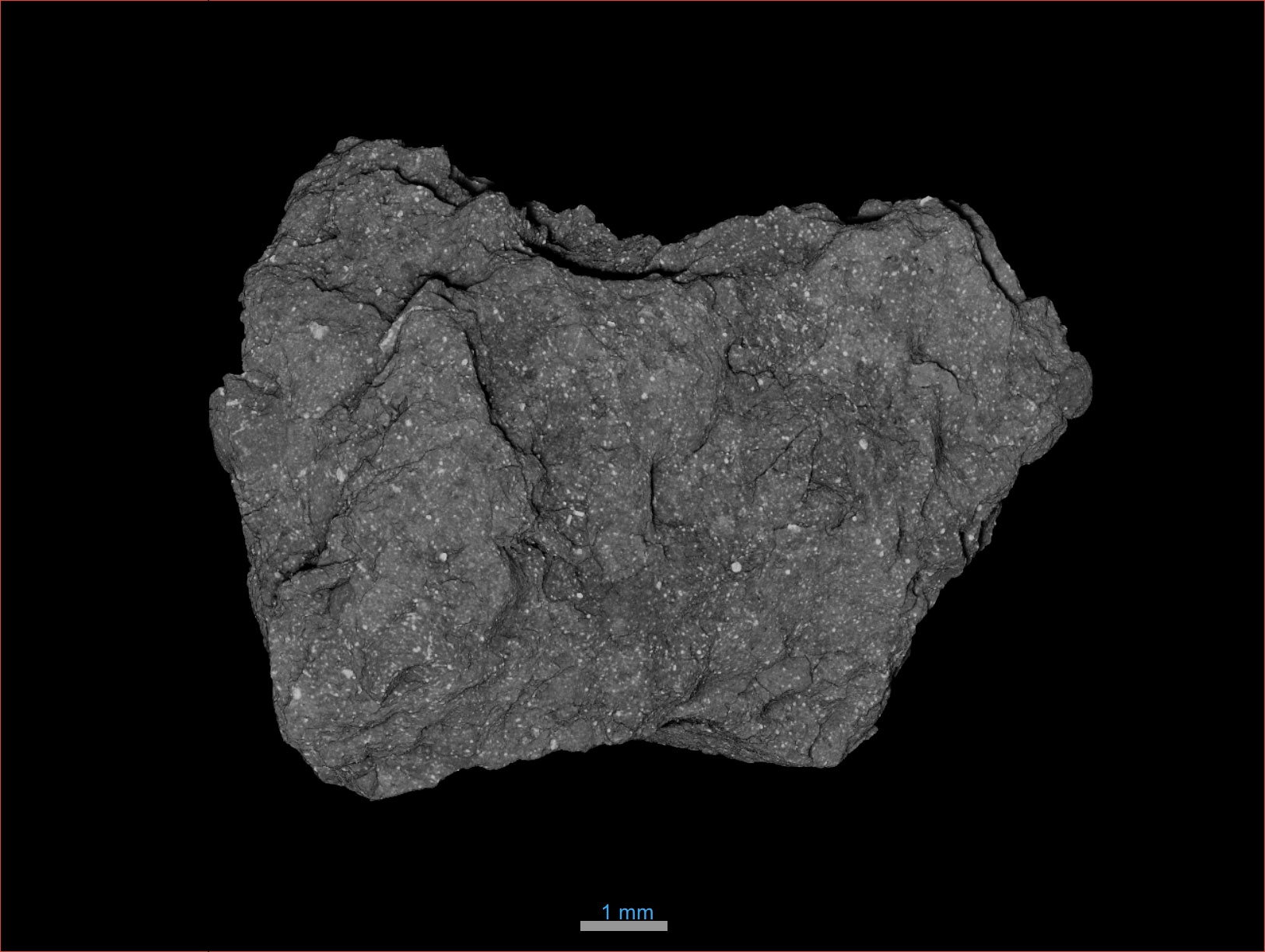 Close-up of a sample particle from asteroid Bennu. Credit: NASA/Scott Eckley
Ryan’s team examined rock particles from Bennu’s surface using several laboratory methods. In a study published in Nature Communications, the authors found that the boulders were porous enough to explain part of the heat loss, but not all of it. Many of the rocks also contained broad networks of cracks.
To find out whether those cracks were helping the asteroid lose heat, a team at Nagoya University in Japan studied Bennu material with lock-in thermography. This laser-based method lets researchers target a tiny spot on a sample and track how heat spreads through it, similar to ripples moving across a pond.
Testing Heat Flow Inside the Rocks
“That’s when things became really interesting,” Ryan said. “The thermal inertia measured in the lab samples turned out to be much higher than what the spacecraft’s instruments had recorded, echoing similar findings obtained by the team of OSIRIS-REx’s partner mission, JAXA’s (Japan Aerospace Exploration Agency) Hayabusa-2.”
To understand how this material would behave in Bennu’s much larger boulders, the researchers needed a way to scale up results from the small returned particles.
Using a glove box, team members at NASA’s Johnson Space Center in Houston sealed sample particles in airtight containers under a protective nitrogen atmosphere, then moved them to a lab for X-ray computed tomography, or XCT, scans. After scanning, each particle was returned to the glove box.
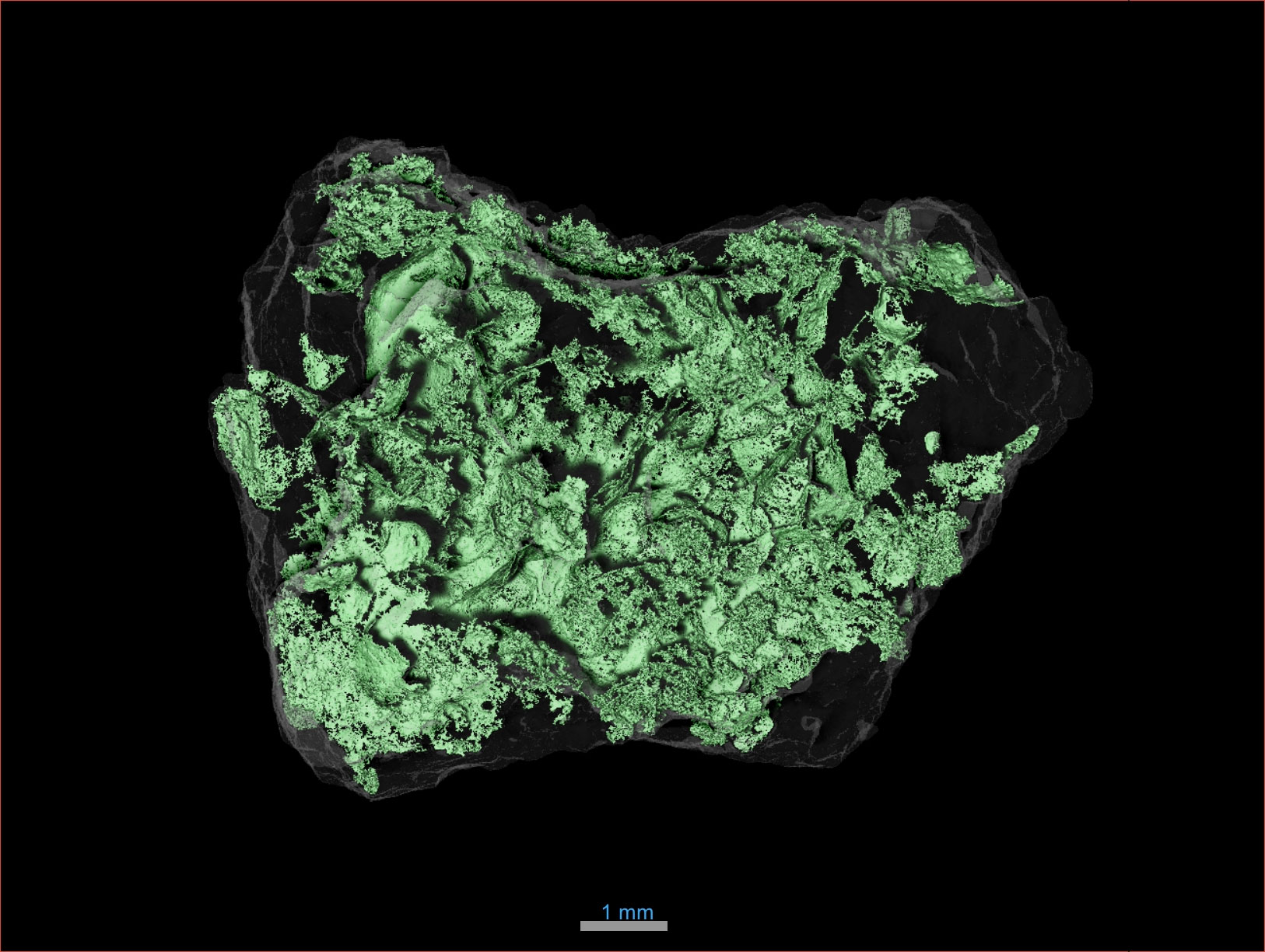 The same particle analyzed with X-ray computed tomography scanning. This specimen shows the most common types of crack networks observed in Bennu samples. One has an extensive and connect framework of curved cracks, whereas the other has sparse, straight and flat fractures. Credit: NASA/Scott Eckley
“The sample goes into its own ‘spacesuit,’ gets a CT scan, and then comes back to its pristine environment, all without having any exposure to the terrestrial environment,” said Nicole Lunning, lead OSIRIS-REx sample curator within the Astromaterials Research and Exploration Science division at NASA Johnson and one of the study’s co-authors. “We can image right through these airtight containers to visualize the shape and internal structure of the rock that’s inside.”
“X-ray computed tomography allows us to look at the inside of an object in three dimensions, without damaging it,” said study co-author and NASA Johnson X-ray scientist Scott Eckley.
Solving the Thermal Mystery
This process created a permanent three-dimensional digital archive of each sample particle’s shape and internal structure, with the data added to a public database. Ryan’s team then used the X-ray CT scan data in computer simulations of heat flow and thermal inertia. When the results were scaled up to the size of Bennu’s boulders, they matched what the spacecraft had measured at the asteroid.
Scientists had once expected Bennu’s boulders to be extremely porous and fluffy, perhaps even spongy. The sample analysis revealed a more complicated reality.
“It turns out that they’re really cracked too, and that was the missing piece of the puzzle,” Ryan said.
Ron Ballouz, a scientist with the Johns Hopkins University Applied Physics Laboratory in Laurel, Maryland, and the paper’s second author, said the study changes how researchers interpret asteroid structure from thermal properties measured from Earth.
“We can finally ground our understanding of telescope observations of the thermal properties of an asteroid through analyzing these samples from that very same asteroid,” Ballouz said.
Reference: “Low thermal inertia of carbonaceous asteroid Bennu driven by cracks observed in returned samples” by A. J. Ryan, R.-L. Ballouz, R. J. Macke, T. Ishizaki, A. Alasli, J. Biele, S. A. Eckley, C. G. Hoover, K. Jardine, A. J. King, C. P. Opeil, M. Pajola, F. Tusberti, J. J. Barnes, H. C. Bates, E. L. Berger, E. B. Bierhaus, C. Calva, S. Cambioni, F. Cheng, M. Delbo, D. N. DellaGiustina, J. P. Dworkin, C. M. Elder, J. P. Emery, J. Freemantle, R. Fujita, D. P. Glavin, C. Gonzalez, P. Haenecour, V. E. Hamilton, R. D. Hanna, L. T. J. Hanton, R. Harrington, A. R. Hildebrand, D. H. Hill, K. Ishimaru, E. R. Jawin, M. K. Kontogiannis, N. G. Lunning, T. J. McCoy, J. L. Molaro, M. Montoya, H. Nagano, E. W. O’Neal, J. Plummer, K. Righter, N. Sakatani, P. Sánchez, P. F. Schofield, M. A. Siegler, S. Tanaka, T. J. Zega, C. W. V. Wolner, H. C. Connolly Jr. and D. S. Lauretta, 17 March 2026, Nature Communications.
DOI: 10.1038/s41467-026-68505-1
Never miss a breakthrough: Join the SciTechDaily newsletter.
Follow us on Google and Google News.
























 English (US) ·
  French (CA) ·
  French (FR) ·