

PROTECT YOURSELF with Orgo-Life® QUANTUM TECHNOLOGY
Orgo-Life the new way to the future Advertising by Adpathway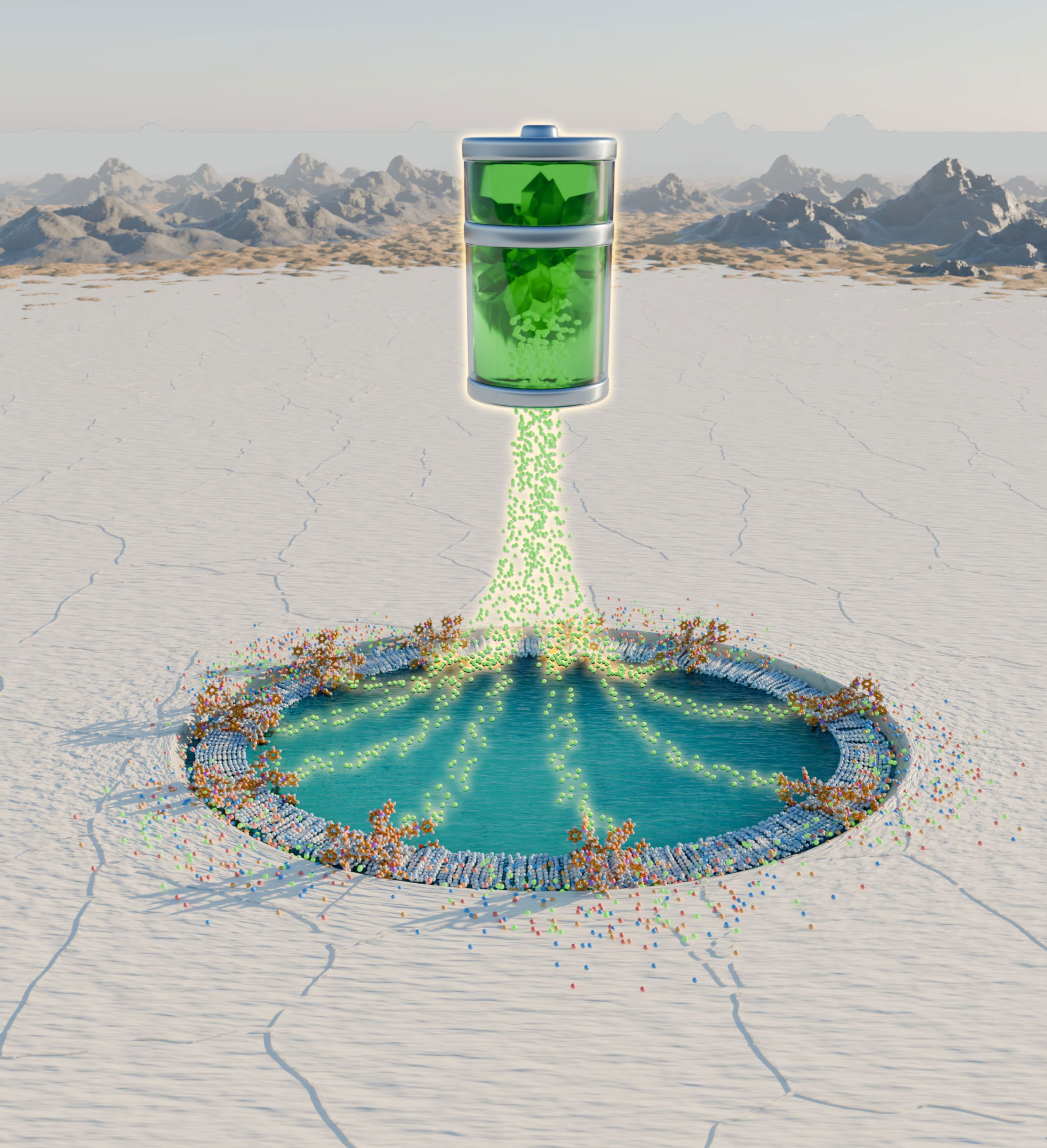 An illustration of gathering lithium ions for batteries. Credit: The University of Texas at Austin
A new breakthrough in lithium separation could help overcome major challenges in extracting this essential battery material.
A new technology developed at The University of Texas at Austin could make lithium extraction faster and more environmentally friendly by separating the valuable element from other dissolved substances with exceptional precision. The approach uses artificial channels so small they operate at the nanoscale, allowing lithium ions to pass through while blocking many competing ions.
Inspired by the molecular gateways found in living cells, the channels demonstrated two to five times greater lithium selectivity than other recently developed lithium transporters. Researchers report that the structures rank among the most selective lithium channels created to date, offering a potential alternative to conventional extraction methods.
Why Lithium Is So Difficult to Extract
Lithium is essential for batteries used in smartphones, electric vehicles, and electrical grids. It occurs in underground saltwater deposits known as brines, hard rock formations, and used batteries. However, these sources also contain elements such as sodium, potassium, magnesium, and calcium, whose ions can be difficult to separate from lithium. Existing extraction techniques often require considerable time and energy and can generate harmful waste.
“Lithium is in our phones, our cars and the power grid, but getting it out of the ground cleanly is still a hard problem,” said Manish Kumar, a professor in the Fariborz Maseeh Department of Civil, Architectural and Environmental Engineering and the McKetta Department of Chemical Engineering who is one of the leaders of the new research published in the Journal of the American Chemical Society. “Our goal is a process that is faster, cleaner and easier to run.”
How Artificial Channels Separate Lithium
The researchers designed tiny pores within membranes that mimic the selective transport pathways of biological cells. Their ability to distinguish lithium from other ions depends on two features working together: chemical groups positioned at the channel entrance and the tightly confined space inside. Interactions at the entrance, combined with the channel’s internal structure, favor lithium transport while restricting competing ions.
The study builds on earlier research into separating rare earth elements, which are important for technologies including wind turbine magnets and electronic displays. By extending the underlying design principles to lithium, the researchers are developing a broader approach to selectively recovering critical minerals.
“We now have a toolkit rather than a one-off result,” said Harekrushna Behera, a research scientist in Kumar’s lab. “By understanding how ions interact with the chemical groups at the channel entrance, we can work toward designing more selective channels for lithium and potentially other critical minerals.”
Moving Toward Cleaner, Large-Scale Extraction
The next challenge is incorporating these highly selective channels into membranes large enough for practical lithium recovery. The team is exploring a recently developed material made from interconnected, cell-like layers that can be constructed using lipids or plastic-like polymers. Such membranes could eventually support continuous lithium separation without harsh chemical solvents.
Although the laboratory results demonstrate strong selectivity, the technology has not yet been validated for industrial extraction. Researchers still need to test its performance using real brines, where numerous dissolved salts coexist, and determine whether the channels can maintain their effectiveness at larger scales.
Beyond recovering lithium from natural deposits, the researchers envision using the same technology to reclaim the element from discarded batteries. Another possible application is improving the separators inside batteries themselves, although further development will be needed to establish whether these uses are practical.
Reference: “Highly Selective Artificial Lithium Channels” by Harekrushna Behera, Tyler J. Duncan, Laxmicharan Samineni, Hyeonji Oh, Chenhao Yao, Raman Dhiman, Siqi Wang, Luke Hatch, Venkat Ganesan and Manish Kumar, 24 October 2026, Journal of the American Chemical Society.
DOI: 10.1021/jacs.6c13878
Never miss a breakthrough: Join the SciTechDaily newsletter.
Follow us on Google and Google News.





















 English (US) ·
 French (CA) ·
 French (FR) ·