

 2 weeks ago
11
2 weeks ago
11
PROTECT YOURSELF with Orgo-Life® QUANTUM TECHNOLOGY
Orgo-Life the new way to the future Advertising by AdpathwayAn investigation into the theft of 17 firearms from a government building in Humansdorp exposes critical security failures and a wider pattern of state weapons slipping into criminal circulation across South Africa, writes Catherine White.
Two men stand accused of stealing 17 firearms from a government building in Humansdorp in April 2025. A year later, all but two guns remain missing, some already linked to organised crime.
The case is not just a local security breach. It exposes how weaknesses in the management of state-owned firearms allow weapons to slip into criminal circulation, with consequences far beyond a single town.
Weapons that resurface
Since then, the Hawks have found two of the stolen firearms in the possession of kidnapping suspects in Chatty, Bethelsdorp. State prosecutor William Booysen described the case as “organised crime in its purest form”.
The other 15 firearms are still unaccounted for.
Humansdorp lies just 80 kilometres from Gqeberha, one of the country’s most violent metros. Some of the stolen weapons have already made their way there, circulating in gang-affected areas. Murder rates in the Nelson Mandela Bay Metro have risen sharply over the past five years, increasing from 865 cases in 2021 to 1 452 in 2025.
And illegal firearms follow the networks of gang violence and kidnapping across the country. In the final three months of 2025, the Eastern Cape recorded 185 kidnapping cases and 471 incidents of illegal firearm and ammunition possession. Nationally, SAPS data shows an average of 52 kidnappings were recorded daily in the same period, alongside 276 gang-related murders.
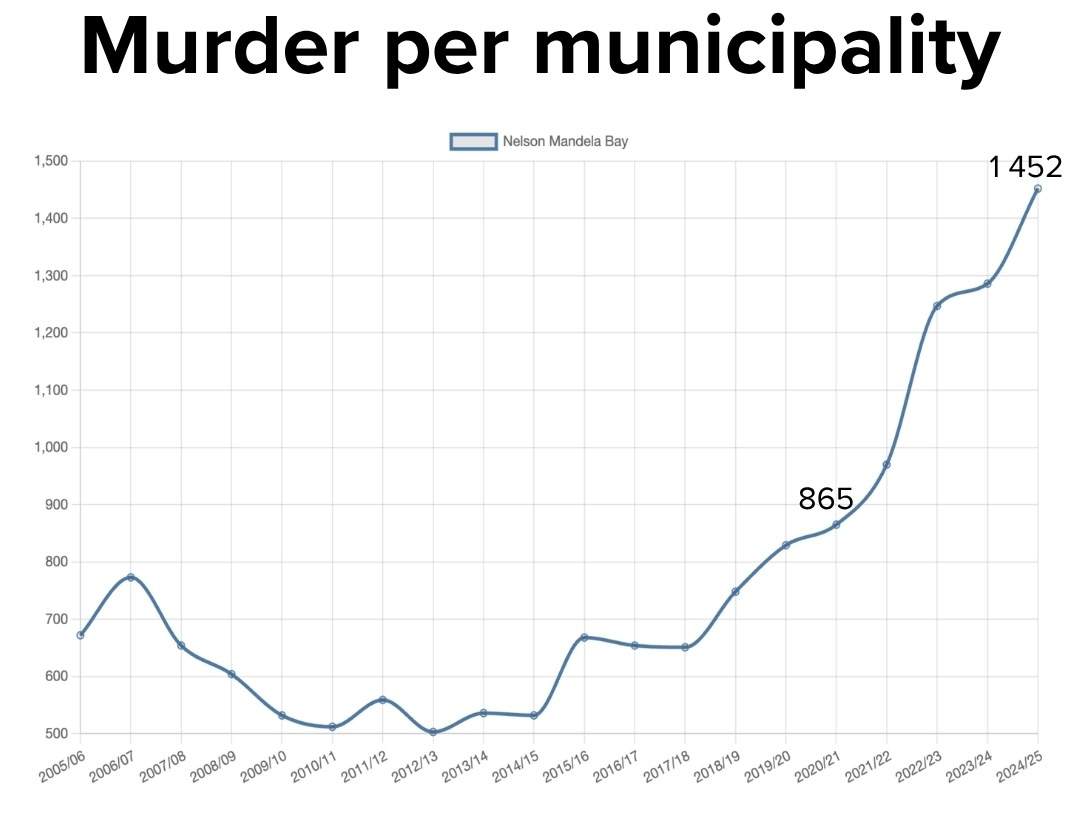
Murder rates in the Nelson Mandela Bay Metro have risen sharply over the past five years, increasing from 865 cases in 2021 to 1,452 in 2025.
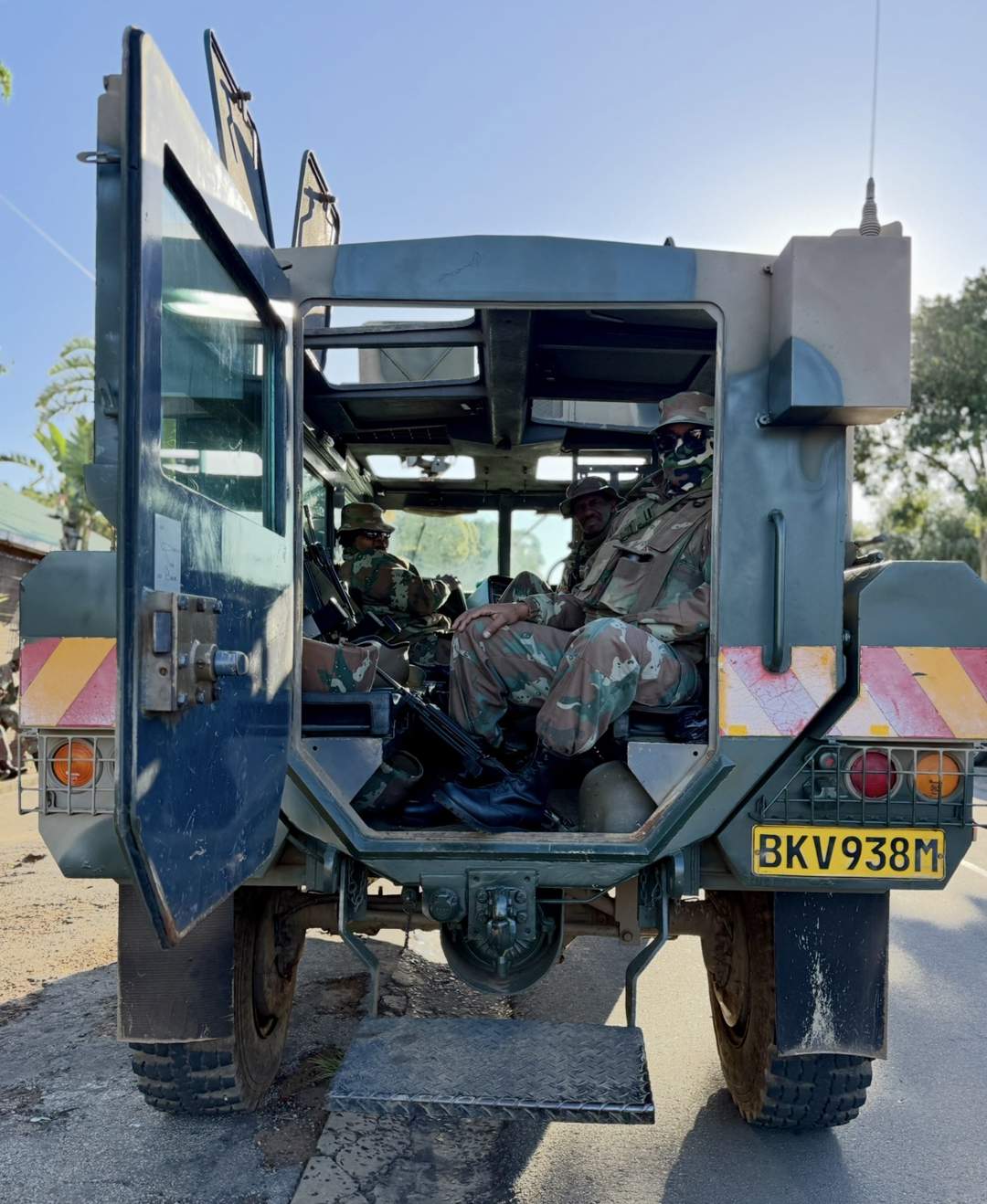
Members of the South African National Defence Force outside the Humansdorp Magistrate’s Court on 20 April 2026 during the court appearance of persons linked to a firearms theft case.
A local story, a national pattern
Investigating how weapons go missing from a government building in a small town like Humansdorp may seem trivial, but the ease with which this happens speaks to a larger national problem.
Humansdorp falls within the Kouga municipal area in the Eastern Cape. Community members here describe violence as part of daily life. A group has established a victim support centre in response, calling it the Fallen Angels.
Michelle Titus, one of the organisers, says: “There is so much anger in the community. Parents are having to pick up their children from the streets. Enough is enough. How would you feel if it was your child?”
In 2025, 34 firearm-related incidents were recorded in this small town. Sixteen people were killed, five of them in shootings. One victim was gunned down on Christmas Day, allegedly over a cigarette.
Annie Rossouw from Humansdorp says: “These 18-year-olds hold themselves brave with their guns. They rule the township. Then they make themselves small in front of the courts… they appear so innocent.”
Criminal defence attorney Chris Morgan, from Jeffreys Bay, says firearm-related offences have become increasingly common. “I’ve spent every day in these courts for the last 20 years. Almost every second case [now] involves a firearm, whether it’s robbery, housebreaking where firearms are stolen, or cases where someone has been killed.”
Around 1 800 police-issued firearms are reported lost each year, with limited transparency over how they are tracked or secured across state institutions.
More than a decade ago, officials indicated that hundreds of government bodies collectively held over a million firearms, many outside direct police or military control. The absence of clear, publicly accessible records raises concerns about how these weapons are managed and how easily they can enter criminal circulation.
Where the system fails
The Humansdorp case is not isolated.
Parliamentary records show that thousands of police-issued firearms have been lost or stolen over time, many later recovered in criminal cases.
A 2021 report by the Global Initiative Against Transnational Organised Crime warned that weak accountability allows state firearms to disappear without consequence.
A 2018 Small Arms Survey estimate placed the number of illegal firearms in circulation in South Africa at around 2.35 million.
More than 30 people are shot and killed every day in South Africa, with firearms involved in around 40% of murders.
Former police colonel Christiaan Prinsloo admitted to diverting around 2 400 firearms earmarked for destruction into criminal networks between 2009 and 2015. Those weapons were later linked to more than 1 000 murders in the Western Cape, in internal SAPS and Project Impi records that later became public through court papers and media reporting. Gun Free South Africa’s class action documents show that at least 67 children were killed with firearms linked to the Prinsloo gun trafficking network, with many more wounded.
Gun Free South Africa has since instituted class action proceedings against SAPS, arguing that systemic failures in firearm management enabled weapons to flow into communities.
Warnings ignored
In his 2026 State of the Nation Address, President Cyril Ramaphosa again pledged to strengthen firearm regulation and enforcement. But these commitments are not new. Illegal firearms and organised crime have featured prominently in policy discussions for years.
Despite repeated warnings, weaknesses remain.
In Humansdorp, those failures can be traced.
Our investigation has uncovered security failures at the facility, including alarm system faults and discrepancies in official records in the days leading up to the break-in, highlighting the importance of adequate oversight and safeguards in protecting state-owned weapons.
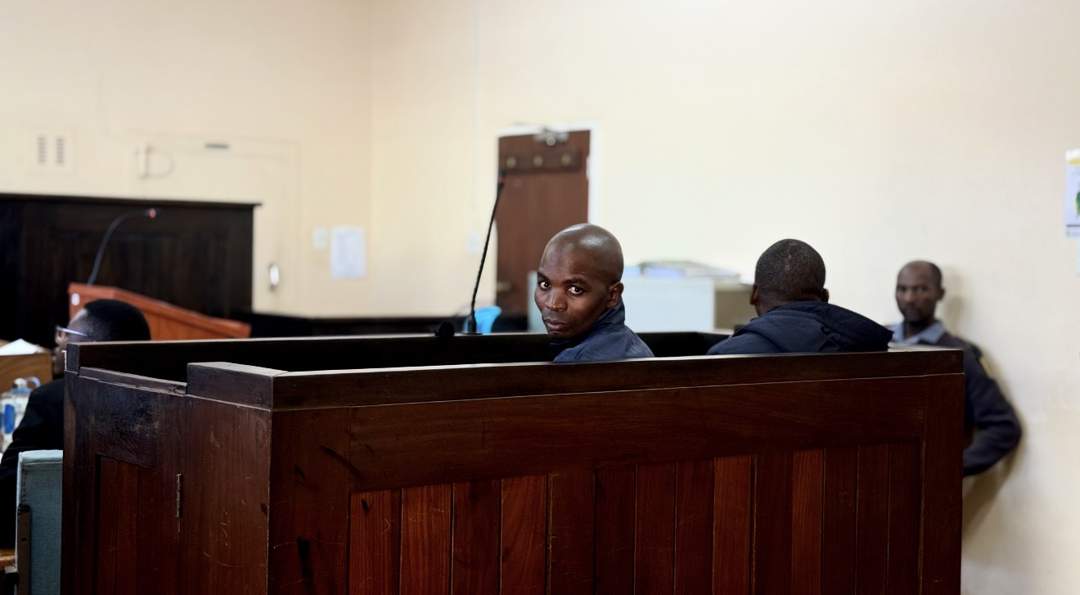
Jackson James appears alongside co-accused Sivuyile Gqabati in the Humansdorp Magistrate’s Court. They were arrested in Gqeberha on 27 March, in connection with the alleged theft of firearms from a municipal facility, with a third suspect still at large. James faces charges of housebreaking, theft, and the unlawful possession of 17 firearms and more than 500 rounds of ammunition.
The break-in
The theft took place over the Freedom Day long weekend in April 2025 at the Kouga Local Municipality traffic department office in Humansdorp. Evidence suggests the intrusion was planned and coordinated.
Parts of the alarm system were tampered with during the break-in. The radio communication unit was unscrewed and disconnected, preventing the system from transmitting signals, while the alarm panel itself was also physically damaged.
Documents reviewed indicate that the municipality’s Incident Command Centre may not have been alerted to critical alarm failures, despite established reporting protocols.
Investigators believe the perpetrators gained entry through the roof, removing roofing sheets to access the exact room where the firearms were stored, effectively bypassing conventional entry points. Their point of entry raises serious questions about whether the structure met the requirements for a walk-in safe under the Firearms Control Act.
A side window was also allegedly opened shortly before the long weekend, creating an additional potential point of entry.
The facility lacked basic detection measures, including roof passives and motion sensors designed to detect movement from above, leaving the intrusion undetected.
Once inside the “walk-in safe”, the perpetrators used heavy-duty tools and construction equipment to force open two smaller safes containing the firearms.
In terms of the act, and standards set by the South African Bureau of Standards, firearm strongrooms and walk-in safes are meant to be built with reinforced concrete walls, floors and ceilings designed to resist forced entry, including cutting, drilling and even explosives.
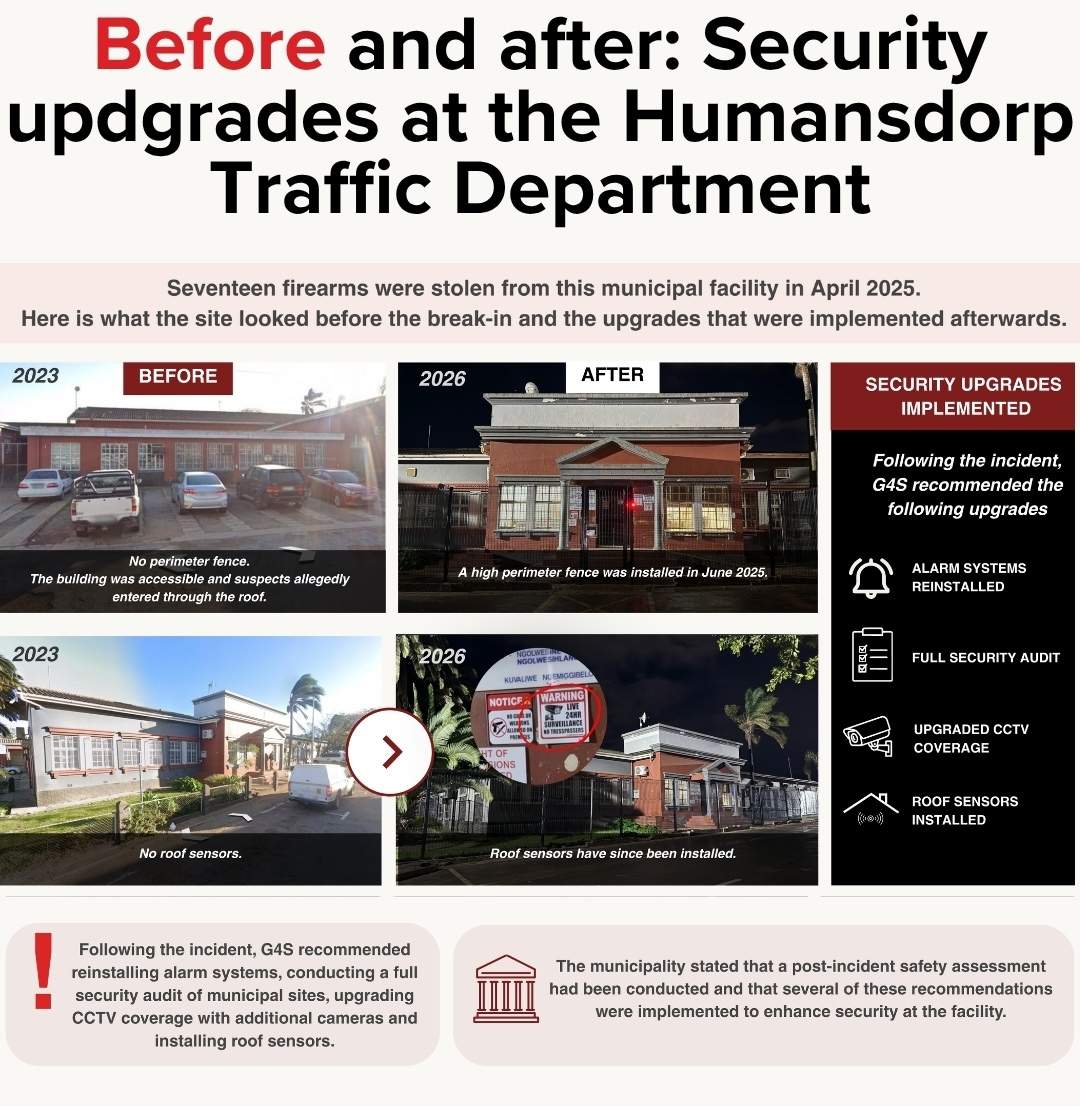
Weeks after the theft, a high-security fence was installed at the site, a measure experts describe as “target hardening” aimed at deterring future incidents.
“Operations like this are rarely opportunistic,” says Lizette Lancaster of the Institute for Security Studies. “They often require inside knowledge about where weapons are stored and how to access them.”
Dr Guy Lamb, a criminologist at Stellenbosch University, says targeting state armouries is a known pattern.
“Criminal groups often aim to secure multiple firearms at once,” he adds. “A traditional method has been to target police stations, metro police or traffic departments. These are highly organised operations because firearms are highly sought after.”

Who is responsible?
The responsibility for keeping these firearms safe doesn’t fall on just one person. The designated firearms officer is responsible for the day-to-day handling, storage and records. The leadership of Kouga Local Municipality must make sure the right systems and security are in place. The South African Police Service is meant to check that everything follows the law under the Firearms Control Act. And G4S, as the contracted security company, should be monitoring alarms and responding if something goes wrong.
During a municipal council meeting on 30 April 2025, a day after the alleged break-in was discovered, councillors debated whether to launch an internal investigation. Councillor Bazil Human of the Patriotic Alliance tabled an urgent motion, describing the incident as a “serious and deeply concerning security breach” and raised concerns that no security personnel had been on site.
While some councillors supported reviewing failures in municipal security procedures, Mayor Hattingh Borman argued the matter was already under police investigation and should await the outcome of the criminal case. Human countered that an internal review could proceed as the matter was not yet sub judice. The motion for internal investigation and further discussion was ultimately defeated, with six councillors in favour and 18 against.
Ivor Chipkin, a political economist who focuses on state capacity and institutional failure, says a political or administrative inquiry should be expected under the circumstances.
“These are issues which the municipality should be investigating, and the criminal investigation might be able to add value to their investigation, but it’s autonomous. It would be absolutely in order.”
While a criminal investigation focuses on identifying suspects, Chipkin says an internal process is aimed at understanding systemic weaknesses and preventing future failures.
Lizette Lancaster of the ISS says that internal reviews are standard practice, even when criminal investigations are under way.
“Internal assessments help identify whether there were security or oversight failures that need to be addressed,” she adds.
The municipality confirmed that no internal investigation was conducted, saying that the matter had been reported directly to SAPS and escalated to the Hawks for investigation. It further stated that no disciplinary measures had been implemented to date, pending the outcome of the police investigation.
However, these responses do not address key questions around accountability, including why no internal investigation was conducted despite the scale of the breach.
Limited access to records
Inspection records indicate that the Traffic Department did not maintain a firearms register or a competency register, placing it in non-compliance with regulatory requirements.
Authorities have also refused to release key records that could shed light on how firearms were managed before the theft.
A request for access to the official firearm register, permit records and compliance documents was denied by Kouga Municipality, citing an ongoing investigation by the Hawks. A supporting letter from the Hawks stated that no information could be released while the case remains under investigation. The request is not for operational details of the investigation, but records that would indicate whether proper procedures were followed.
The refusal raises further concerns about transparency and accountability in how state-owned firearms are managed and why Kouga Municipality would not allow access to these documents to prove compliance.
Alarm system failures
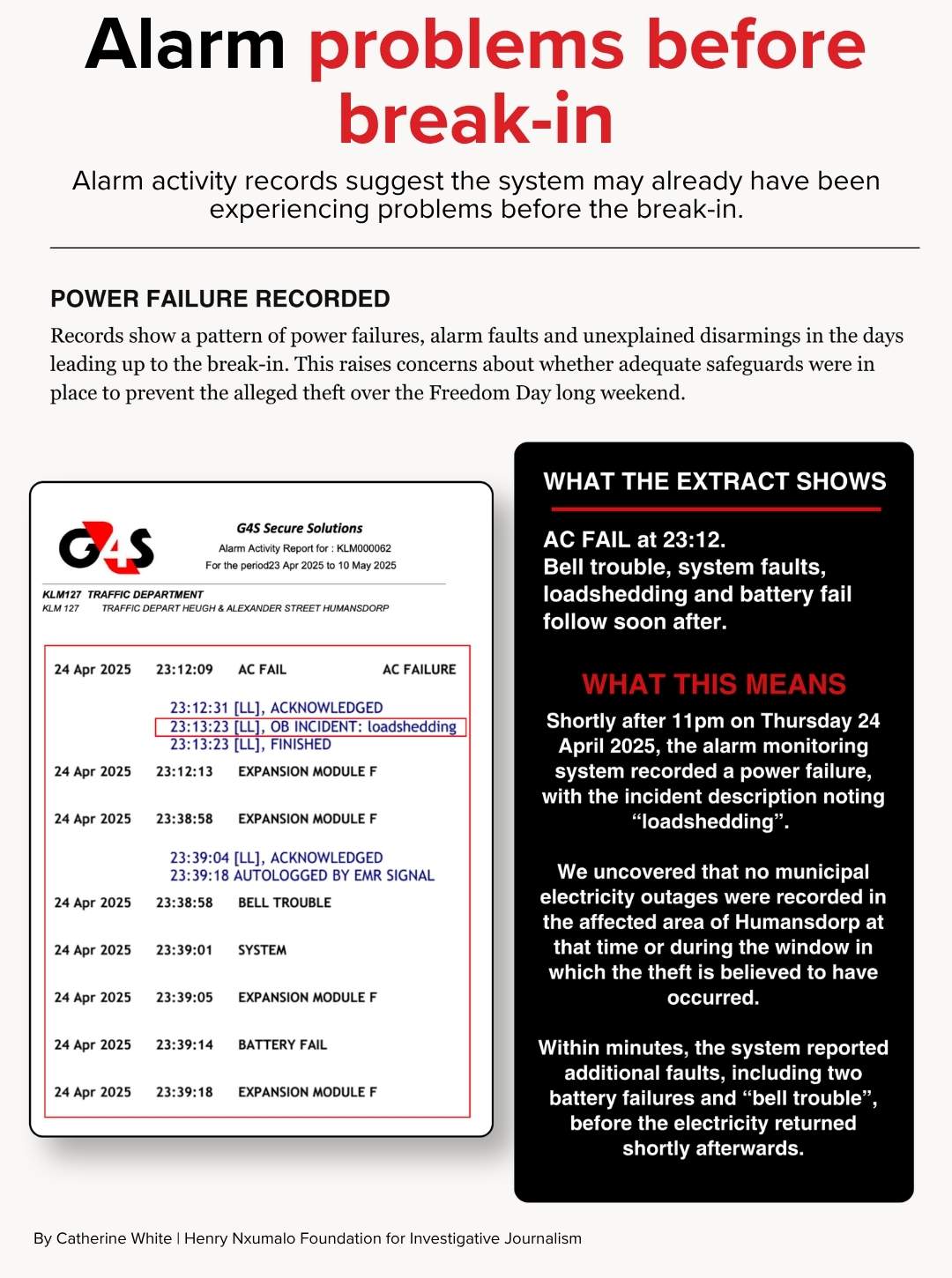
Records show irregular alarm activity in the days leading up to the break-in, including power failures, system faults and unexplained disarmings.
The last critical alert was logged on 26 April 2025. No further activity appears in the records until 29 April, when the break-in was discovered, leaving a gap of more than two days during which the intrusion may have occurred.
Although the municipality said the system had been “deliberately and strategically dismantled”, alarm records indicate that it may already have been unstable before the incident. There is no evidence that response teams were dispatched or that alerts were formally recorded in the occurrence book, as required.
Further alarm activity did not align with CCTV records, raising questions about whether the system was malfunctioning or inaccurately recording events.
Following the break-in, concerns were raised by the municipality with G4S regarding compliance with monitoring procedures and response protocols. G4S was contacted for comment on whether alerts recorded before the break-in were investigated or whether any personnel were dispatched. A representative indicated that they had been instructed by the municipality not to comment.
Security contract questions
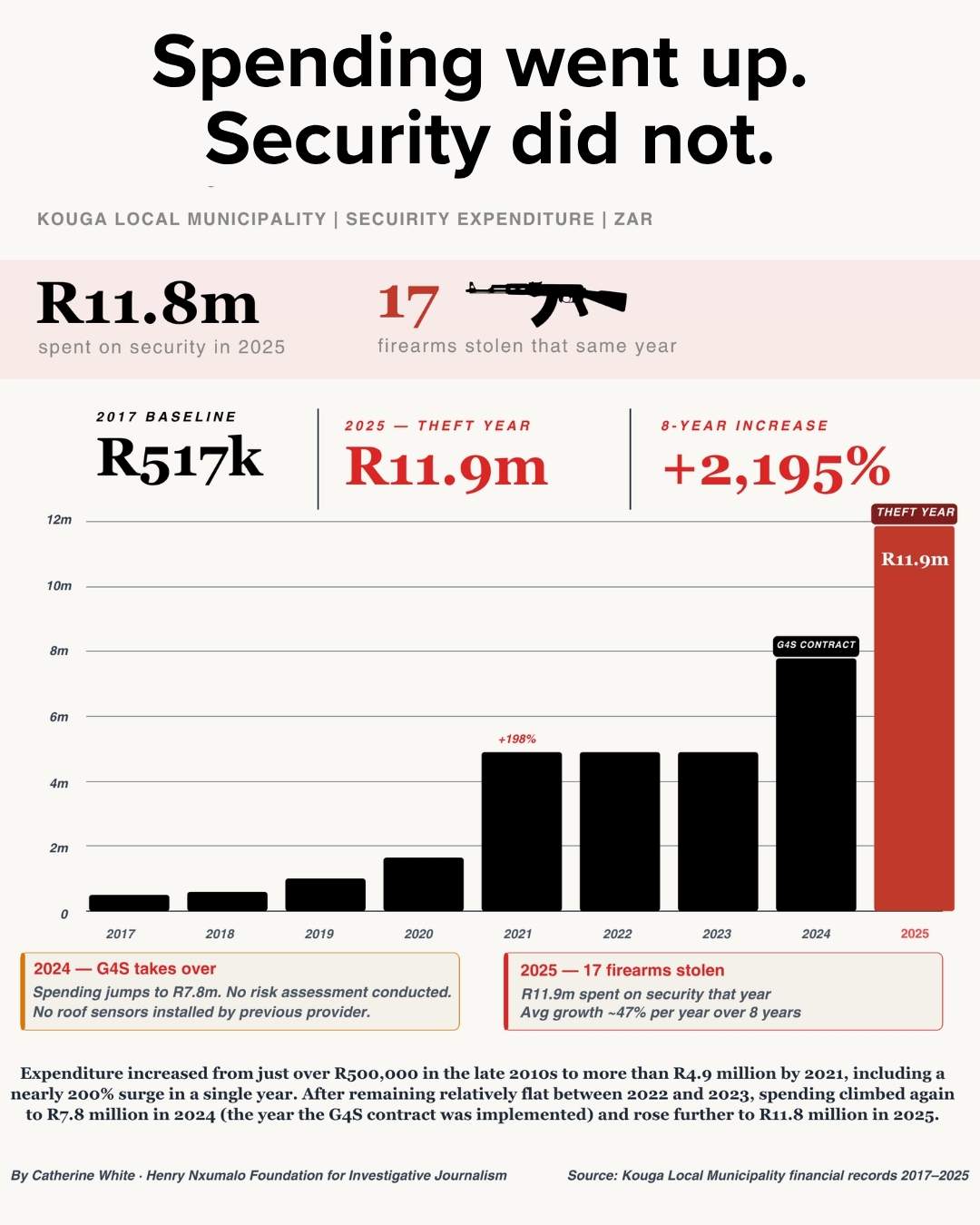
Security for Kouga Municipality facilities had been outsourced in 2023 under a contract requiring alarm monitoring, incident reporting and armed response. The contract, held by G4S, required site inspections, response vehicles on standby and clear reporting procedures.
However, during a visit to the premises on the first anniversary of the Freedom Day long weekend burglary, a guard on site was employed by a separate security provider, Exec Ops, which operates under G4S. The contract states that G4S remains responsible for anyone who may be subcontracted.
The occurrence book, which should document all security activity, contains no record of any response to alarm alerts or faults at the traffic department over the long weekend in which 17 firearms were stolen.
Correspondence reviewed indicates that G4S did not conduct full risk assessments during the transition between service providers. After the theft the monitoring company noted gaps in the existing system, including the absence of roof sensors.
The correspondence also refers to “budget constraints” affecting additional security measures, despite municipal spending on security increasing significantly over time.
G4S received battery warnings from the alarm system. However, there is no evidence that any response team was dispatched, or that these alerts were formally recorded as required.
Neither Kouga Local Municipality nor G4S have explained whether the alerts were investigated, whether a response vehicle was deployed, or what measures were in place beyond the alarm system itself.
The findings point to failures across multiple layers of security, from detection and monitoring to response and oversight.
Chain of weaknesses
The evidence points not to a single failure, but to a chain of weaknesses: alarm faults, gaps in monitoring, failures in response, and a lack of internal accountability.
In Humansdorp, those failures allowed weapons to leave state control. In a country already grappling with high levels of violent crime, the consequences extend far beyond the town where they went missing.
A year after the break-in, 15 of the 17 stolen firearms remain unaccounted for, with two already linked to kidnapping suspects, who have been arrested.
Despite multiple layers of responsibility, no individual or institution has been held accountable for how 17 firearms left state control.
This work was produced with the support of the Henry Nxumalo Foundation.

























 English (US) ·
  French (CA) ·
  French (FR) ·