

 2 months ago
42
2 months ago
42
PROTECT YOURSELF with Orgo-Life® QUANTUM TECHNOLOGY
Orgo-Life the new way to the future Advertising by Adpathway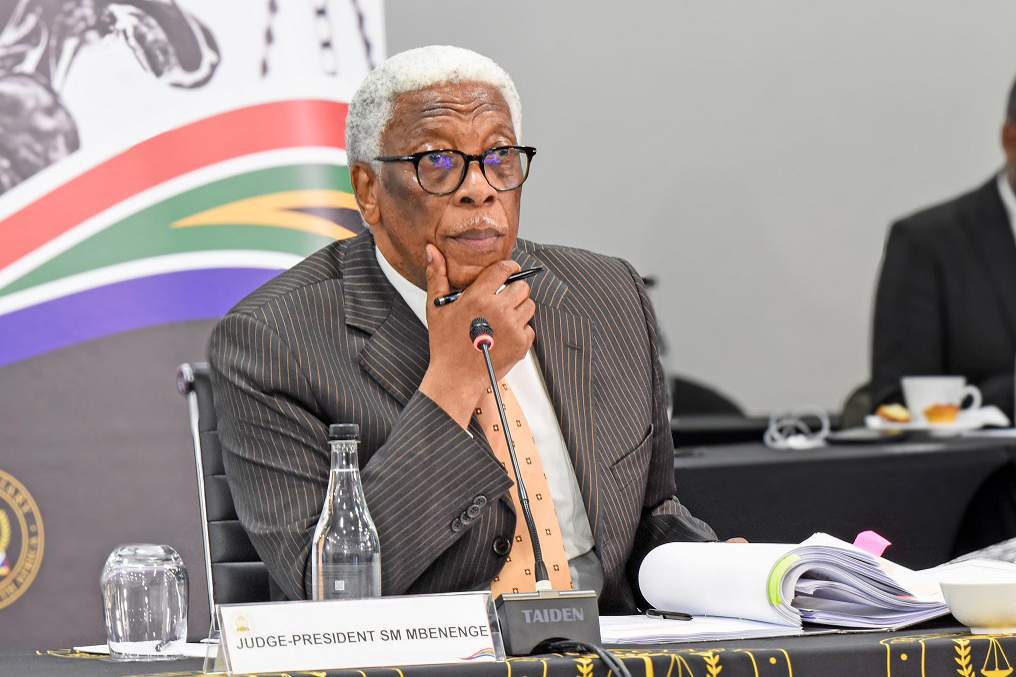
Eastern Cape High Court Judge President Selby Mbenenge was accused of sexual harassment by Andiswa Mengo, who worked as a judges’ secretary in his court.
- Eastern Cape High Court Judge President Selby Mbenenge was accused of sexual harassment by Andiswa Mengo, who worked as a judges’ secretary in his court.
- A Judicial Service Commission (JSC) judicial conduct tribunal found Mbenenge not guilty of impeachable gross misconduct in relation to his conduct towards Mengo, but found him guilty of misconduct.
- That finding was overturned by the JSC, which found that Mbenenge should face an impeachment vote. The Judge President is now challenging both that decision and the misconduct finding made against him by the tribunal.
Eastern Cape Judge President Selby Mbenenge is adamant his sexually loaded WhatsApp exchanges with High Court secretary Andiswa Mengo were consensual, and says the Judicial Service Commission (JSC) finding that he should face impeachment for sexual harassment is unlawful, unfair and irrational.
Mbenenge has launched an application in the Gauteng High Court in Pretoria to block Parliament from proceeding with the impeachment process and the vote that could strip him of all his judicial benefits, pending a far-reaching legal challenge to the findings against him.
A judicial conduct tribunal, which was headed by retired Judge President Bernhard Ngoepe, endorsed Mbenenge’s argument that his WhatsApp exchanges with then 37-year-old single mother Mengo were consensual and not unwelcome, and found “there was no sexual harassment”.
The tribunal did, however, find Mbenenge “guilty of a degree of misconduct not amounting to gross misconduct in that he contravened Article 5.1 of the Code of Judicial Conduct, read with Note 5 (iii) thereto in that he, at a place of work and during working hours, initiated, and subsequently conducted, a flirtatious relationship with Ms A Mengo through a series of WhatsApp messages exchanged between them”.
That finding was overturned by the JSC, which found that Mbenenge was guilty of gross misconduct and should face impeachment.
READ | JSC disagrees with tribunal, finds Mbenenge guilty of impeachable gross misconduct
Mbenenge is now seeking to challenge both that decision and the tribunal’s finding that he was guilty of a lesser charge of misconduct, with the Judge President arguing he was never given an opportunity to defend himself against it. He nonetheless endorses the tribunal's findings against Mengo, who it found was not a credible witness.
While Mengo’s legal team had argued that the vast majority of sexually loaded messages had been sent to her by the much older Mbenenge, they contended that she played along out of fear that not doing so could harm her professionally; however, the tribunal rejected that submission.
Instead, it stressed that the case against Mbenenge was based on “written WhatsApp messages, which speak for themselves, some of which, as already indicated, came from [Mengo] herself and were flirtatious and salacious, and which, importantly, she did not deny authoring and sending”.
The tribunal report focuses almost entirely on Mbenenge’s attack on Mengo’s credibility as a witness, and accepted his accusation that she lied about not copying her first sexual harassment complaint against him from an earlier complaint that was lost by the Office of the Chief Justice (OCJ). It also found that Mengo “omitted flirtatious and salacious messages that she herself had written and sent to [Mbenenge]” from her complaint statement against him.
READ | Mbenenge fights JSC harassment findings to block impeachment
After finding that the married grandfather Mbenenge was “buoyed by the flirtatious and salacious messages” exchanged between himself and Mengo and “wanted to take matters to the next level, namely, to be intimate with her” after she asked if they could meet in East London, the tribunal found that the Judge President seemed to “misread the situation; the fact that [Mengo] did not disclose what the purpose of meeting in person was, did not help”.
While noting that Mbenenge “admitted being desirous of being intimate with [Mengo in East London]”, the tribunal said he testified that “he accepted the rejection of that idea by [Mengo]”.
“In his evidence, he described that rejection or rebuff as being specifically in relation to being sexually intimate, but not as a rejection of a flirtatious relationship,” the tribunal said, in a finding that rejected Mengo’s testimony that she had said no to Mbenenge’s proposal of a sexual relationship.
The so-called “small JSC” (the JSC without political party members) majority did not accept that reasoning.
Instead, it found that the tribunal had conducted a limited assessment of Mbenenge’s conduct towards Mengo, which failed to examine how the vast majority of their “grossly inappropriate” WhatsApp messages were initiated by him and “sustained over a period of time”. The JSC also found that “the admitted facts” showed that communications extended beyond working hours and the workplace and included communications whose “nature bore directly on the standard of conduct expected of a judge”.
READ MORE | Eastern Cape Judge President Selby Mbenenge placed on special leave pending JSC decision
It further found that Mbenenge was guilty of gross misconduct because of the sexual nature of the WhatsApp communications initiated by him, his apparent pursuit of Mengo, his self-admitted intention to pursue a sexual relationship with her and the imbalance of power between him and the secretary and his position of authority as a Judge President.
The JSC also found that Mbenenge’s own evidence revealed that he did not appreciate the responsibility associated with his position as the Judge President and had shown no real remorse for his conduct. It asserted that his conduct was incompatible with “the standard of honourable behaviour and propriety required of judicial office” – in particular, the expectation that judges would demonstrate integrity, accountability, equality, respect and dignity.
According to Mbenenge, the JSC’s overturning of the tribunal’s acquittal of him for sexual harassment “is beset by several material irregularities, both procedural and substantive”.
“The decision is also irrational at both procedural and substantive levels. The irregularities overlap,” he argues.

















 English (US) ·
  French (CA) ·
  French (FR) ·