

 2 months ago
23
2 months ago
23
PROTECT YOURSELF with Orgo-Life® QUANTUM TECHNOLOGY
Orgo-Life the new way to the future Advertising by AdpathwayThere is a recurring mistake in the history of governments that believe history has given them permission to reshape national political economies, and it is not the one their critics usually name. Not greed, not incompetence, not the corruption that follows power when it concentrates too long in too few hands, but something more fundamental: the confusion of an asset with the conditions that made it valuable.
Hugo Chávez understood this too late. When Venezuela asserted full state control over the national oil and gas firm PDVSA in 2003, it fired thousands of engineers and technical managers and replaced them with political loyalists. Venezuelan oil production had peaked at 3.4 million barrels per day before Chávez; by 2019 it had collapsed to under 1 million. What could not be replaced was the commercial discipline, the logic of reinvestment, and the accumulated operational judgement that belongs to organisations rather than objects and dissolves when the organisation is replaced by one answering to different pressures.
Indonesia is repeating a version of this error under President Prabowo Subianto, and the difficulty in confronting it clearly is that the error is wrapped around a legitimate grievance.
Permission from the past
State intervention in Indonesia’s productive sectors has a case behind it, and it is not manufactured. It draws on a history that is real and, for most Indonesians, living. The Dutch colonial economy was organised explicitly around extraction: the cultivation system that compelled Javanese farmers to dedicate a portion of their land to export crops for European markets was among the most systematically predatory arrangements in modern colonial history, and it left behind a particular social geography in which productive assets and the populations that worked them existed in entirely different relationships to whatever surplus was generated. Independence did not dissolve this structure so much as transfer command of it to a domestic elite and its foreign partners.
The Suharto era produced genuine growth and development, and it also produced a political economy in which proximity to the presidency was the primary determinant of who accumulated and who did not. Indonesia’s dominant private conglomerates were constituted through a system of licences, concessions, and protected market access that made competitive merit largely beside the point. When Indonesians look at private wealth concentrated in their country’s resource sectors, they are looking at something that has never been cleanly separable from the political arrangements that generated it.
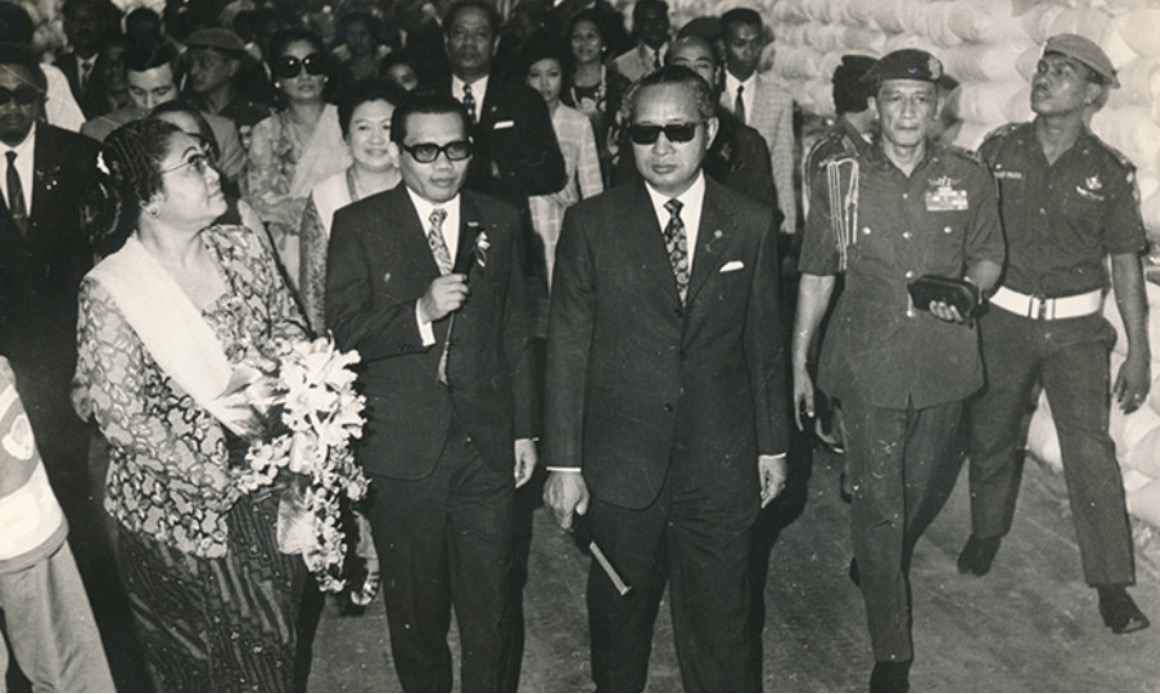
President Suharto and First Lady Tien Suharto at the inauguration of PT Bogasari’s flour mill (1971). Bogasari’s owner, Sudono Salim, was among the most prominent of the Suharto-era conglomerates whose dominance was built as much through presidential proximity as commercial acumen
This is the moral foundation of the current statist–nationalist turn in Indonesian political economy, which has encompassed resource nationalism and the steady expansion of state mandates into strategically important sectors. This reorientation has deep roots. During the Yudhoyono presidency, resource policy began moving decisively in this direction, most visibly through the 2009 Mining Law, which restructured the industry to give the state far greater discretion over long-term extractive projects, and through the rapid expansion of palm oil as the foundation of a resource-based development model explicitly centred on national economic competitiveness.
Former president Joko Widodo deepened and institutionalised this trajectory across his decade in office by consolidating state ownership over strategic extractive assets and expanding state mandates well beyond what Yudhoyono had been willing to attempt, while still leaving enough space for foreign and private capital to engage on the state’s terms. This was most visible in the nickel sector, where the state’s intervention was designed less as nationalisation than as an act of industrial policy—compelling the emergence of a domestic processing industry that would not otherwise have been built, and that has since grown into one of Indonesia’s most significant export earners.
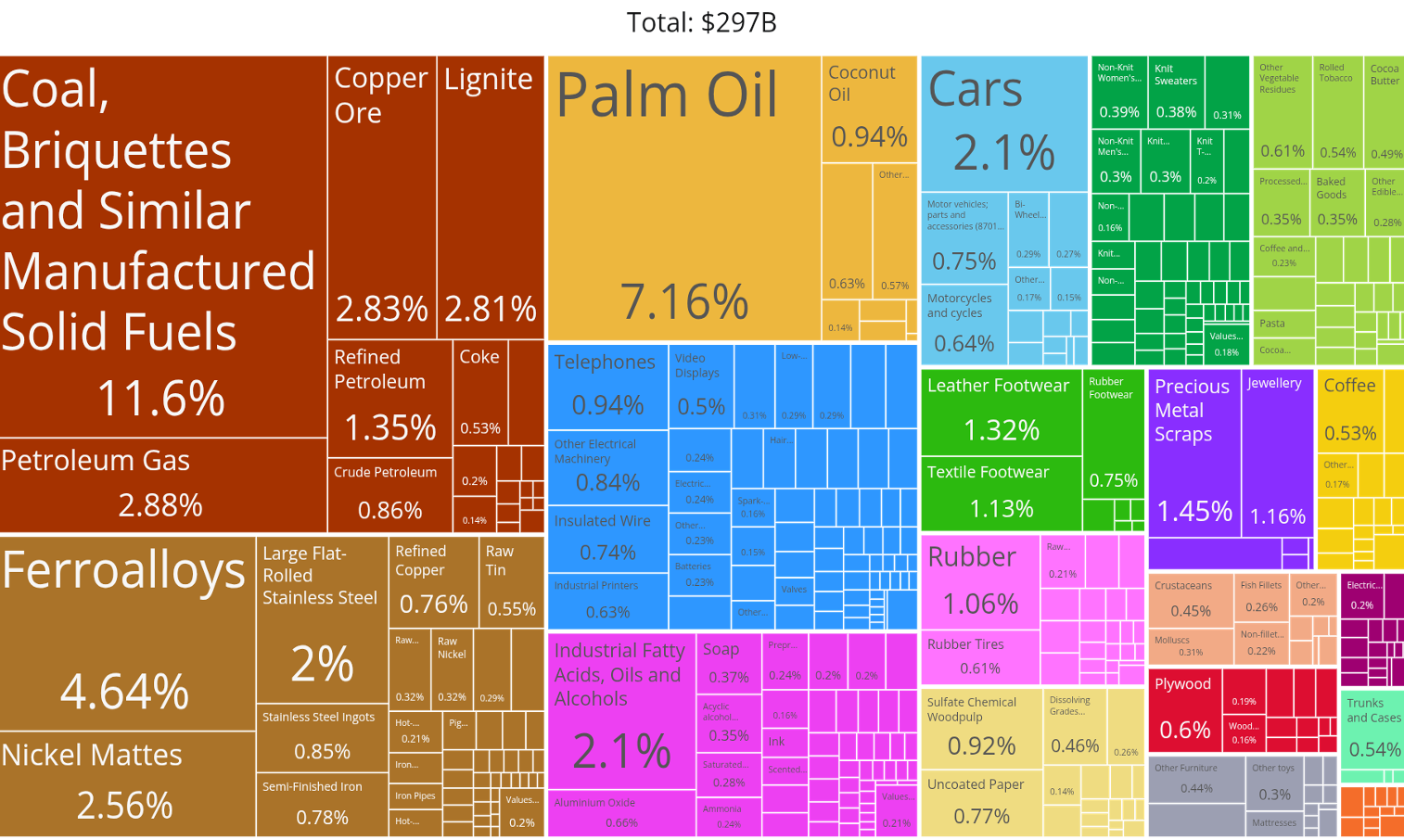
Indonesia’s export composition (2024, OEC, $297B total). Three of the country’s largest export categories—coal, palm oil, and ferroalloys—are the direct products of the resource-based development model that successive administrations built and that Prabowo now claims as the foundation for deeper state control.
This moral driver deserves genuine engagement, not dismissal as convenient rationalisation. The premise that private capital in certain sectors is fundamentally extractive is, in the Indonesian context, substantially a description of how private capital in those sectors historically came to exist. The grievance is legitimate, yet the instrument chosen to address it is destroying something of greater value than what it is trying to recover.
The state arrives
Over the past year, the Prabowo administration has moved with evident purpose to reshape Indonesia’s productive landscape, operating on a premise that private capital in strategically important sectors is fundamentally extractive, and that inserting the state into ownership corrects this in the public interest. The ambition itself has precedent across the postcolonial world, and the assumption underneath has gone unexamined each time—that the state, by acquiring what private actors have built, inherits the conditions that made those assets productive in the first place.
Across sectors, the pattern is consistent. The forest area enforcement task force (Satgas PKH), which operates with enforcement powers that largely bypass normal judicial channels, has seized millions of hectares of private palm oil plantations and transferred them to Agrinas Palma Nusantara, a newly created state enterprise now the largest palm oil company in the world by land holdings. The same logic has been extended to mining, with permits revoked and operations channelled towards Perminas, another new state enterprise whose board sits within patronage networks connected to figures in Prabowo’s inner circle. In retail, the government’s flagship cooperative program (Koperasi Desa Merah Putih) aims to establish over 80,000 state-sponsored village cooperatives funded through the state budget, while ministers push to freeze expansion licences for the private retail chains they are meant to displace.
The scale and pace of this is worth pausing on. Agrinas, Perminas, and Koperasi Desa Merah Putih are all creatures of 2025—none existed before Prabowo, and all are either already reshaping the sectors they were dropped into or well on their way. Within months, the administration has restructured or is actively restructuring the ownership landscape of three of Indonesia’s most economically significant sectors through presidential decree and prosecutorial muscle alone. The speed is not incidental. Moving faster than legal challenge, investor response, or public scrutiny can catch up is itself a governing strategy.
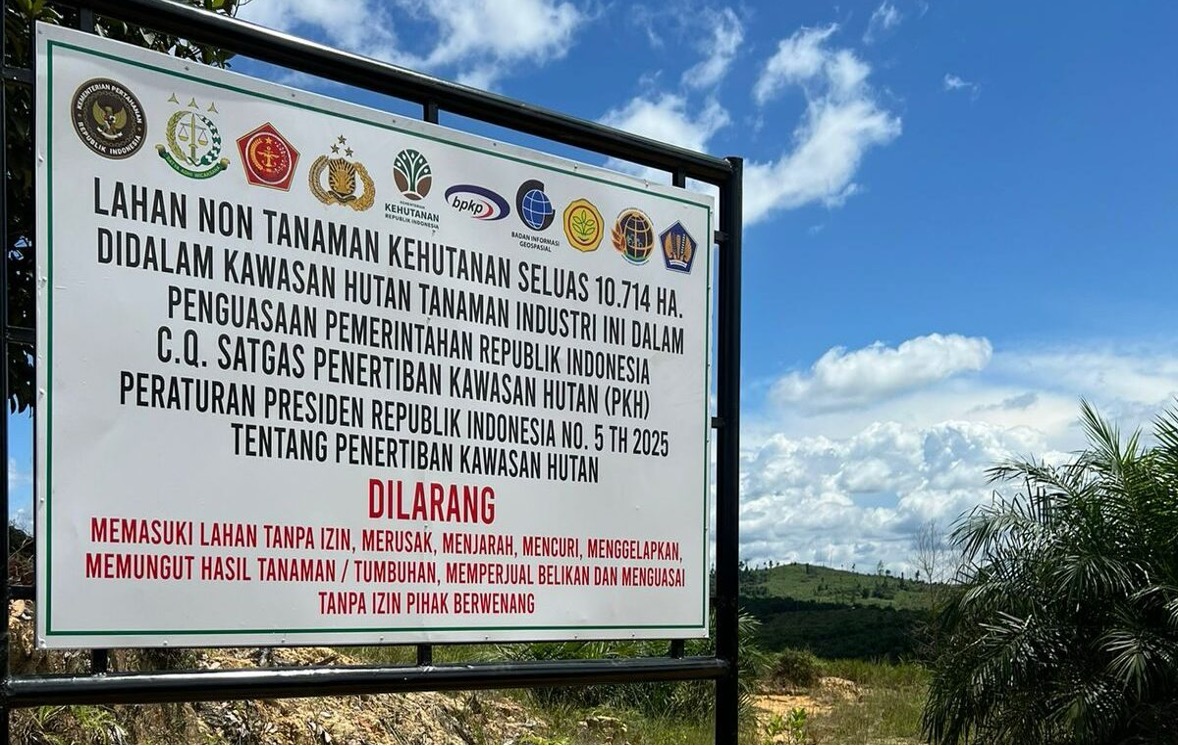
A Satgas PKH sign marking a seized land within an industrial plantation forest zone, Kalimantan (2025). The taskforce, established under Presidential Regulation No. 5 of 2025, has seized millions of hectares of privately owned land across the archipelago.
Politically administered state enterprises and cooperatives that are programmed to replace private actors operate under the discipline of political survival, which rewards the distribution of positions, the maintenance of relationships, the performance of loyalty—not the unglamorous iterative work that sustains a productive enterprise across changing conditions. Several of the entities created through these interventions sit within patronage networks connected to prominent political figures. An entity asked to optimise for viability and political reward simultaneously is effectively being asked to do neither.
The deeper consequence, however, is not what these entities will fail to produce. It is what their existence forecloses.
Every economy in Asia that has made the transition from resource extraction towards manufacturing complexity built it through a mechanism that is almost the inverse of what Indonesia is currently constructing. When Meiji Japan set out to industrialise in the 1870s, it built state enterprises not because it believed the state was a superior economic actor, but because private capital did not yet exist at the scale industrialisation required. The logic was explicitly temporary. Once those enterprises were viable, the government sold them, often at significant loss, to private actors who could run them under competitive pressure. The Meiji state’s greatest contribution to Japanese industrialisation was recognising that it could not be the one to complete it. What it built, it built in order to hand over.
South Korea and Taiwan a century later operated on a similar understanding, expressed through different architectures. Korea’s developmental state was highly directive but maintained genuine performance pressure on firms that bore real risk and competed against one another for state support that was conditional, never assured. Taiwan worked through ferociously competitive small and medium enterprises in export markets, backed by institutions that provided infrastructure and credit without insulating firms from failure. In both cases the state shaped and intensified private competition without substituting for it.
Prabowo’s Indonesia is running this logic in reverse by acquiring what private capital has already built, instead of building what private capital cannot yet attempt, and then retaining rather than transferring it.
Sovereign by decree, competitive by nothing
Once the state becomes the primary economic actor, and not the architect of the environment in which private actors compete, it has destroyed the mechanism it was trying to harness. Indonesia’s ambition to move up the value chain, to attract the foreign partnerships that transfer technology and integrate domestic producers into global supply chains, to generate the higher-productivity employment that has transformed living standards across the region—none of this is achievable through entities whose competitiveness is assembled by political arrangement.
This pattern of interventions damages the economy on two levels, the second far outlasting the first. The direct losses in the affected sectors are real and accumulating, but private investment is a continuous sequence of threshold decisions made by actors updating their assessment of risk against expected return, and those decisions happen before they are announced, in the quiet lengthening of a holding period or the shrinkage of a commitment from meaningful to token. When a government demonstrates that proven profitability in a strategic sector invites state displacement, those decisions shift across the entire investment landscape in aggregate and well in advance of any policy reversal. The revisions to sovereign credit rating outlooks and warnings of securities index reclassification Indonesia has received over the past year are the visible portion of a calculation private capital has already completed.
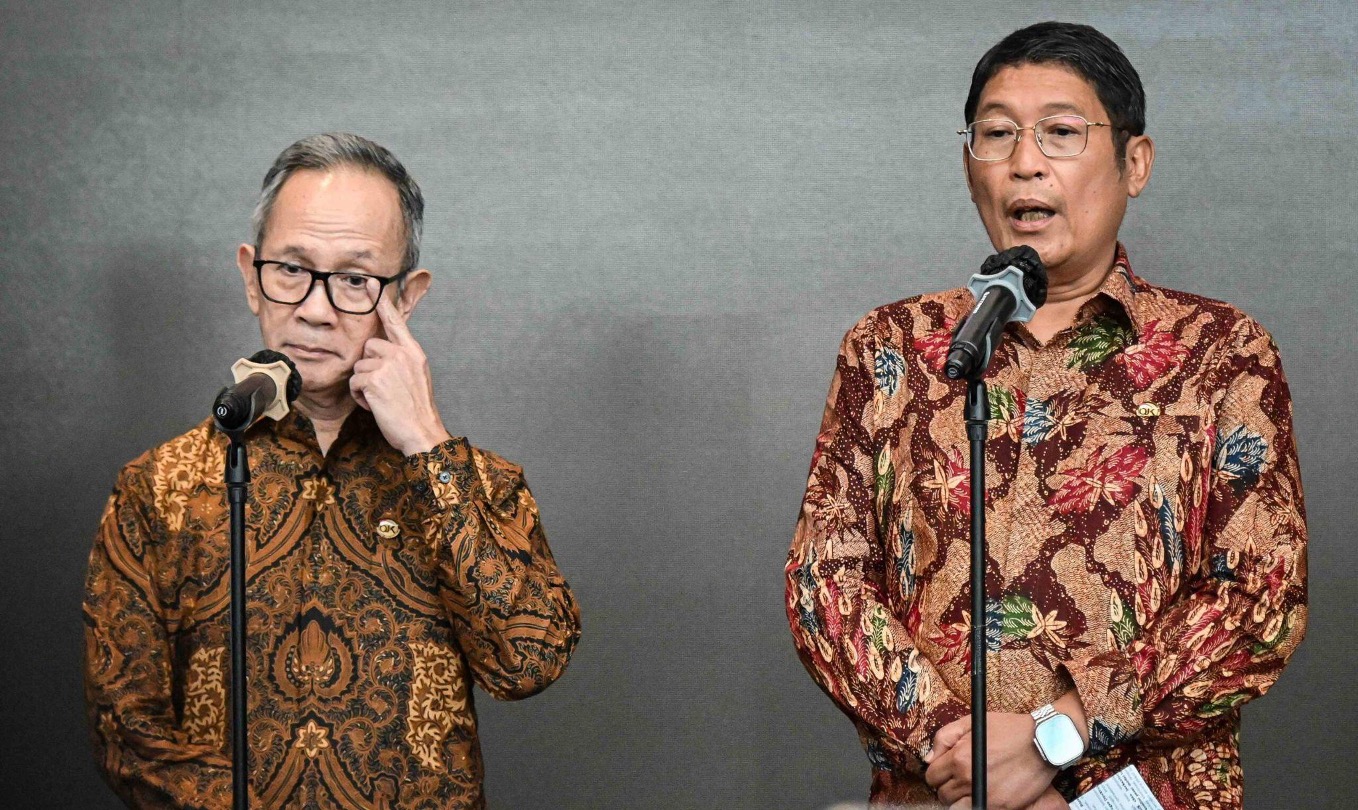
OJK Chairperson Mahendra Siregar (left) and Capital Market Chief Executive Inarno Djajadi (right) address the press at the Indonesia Stock Exchange, Jakarta (2026). Both officials would later resign—among the most visible signals of institutional turbulence accompanying the Prabowo administration’s economic interventions.
Yet the market reaction, significant as it is, still understates the problem. What is being foreclosed is not a mere marginal reduction in investment flows, but Indonesia’s window for structural transformation that does not stay open indefinitely. The demographic dividend that could underwrite a generation of industrial deepening is already narrowing, and global supply chains are reorganising in ways that will not wait for Indonesia to resolve its domestic political economy.
Countries that have successfully positioned themselves as the next tier of manufacturing complexity—Malaysia and Vietnam most conspicuously, but also Bangladesh and Morocco—did so by spending years constructing the institutional credibility and investment environment that attract deep, technology-transferring foreign commitment. None of that was built quickly, and none of it is rebuilt quickly once damaged.
What never arrived
Ecologists use the term shifting baseline syndrome to describe a particular kind of collective forgetting, in which each generation of observers takes the degraded world it first encounters as the normal one and measures subsequent change against that diminished standard. Something analogous happens to investment environments after they are damaged. The capital that does not arrive, the partnerships never formed, the technology not transferred, these absences become the new baseline because they never existed to be observed, and the loss compounds quietly across cycles without ever appearing in a single account of what went wrong.
Related
Measuring "colonial drain" isn't a straightforward business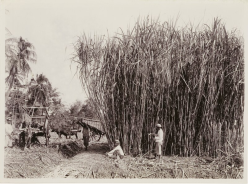
Colonial rekening: what does the Netherlands owe Indonesia?
In acting on what it can see—the ownership, the profits, the physical assets that private enterprise has assembled, and the injustices that shaped how those assets came to be distributed—the government is dismantling what it cannot see, which is the incentive structure that determines whether those assets continue to develop or slowly cease to. History will not record this as a turning point, which is precisely the problem. The damage accumulates in the register of things that did not happen, and countries that fall short of their potential rarely get to know how far short they fell.




















 English (US) ·
  French (CA) ·
  French (FR) ·