

 2 months ago
90
2 months ago
90
PROTECT YOURSELF with Orgo-Life® QUANTUM TECHNOLOGY
Orgo-Life the new way to the future Advertising by AdpathwayEditor’s note: this piece was first published by AcademiaSG, a scholarly site promoting scholarship of/by/for Singapore. Its contents draw on the author’s book The Albatross Files Unredacted: What the Official Story Leaves Out (Pagesetters, 2026).
• • • • • • •
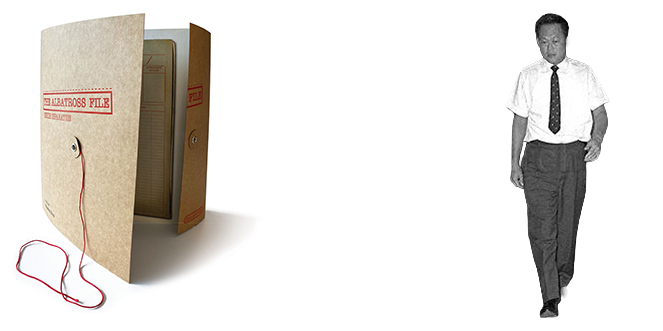
The irony of The Albatross File Exhibition at Singapore’s National Library, and its accompanying book (The Albatross File: Inside Separation) is that, in trying so hard to honour Lee Kuan Yew, it ends up diminishing him. It does so not by attacking him, but by protecting him. It strips away the ambition, ruthlessness, brilliance, opportunism, impatience, and moral flexibility that made Lee such a consequential historical actor. Instead, it seeks to present Lee as statesman, visionary, and victim: a man who saw clearly what others did not and tried to make Malaysia work, but was pushed into escalation by communal extremists, and finally accepted separation only when there was no other choice. It is a comforting story, but it is deeply misleading.
Its problem is what it chooses not to say. In particular, there are three major omissions: why merger happened; why Malaysia was so discriminatory to Singaporeans; and Lee’s role in the creation and failure of Malaysia. By stripping away the most difficult parts of the story, the official narrative makes Lee look smaller, less capable, less consequential than he really was. It turns one of the most consequential political actors in modern Southeast Asian history into a passive figure swept along by events.
The irony is that a close reading of the newly declassified documents presents a very different man from the Lee featured in the Exhibition. The same qualities which made him great—his audacity, obsessiveness, and willingness to gamble with thousands of lives in pursuit of his aims—also produced the conditions of his failure. But because the Exhibition cannot talk about his failure, it cannot talk about his greatness.
Instead, we are left with a myth that protects Lee from blame by robbing him of agency. This is a disservice not only to Lee Kuan Yew, but to Singaporeans. The purpose of history is not to protect the dead from judgement, but to protect the living from illusion. If we are told only a sanitised version of merger and separation, then we learn the wrong lessons from history. We are told that Singapore was simply the innocent victim of communalism across the Causeway and that our leaders were rational while others were emotional, communal, and reckless. We learn, accordingly, that separation was inevitable. We do not learn how fear, ambition, race, brinkmanship, and moral compromise destroyed Malaysia. We do not learn how political leaders can create crises they later cannot control. We do not learn about the real trade-offs that nation-building and leadership require.
This matters because official history is not just about the past. It is a form of power in the present. It tells us who matters and whose lives were acceptable collateral damage; which values matter and which can be cast aside; what is rational and what is dangerous. The Exhibition teaches Singaporeans how to remember separation. But in teaching us how to remember, it also teaches us how not to ask questions.
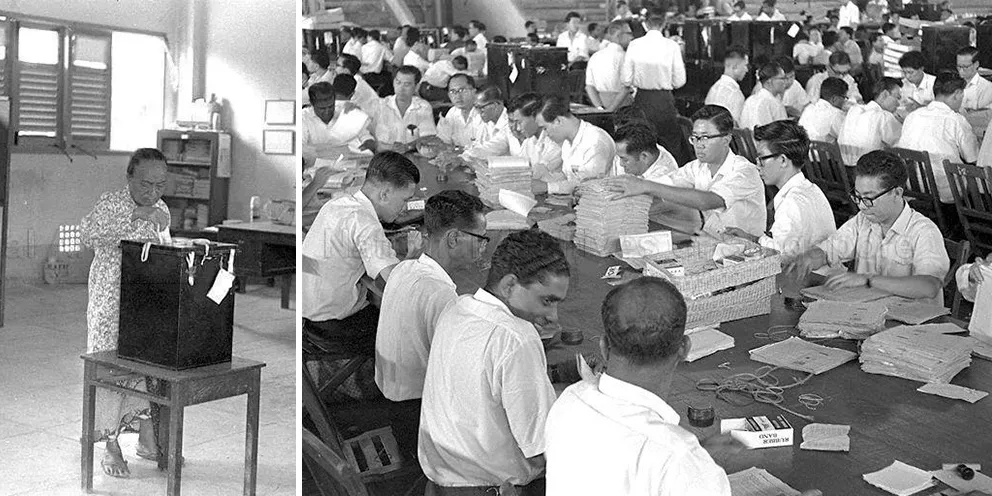
National Referendum for merger, 1962 (Photos: National Archives of Singapore)
Understanding the omissions
The official story of merger presented in the Exhibition and the book is familiar: Singapore needed merger for independence, economic survival, and protection from a “communist” threat. Malaysia then failed because Kuala Lumpur could not accept a genuinely multiracial politics, because Malay extremists whipped up communal hatred, and because Lee’s vision of a Malaysian Malaysia threatened the foundations of Malay supremacy. This story is not false. That is why it is so powerful. But it is incomplete in precisely the ways that matter.
Merger did not become urgent in 1961 simply because of abstract questions of survival, but because Lee and the governing People’s Action Party (PAP) were in deep political trouble. The PAP had lost badly in the Hong Lim by-election. It then lost Anson. Rather than acknowledge his missteps, Lee chose to expel his critics from the party. Lim Chin Siong and his allies formed the Barisan Sosialis. The PAP lost much of its membership, machinery, and political momentum. In that context, merger was not merely a constitutional project. It was also Lee’s political lifeline, and Lee rushed into a hastily planned merger to save his political skin. This does not mean merger had no national-interest rationale. Arguments about long-term economic viability were real, but merger was also a strategy to defeat his political rivals and reassert Lee’s authority at a moment of acute vulnerability. Lee understood that merger gave him leverage.
This omission changes the moral shape of the story. Lee was not proceeding calmly and logically to merger. Instead, it was a frantic, improvisational, and often undignified scramble. Lee took a popular and emotionally resonant aspiration of the people of Malaya (the reunification of Singapore with the rest of Malaya) and turned it into a wedge issue: support merger on his terms, or be painted as opposing reunification altogether. That was politically brilliant. It was also dangerous, because the terms he accepted were deeply flawed.
Related

The growing contradictions of Singapore’s HDB scheme
A notionally egalitarian public housing program has come to fuel class and intergenerational inequalities
For Malaysia was never designed as a union of equals. It was designed to take Singapore in while keeping Singapore politically contained. Singapore would be part of Malaysia, but not on equal terms. Singaporeans would not enjoy the same rights as other Malaysians. Singapore would have reduced parliamentary representation. Singapore’s voters would be quarantined in Singapore, with limited political rights north of the Causeway. Internal security (including the police and Special Branch) would be controlled by Kuala Lumpur. This was the price of convincing Tunku Abdul Rahman and UMNO to accept Singapore.
The reason was that UMNO feared Singapore’s voters. It feared a largely Chinese, left-leaning electorate that might disrupt the Alliance’s electoral dominance and challenge the Malay-first basis of the Federation. The electoral maths is simple enough. In the 1959 Federation elections, the Alliance parties—UMNO, MCA, and MIC—won 51.77% of the vote. But if those results are combined with Singapore’s 1959 election results, the Alliance vote share falls to just over 40%. This was the danger Singapore posed to UMNO: not merely a troublesome island, but a voting population large enough to threaten the Alliance’s dominance. Malaysia could therefore only be created if Singapore was incorporated and contained at the same time, with the Borneo states added to dilute Singapore’s voters. The result was a country built around a contradiction: Singapore was inside Malaysia, but not fully inside the Malaysian nation.
Lee ignored all the critics, such as Lim Chin Siong and Tommy Koh, who pointed out that contradiction made Malaysia unworkable, and instead endorsed it because he needed Malaysia. Then, almost immediately after Malaysia was created, he tried to overturn the very bargain he had accepted.
This is where the Exhibition’s treatment of Lee becomes especially inadequate. It presents him as reacting to provocation: the Tunku broke faith; UMNO extremists inflamed communal tensions; the riots shocked Singapore; Lee then responded with courage and clarity. Again, this story is not false: UMNO’s communalism was real. Malay supremacy was real. The inflammatory rhetoric directed at Lee and the PAP was real. The danger to Singapore was real.
But the story is deeply misleading. Lee was not merely reacting, caught up in events. His actions had provoked the anger. He had endorsed Malaysia on the basis that Singapore would be politically quarantined, then tried to break out of that quarantine almost as soon as Malaysia was born. UMNO saw this as hypocrisy and betrayal. And when he failed, he escalated, plunging Malaysia further into crisis.
The PAP’s entry into the 1964 federal election was therefore far more significant than the Exhibition suggests. Lee had persuaded Kuala Lumpur to accept Singapore on the basis that Singapore politics would not spill across the Causeway. For the PAP then to enter federal politics was a direct challenge to the founding premise of Malaysia. From Kuala Lumpur’s perspective, this was precisely the danger Malaysia had been created to prevent, and seemed to confirm Kuala Lumpur’s suspicion that Lee, and Singapore’s largely Chinese electorate, could not be trusted.
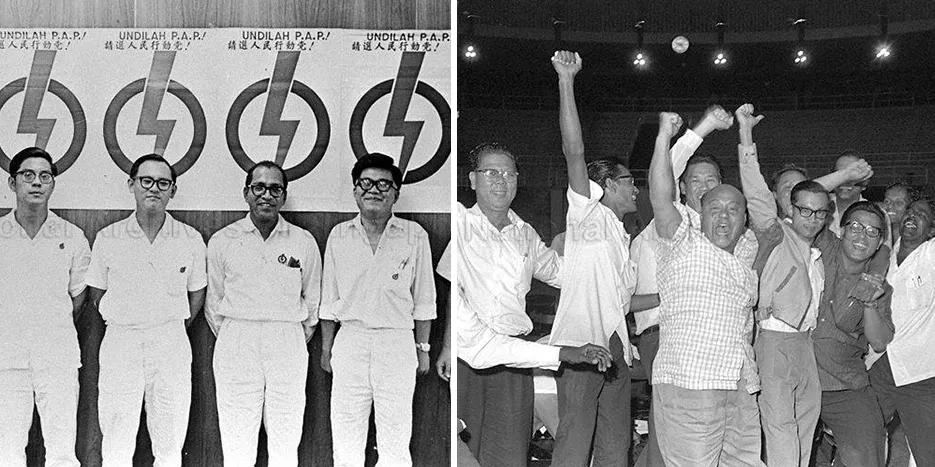
The PAP contests seats across the Causeway in the Malaysian federal election, 1964 (Photos: National Archives of Singapore)
Lee later blamed the Tunku for breaking a “Gentleman’s Agreement” not to interfere in each other’s politics when the Tunku campaigned for Singapore’s Alliance parties in Singapore’s 1963 elections. This, Lee argued, legitimised the PAP’s contesting the 1964 federal elections. However, in the newly declassified documents, Lee’s own colleagues explicitly say no such agreement existed and recalled Lee himself confirming at the time that no agreement existed. To them, it was simply an issue of fairness: why could UMNO participate in Singapore’s politics when Singapore parties could not participate in federal politics? In any event, such an agreement was simply untenable. One country cannot exist with two separate governments. The federal government was supposed to govern the whole country, so how could they not participate in Singapore politics? Likewise, the Singapore government was supposed to represent the interests of Singapore to the rest of the country, so how could they not take part in federal politics?
In trying to break out of Singapore and achieve his stated goal of a “multiracial and socialist Malaysia”, Lee moved through a series of strategies. First, he tried to work within the communal model by positioning the PAP as an alternative to the MCA. After this failed, he sought renegotiation, especially as financial disputes worsened relations between Singapore and Kuala Lumpur. This was blocked by the British. Finally, he moved towards a direct challenge by seeking to use the contradictions inherent in Malaysia to either break it or force a settlement.
On the fundamental question, Lee was right: a country organised around ethnic hierarchy could not produce a stable, democratic, multiethnic future. But the problem was that he had explicitly ignored Lim Chin Siong’s repeated warnings, to instead create Malaysia on precisely those terms. Lee had accepted Singapore’s political quarantine, legitimised Kuala Lumpur’s suspicion of Singapore’s voters, and defended a structure that treated equal citizenship as a threat. Then, once Malaysia existed, he tried to lead the struggle against the very structure he had helped build.
This was the great political reversal at the heart of separation. Lee and Goh had defeated Lim Chin Siong and the Barisan Sosialis by arguing for merger on terms their opponents warned were discriminatory and unworkable. Within two years, they had effectively returned to that critique. Malaysia was discriminatory. Singaporeans were not equal. The bargain was unworkable. But they drew different conclusions. Lee sought to force Malaysia to change; Goh would conclude that Singapore had to leave. Navigating this reversal in such a short time was political skill of the highest order, but it was also a reminder that they had not got it right from the start. Lee and Goh made a high-risk wager with other people’s futures. They won the political argument for merger, but the terms they defended helped produce the crisis they later had to escape.
That is what makes the story tragic. Lee was not, as the Exhibition presents, the victim of Malaysia’s contradictions, but first a key author and then the chief critic.
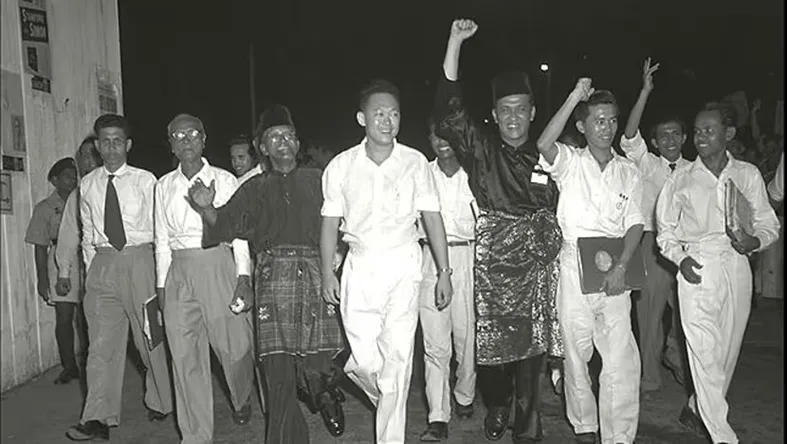
Polling day in Singapore, 1965. Lee Kuan Yew leads the multiracial PAP into its first election (Photo: National Archives of Singapore)
The trolley problem
This brings us to the central moral problem at the heart of Lee’s Malaysia strategy.
If Malaysia was founded on discrimination, how far should one go to overturn it? If millions of people were to be condemned to permanent second-class status under a Malay-first order, was it moral to force a confrontation? If a crisis might open the way to a genuinely multiethnic Malaysia, how much violence was an acceptable risk?
Put brutally: how many people would you risk killing for the chance of a multiracial socialist Malaysia? That was the terrible question beneath Lee’s strategy, which the Exhibition and the Inside Separation book both avoid.
The evidence does not suggest that Lee wanted violence. What Lee outlined in his July 1964 and January 1965 memoranda is something far more subtle and more troubling. He predicted that the structure of Malaysia, with a 47% Malay minority dominating a 53% non-Malay majority, was unsustainable. Given UMNO’s refusal to compromise, it would inevitably lead to violence. In this, he was tragically prescient. The contradiction he identified would later explode on 13 May 1969.
What Lee then argued was that, if violence was inevitable, then it should be used to their advantage. Lee was willing to contemplate an outbreak of violence as a political opportunity: a crisis that might expose the impossibility of the existing arrangement and open the way to Malaysian Malaysia:
“If they [UMNO] can act unconstitutionally, then we shall be temporarily scrubbed out and trouble will break out in the country. If they cannot act unconstitutionally, and refuse to come to terms on a Malaysian nation, they must join Indonesia. If they do not lose their nerve and join Indonesia, they will have to come to terms, and finally agree on a Malaysian Malaysia. We would then have achieved what ideologically we have always set out to do.”
This was an extraordinarily high-risk strategy, but Lee was not one to shy away from the impossible. From March 1965, Lee made speech after speech designed to send UMNO’s Malay extremists into a frenzy: describing Malay culture as “warm sunshine and bananas and coconuts”; arguing that Malays were not the native people of Malaya (The Straits Times, 5/5/1965); stating that the PAP could govern Malays better than UMNO (“in 10 years, we will breed a generation of Malays with educated minds, not filled with obscurantist thought”); suggesting that Singapore, Sabah, and Sarawak secede and take Malacca, Penang, and maybe even Johor with them. UMNO responded predictably. Speech after speech attacked Lee. Demonstrations demanded action against him.
British officials and the leaders in Kuala Lumpur recognised the logic of the strategy. British High Commissioner Lord Head succinctly summarised Lee’s plan to London: “His aim remains rather to provoke Alliance to [the] point where they either put themselves clearly in [the] wrong, e.g. by arresting him, or suggest some kind of disengagement to get him out of their hair.” Lee’s calculation, in other words, was not that violence was desirable, but that escalating confrontation could force Kuala Lumpur into a choice it had been avoiding: Concede a Malaysian Malaysia; or arrest him and expose the coercive basis of the federation, risking the break-up of Malaysia amid Konfrontasi.
Knowing this, the federal cabinet debated how to respond. They pondered whether to lock Lee up, outflank Lee by empowering the Barisan Sosialis, attempt a reconciliation, or pass a new law to make inciting communal strife illegal, thus giving them a legal basis to arrest Lee if he persisted. At one point, they caved to internal pressure and agreed to detain Lee, but British PM Harold Wilson told the Tunku in no uncertain terms not to do so.
This is where Goh Keng Swee comes in. The official narrative presents Goh as the practical technocrat, the man who quietly negotiated the terms of separation. But Goh was deeply troubled by what he was seeing. He responded to the violence of the July 1964 riots in Singapore by starting a file on leaving Malaysia: the Albatross File. A year later, as Malaysia careened out of control, Goh feared calamity. He saw that Lee’s strategy might not work. He saw that Singapore could be destroyed by the very confrontation Lee was trying to force. Goh was then on a medically imposed sabbatical at a remote German spa. News trickled in: racist speeches, street marches, demands for Lee’s arrest, Ong Eng Guan’s resignation, proposals for Singapore and the Borneo territories to secede, Alex Josey’s expulsion, and rumours of Lee’s detention or assassination. Goh grew increasingly anxious.
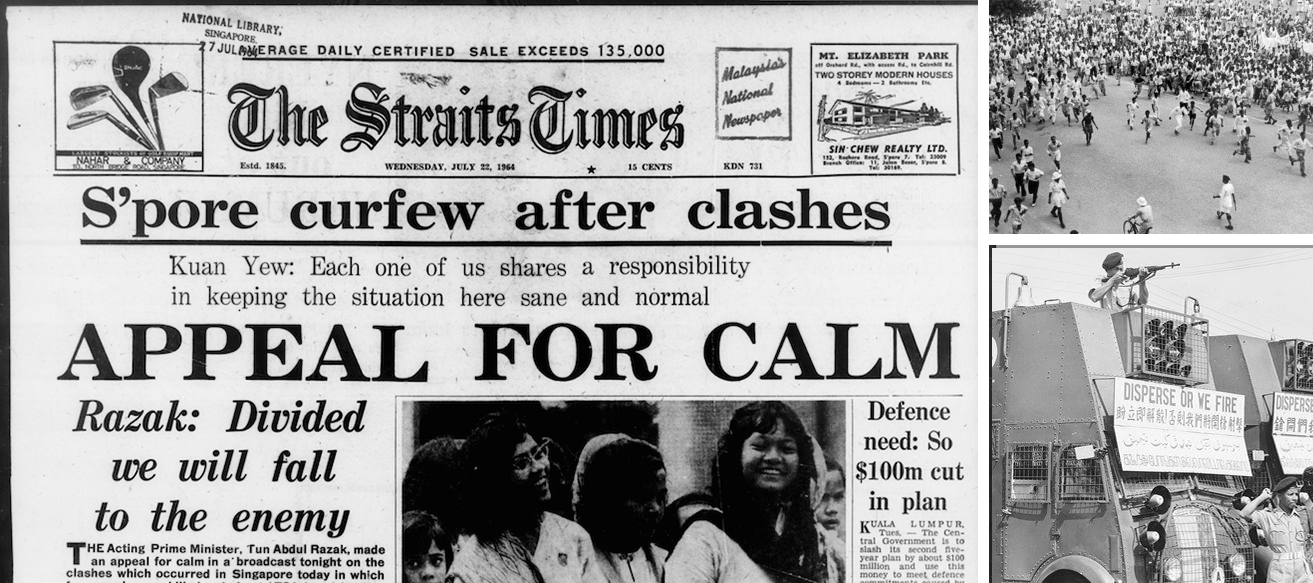
The 1964 race riots (Photos: National Archives of Singapore)
By July, the situation had snowballed into a combustible political crisis in which real people could die, but Lee, steadfast in his self-belief, showed no sign of wavering from his path. Goh had enough: he checked himself out and returned to Singapore. Given the opportunity, he suggested to Deputy Prime Minister Razak that Singapore leave Malaysia. Lee later believed that Goh had simply carried out his instructions. Only in 1994 did he learn that Goh had gone further than Lee had authorised, and had presented separation as a fait accompli. That fact alone should change how we understand separation. It was an internal PAP intervention against Lee’s own strategy—and the final turn in the political reversal that had begun when the PAP discovered that the Barisan’s central warning about merger had been fundamentally correct.
In that sense, Goh may have saved Singapore, but he also ended Singapore’s role in the struggle for the multiracial socialist Malaysia that the PAP had envisioned. Separation removed Singapore from Malaysia just as the struggle over Malaysia’s future was intensifying. That makes the story even more painful. The Malaysian Solidarity Convention’s shared vision of Malaysian Malaysia was neither trivial nor opportunistic, but spoke to a real alternative future for Malaysia where citizenship was not organised around ethnic hierarchy. But the path Lee took towards that future was reckless, contradictory, and morally compromised.
The shadow of 13 May 1969 hangs over the whole story. Lee did not cause 13 May, in the sense that it was created by internal contradictions of Malaysia which Lim Chin Siong had sought to warn him about in 1961. The Federation’s communal structure, UMNO’s politics, the Alliance’s fragility, and the unresolved struggle over equal citizenship all long predated merger, and were inherited by Malaysia. But when Lee finally recognised those contradictions, he sought to use them as leverage. In doing so, he intensified many of the forces that would erupt into conflict in 1969. When the explosion finally came, he was not there to take responsibility or advantage. Malaysians were left to live with the wreckage.
Choices have consequences
That is a key lesson that is left out of the Exhibition: that history is made by choices, and those choices have consequences far beyond the intentions of the people who make them.
The real Lee Kuan Yew is much larger than the Lee of The Albatross File Exhibition. He was not merely a wise man tragically misunderstood. He was brilliant, courageous, ruthless, impatient, arrogant, selfish, and often reckless. He could look hard at truths that others averted their eyes from. He could also create conditions that made those truths harder to act upon. He opposed Malay supremacy after helping build a Malaysia that preserved it. He fought for a multiethnic future after accepting a constitutional bargain that denied equal political rights. He tried to bend history to his will, and for a while it seemed possible that he might succeed.
(Photo: Epigram Books)
Lee deserves better than mythology. A myth can only be worshipped or rejected. A man can be studied, judged, understood, and learned from. The real Lee does not need protection from historical scrutiny. If anything, he becomes more compelling when we see him whole: not as saint or villain, but as a human being making impossible choices, sometimes with extraordinary courage, sometimes with devastating consequences.
Singaporeans deserve better too. A misleading account of separation teaches us to congratulate ourselves rather than examine ourselves. It teaches us that multiracialism is something Singapore earned and Malaysia tragically lacked. But the history is more complicated. Multiracialism was not a Singaporean inheritance. It was a political struggle. It was contested, compromised, invoked, betrayed, and used. It could be a genuine ideal or it could also be a weapon.
Related
The growing contradictions of Singapore’s HDB scheme
A notionally egalitarian public housing program has come to fuel class and intergenerational inequalities
If we do not understand that, we draw the wrong lessons. We learn to fear politics rather than understand it. We learn to treat conflict as proof that strong rule is necessary. We learn to see history as a morality play in which our leaders were rational and others were dangerous. We do not learn how leaders use fear to justify necessity. We do not learn how strategic brilliance can become recklessness. We do not learn how anti-communal politics can itself become entangled in communal provocation. We do not learn how the pursuit of national survival can become a willingness to sacrifice others.
That is why The Albatross File Exhibition’s omissions are not academic quibbles, but political acts. They shape how Singaporeans understand power, race, leadership, and responsibility. They shape whether we see separation as inevitable tragedy or as the outcome of human choices. They shape whether we learn from history, or merely inherit a comforting myth.
To do Lee Kuan Yew justice, we must stop making him smaller than he was. We must tell the whole story: not of a saint floating above history, but of a man who tried to bend history to his will, came frighteningly close, and left the rest of us to live with the consequences.















 English (US) ·
  French (CA) ·
  French (FR) ·