

 2 months ago
29
2 months ago
29
PROTECT YOURSELF with Orgo-Life® QUANTUM TECHNOLOGY
Orgo-Life the new way to the future Advertising by Adpathway“I hope the monsoon arrives by this month-end. I can sow bajra even it comes by July 15. The problem will be if it’s delayed beyond that,” says Ramsingh Meena.
The 52-year-old from Jalalpura village in Baijupara tehsil of Rajasthan’s Dausa district grows bajra or pearl millet on his entire 50-bigha (31 acres) land: “This is the best crop in kharif (monsoon). It matures in 85-90 days, giving us time to plant mustard (in October) or wheat (in November) during the rabi (winter-spring) season”.
Short-duration and suitability to fit into the mustard-wheat crop cycle isn’t the only reason, though. For Meena, bajra not only yields an average 40 mann (16 quintals; one mann=40 kg) of grain per acre. It also provides kadbi (dry fodder), which is 1.5 times of grain, i.e. 24 quintals per acre.
“During November-March, our animals are mainly fed bajra kadbi along with kasni (chicory) and rajka (lucerne) grass,” explains Meena, who has 35 buffaloes – 15 in-milk, 10 pregnant and 10 calves.
 A farmer purchasing a hybrid bajra seeds packet in Sikandra in Rajasthan’s Dausa district. (Express photo by Harish Damodaran)
Meena and Ramraj Patel, a 14-bigha (8.7 acres) farmer from Nandri village in Dausa’s Sikrai tehsil, have already sown bajra on a third of their holdings. They did it on June 9 and June 14, following Western Disturbances-induced showers in the preceding days.
Low irrigation advantage
“Farmers in south Haryana and Rajasthan mostly sow bajra from end-May through June with the pre-monsoon showers. The monsoon rains come after sowing and germination happens. Some farmers, in the absence of pre-monsoon showers, give one pre-sowing irrigation. Even with rainfall deficiency, they may have to irrigate just two more times – at 30 days and 60 days after sowing,” notes Satyender Singh, CEO (Seeds) at Crystal Crop Protection Ltd.
A maximum requirement of three irrigations – compared to at least five-six for cotton (a 160-day crop), four-five for wheat (130-140 days) and two-three for mustard (120-130 days) – has made bajra virtually the first-choice crop for farmers across Rajasthan, southern Haryana and neighbouring parts of Uttar Pradesh.
Story continues below this ad
This is especially so in what increasingly appears an El Niño-influenced deficient monsoon year. Rainfall has been 42.3% below normal for the country as a whole during the current southwest monsoon season (June-September) as on June 23.
“Bajra needs very little irrigation. Its requirement of fertilisers (20 kg of di-ammonium phosphate and one bag or 45 kg of urea) and agro-chemicals (0.5 kg of Atrazine 50% wettable powder herbicide) per acre is also low. And it gives fodder that is of better quality than tuda (chopped wheat straw),” points out Bansi Lal.
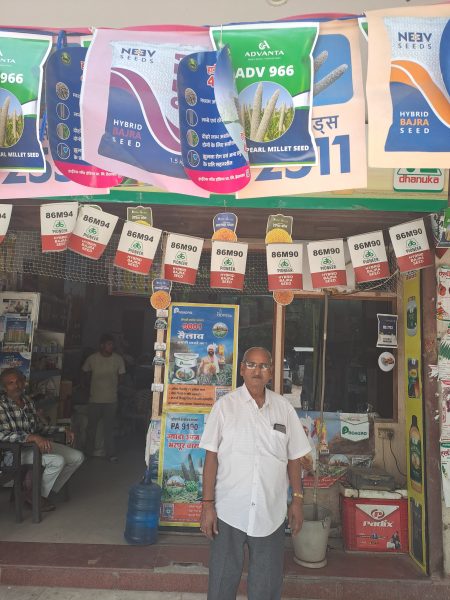 A seed retail outlet in Rewari, Haryana. (Express photo by Harish Damodaran)
This 55-year-old farmer from Balawas village in Bawal tehsil of Haryana’s Rewari district has sown bajra on 5.5 out of his total 10 acres. On the remaining land, he has sown cotton and multi-cut fodder jowar (sorghum grass) on one acre each: “If it rains enough, I will plant bajra on another 2.5 acres”.
Hybrid seeds edge
Interestingly, despite being a largely rainfed crop – more so, in the Jodhpur-Jaisalmer belt of western Rajasthan – bajra has an estimated 18,000-tonnes commercial hybrid seeds market worth roughly Rs 720 crore at an average farmgate price of Rs 400 per kg. The top two – Corteva Agriscience (‘Pioneer’ brand) and Crystal Crop Protection (‘Proagro’) – have a 50% combined share of that, with Tata Rallis (‘Dhaanya’), Nath Bio-Genes, SeedWorks International, JK Agri Genetics and Hytech Seed India being the other major players.
Story continues below this ad
“Farmers traditionally grew bajra only for fodder and grain for self-consumption. But with the higher yields from hybrids, it has emerged as a commercial crop. Bajra grain is even mixed with maize for use as poultry feed,” states Satyender Singh. His company’s ‘Proagro 9001’, which is planted on some 1.6 million hectares, and Corteva’s ‘Pioneer 86M94’ are among the popular hybrids grown by farmers.
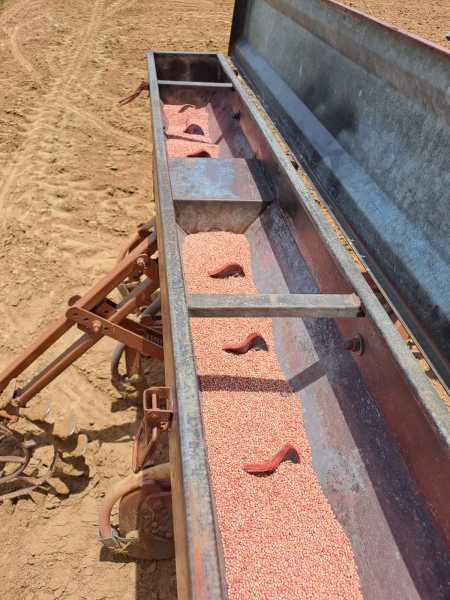 Bajra seeds inside a tractor-mounted drill machine. (Express photo by Harish Damodaran)
Last year, Meena harvested around 500 quintals of bajra; only a tenth of it was consumed at home. The balance 450 quintals, just as his 280 quintals of wheat and 76 quintals of mustard, was sold in the market.
Bansi Lal pegs the production cost of bajra at Rs 19,000-20,000 per acre. This covers ploughing (Rs 4,000), seed (Rs 800 for 1.5 kg), fertiliser (Rs 1,000), chemical and spraying charge (Rs 700), nirai-gudai or weeding and hoeing (Rs 4,000), harvesting (Rs 6,000-7,000, with 10 labourers at Rs 600-700 each) and threshing (Rs 2,500). At 16 quintals yield and Rs 2,000/quintal price, the farmer would net Rs 12,000-13,000 per acre.
“That’s decent, as it excludes the value of fodder,” according to Naresh Goyal, one of India’s largest bajra seeds wholesaler. His Alwar (Rajasthan)-based firm, Rahul Enterprises, does an annual turnover of Rs 50 crore from about 200 tonnes of bajra, 400 tonnes of wheat, 30 tonnes of onion and 10 tonnes of mustard seeds.
Story continues below this ad
No pest worries
Bajra has gained acreage from cotton, which has become vulnerable to pink bollworm pest insect attacks. “Till four years back, farmers were getting 8-10 quintals of kapas (raw un-ginned cotton) per acre and I was selling 100,000-odd seed packets (of 475 grams each). But their yields have fallen to 2.5-3 quintals and my sales to 6,000-7,000 packets now,” adds Goyal.
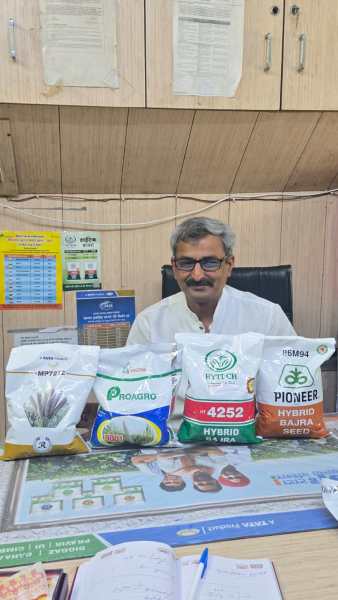 Seeds dealer Sandeep Gupta at his office in Rewari, Haryana. (Express photo by Harish Damodaran)
Sandeep Gupta, a leading dealer in Rewari who sells 150 tonnes of bajra seeds annually, attributes the increased farmer interest primarily to private sector-bred hybrids.
The earlier open-pollinated varieties such as ICTP 8203 and hybrids like HHB 67 developed by government institutions yielded 6-7 quintals and 9-10 quintals per acre respectively. The private sector hybrids, which were aggressively marketed from the early-2000s, give up to 20-21 quintals per acre.
The likes of Crystal Crop Protection are, moreover, selling hybrids in a wide maturity range of 70-72 days (Proagro 9072), 78-82 days (Proagro 9180 and 9190) and 85-90 days (Proagro 9001), besides being adaptable to diverse climatic and soil conditions.
Story continues below this ad
Farmers, meanwhile, have a simple demand: The government should ensure payment of minimum support price (MSP).
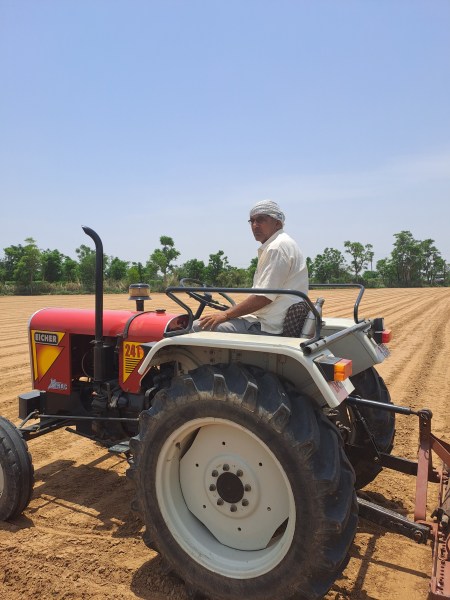 Farmer Ramchandra Choudhary sowing bajra at his field in Jatuwas village of Haryana’s Rewari district. (Express photo by Harish Damodaran)
“They fixed the MSP of bajra at Rs 2,775/quintal last year and Rs 2,900 for this year’s crop, whereas we are only getting Rs 2,000. The Haryana government is offering a so-called price difference of Rs 575/quintal (under its Bhavantar Bharpai Yojana scheme), but only for a yield of up to 8 quintals per acre. Why are we being penalised for producing more?” asks Ramchandra Choudhary, who farms 15.5 acres in Jatuwas village of Rewari tehsil and district.


















 English (US) ·
  French (CA) ·
  French (FR) ·