

 8 hours ago
2
PROTECT YOURSELF with Orgo-Life® QUANTUM TECHNOLOGY
Orgo-Life the new way to the future Advertising by AdpathwayThe more speeds a chain is designed for, the more durable it often is. This might seem completely counterintuitive, given that modern chains are significantly narrower than their predecessors. However, recent laboratory testing has found exactly that.
Thousands of kilometres can separate the shortest- and longest-lasting chains, with 12- and 13-speed chains ruling the roost. We’ll get into why these narrower chains are lasting so long shortly.
There are substantial differences in drivetrain friction, too. With the same chain lubricant applied, drivetrain losses can vary by as much as 4 watts between chain models.
In this article, we’ll compare the bicycle chain durability and drivetrain friction of 8 through 13-speed chains to find out whether modern, narrower chains are really more durable (and faster) than their older counterparts.
But first, let’s look at how chains wear, how manufacturers make them durable, and what makes some chains faster than others.
How Do Chains Wear?
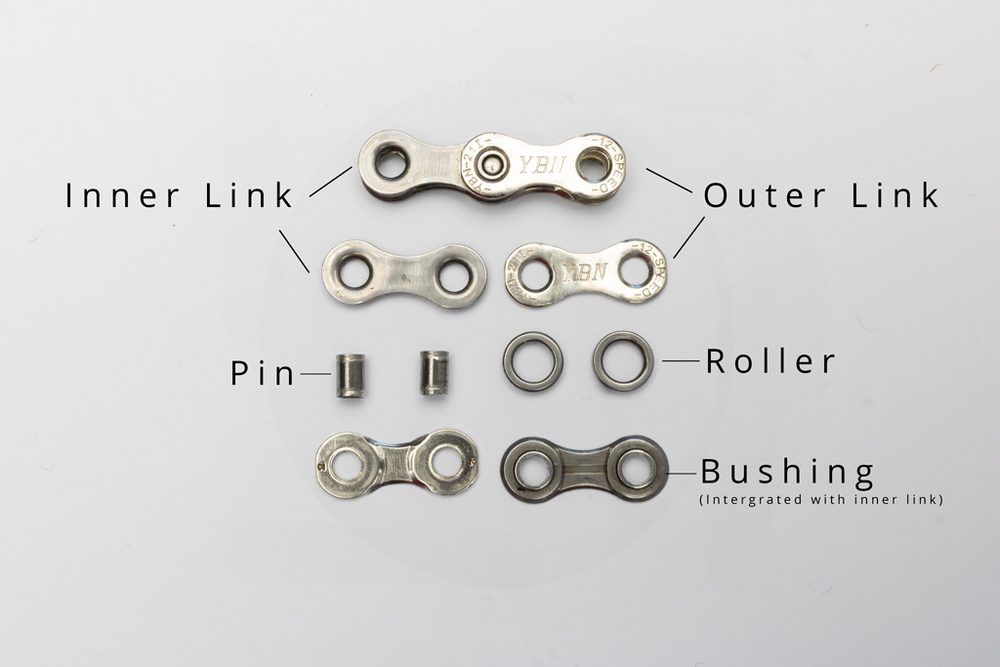
Chains experience wear primarily at their internal contact surfaces, particularly between the pins and inner links. As material wears away from these surfaces, the fit between the pins and inner links becomes looser. Even a tiny amount of wear at every link accumulates across the chain, resulting in measurable elongation.
This elongation gradually changes how the chain engages with the cassette and chainrings. As the distance between the pins increases, the chain’s pitch no longer matches that of the sprocket teeth, accelerating wear throughout the drivetrain.
Rollers are another important source of wear. They’re the parts of the chain that physically engage with the sprocket teeth, so changes to their diameter and internal clearances can affect how accurately the chain meshes with the drivetrain.
Ultimately, the goal is to make the pins, inner link surfaces and rollers as hard and wear-resistant as possible, while maintaining smooth contact surfaces and precise dimensions.
How Do You Make A Chain Durable?
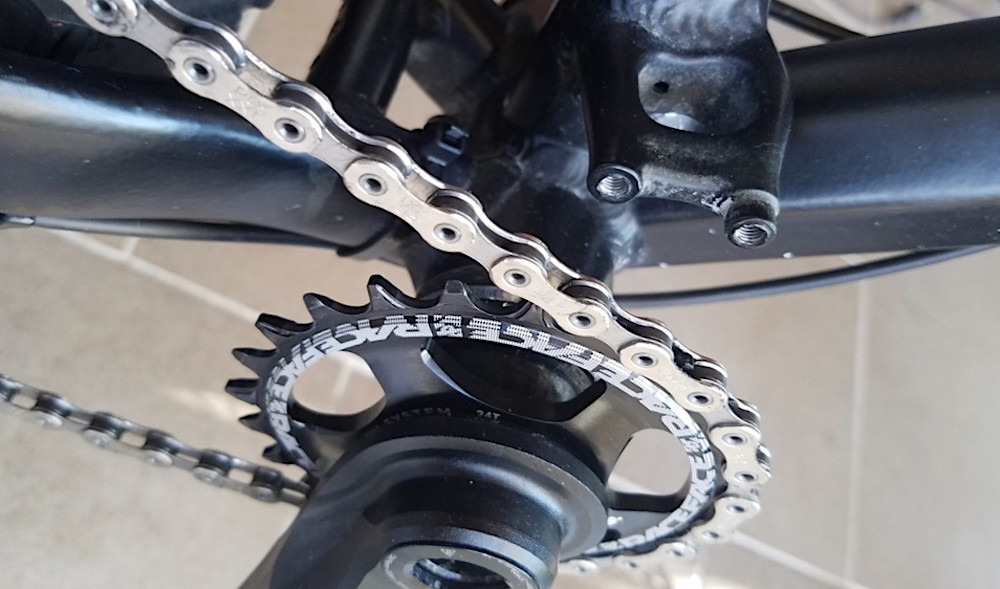
Chain manufacturers have several ways to improve durability, starting with the materials themselves.
They select high-quality steel alloys, then use heat treatment and other chemical processes to improve the strength and wear resistance of the metal. Surface treatments such as SRAM’s Hard Chrome technology provide another layer of protection, adding a highly wear-resistant finish to the underlying metal.
Manufacturing precision is equally important. Accurate dimensions, consistent clearances and smooth, polished surfaces help ensure loads are distributed evenly across the chain’s contact surfaces, reducing friction and uneven wear.
Producing a durable chain requires significant investment in materials and manufacturing processes. This increases the purchase price, but high-end chains can last several times longer than cheaper alternatives, potentially offering better value over their lifetime. They can also extend cassette and chainring life, as a worn chain accelerates sprocket wear.
Note: chain durability can refer to two different things. Tensile strength describes how much force a chain can withstand before breaking, while wear resistance describes how long it takes for the chain to reach a given level of elongation. This article focuses on the latter, rather than how resistant chains are to snapping under high loads.
How Do You Make A Chain Fast?

Reducing friction in a bicycle chain involves optimising the clearances between its moving components. These clearances influence how freely the chain articulates, how effectively lubricant moves through the individual components, and how much friction develops at the internal contact surfaces.
Interestingly, slower chains in laboratory testing often tend to have tighter clearances between their components. However, tight clearances alone don’t necessarily make a chain slow. Chain geometry and manufacturing precision also influence how efficiently the components move against one another.
The surface treatments used in chain manufacturing play a role too. Specialised low-friction coatings can create exceptionally smooth contact surfaces, reducing friction between moving components. The downside is that these advanced finishing treatments can add considerably to the purchase price.
Right, let’s now jump into the lab tests.
Chain Wear Lab Testing

The first laboratory test measures chain wear.
Zero Friction Cycling conducted this accelerated chain wear test using a motor-driven Tacx Neo trainer. Lubrication and contamination levels were kept consistent throughout, with White Lightning Epic Ride used as the lubricant. This particular lube had previously been shown to perform poorly and cause significant wear, making it ideal for a chain torture test.
Chain elongation was monitored throughout the test. Each chain was run until it reached 0.5% elongation, with the distance travelled recorded as its wear life. To ensure accurate results, pin-to-pin elongation was measured under load, with each chain checked at least twice.
Measurements were also compared against a half-length Shimano Ultegra control chain. This produced consistently repeatable results and helped validate the figures reported here.
Chain Efficiency Lab Testing

Our second laboratory test measures drivetrain efficiency, specifically how much power is lost between the crank spindle and rear hub. Because the chain is the only component changed between tests, the differences in drivetrain losses provide a direct comparison of chain efficiency.
All tests were performed by CeramicSpeed in Denmark using a custom-built test rig designed to replicate real-world riding conditions. The rig was set to simulate an input power of 250 watts at a cadence of 90 RPM. All chains were lubricated using the same product: CeramicSpeed UFO V2 race treatment.
Each chain underwent a seven-minute run-in period, with the first drag measurement taken at the end. Testing then continued for 13 hours, during which each chain covered the equivalent of 710 km. Drag was measured at a total of six intervals throughout the test, and the tables below show the typical range of results recorded for each chain.
8-10 Speed Chain Durability
| Wear Longevity | Increase In Longevity | |
| Shimano HG40 8-Speed | 900 km | Baseline |
| Shimano HG93 9-Speed | 2200 km | +150% compared to 8-Speed |
| Shimano Ultegra 6701 10-Speed | 2600 km | +18% compared to 9-Speed |
We have relatively little wear data on older chains, as most of the testing we’re drawing upon has been conducted over the past decade. However, to establish a baseline, Zero Friction Cycling tested several Shimano 8, 9- and 10-speed chains.
At least within Shimano’s range, moving up each speed category brought a substantial improvement in durability. The difference between 8 and 9-speed was particularly dramatic, with the 9-speed chain lasting 150% longer before reaching 0.5% elongation. The jump from 9 to 10-speed was more modest, but still delivered an 18% improvement in wear life.
These results suggest that the reduced dimensions of 9 and 10-speed chains haven’t necessarily come at the expense of longevity. Manufacturers have continued improving the materials and surface treatments used on their critical wear surfaces, more than compensating for the narrower dimensions.
Please note: wider chains generally tolerate more elongation before causing excessive cassette wear, so manufacturers suggest that a 0.75% replacement threshold is more appropriate than 0.5%. Applying this higher wear limit would mean the 8-speed chain could potentially last over 1,300 km in this test, while the 9-speed chain would exceed 3,000 km.
11 Speed Chain Durability
| Shimano LG500 | 4300 km | 5 to 6 Watts |
| SRAM XX1 MTB | 3300 km | 5 to 6 Watts |
| YBN SLA | 3300 km | 4 to 5 Watts |
| Campagnolo Record | 2900 km | 4 to 5 Watts |
| Shimano Dura-Ace | 2900 km | 3 to 4 Watts |
| SRAM PC1190 Road | 2800 km | 5 to 6 Watts |
| KMC X11E | 1700 km | 3 to 4 Watts |
| Average | 3030 km | 4.65 Watts |
On average, the 11-speed chains last 16 to 17% longer than a 10-speed Shimano chain.
The Shimano LG500 is the longest-lasting 11-speed chain tested, lasting around 65% longer than a Shimano Ultegra 10-speed chain. That said, this comes at the expense of higher drag than other chains.
The SRAM XX1 MTB chain is the most durable 11-speed model from SRAM, offering about 20% greater longevity than the SRAM PC1190 road chain. It doesn’t offer a meaningful difference in drag, though both chains are less efficient than several competing options.
YBN’s 11-speed chain offers impressive longevity alongside good efficiency, making it a great option for both racing and training. Campagnolo’s 11-speed chain delivers similarly impressive results, with an equally good balance of durability and efficiency.
Shimano chains offer similar longevity to Campagnolo, but have an advantage when it comes to efficiency. Dura-Ace chains set the benchmark for low drag, recording the lowest figures in CeramicSpeed’s 11-speed laboratory tests.
SRAM’s PC1190 road chain wears at a similar rate to Dura-Ace, but is notably less efficient, losing around 2W more. As a result, it’s hard to recommend this model compared to the previously mentioned chains.
Lastly, KMC chains are fast, but offer roughly half the longevity of the other options here. Zero Friction Cycling suspects that the coatings used on some KMC chains may repel common lubricants, preventing them from doing their job effectively.
12 Speed Chain Durability
| SRAM X0/XX Eagle | 7000 km | 6 to 7 Watts |
| SRAM Force/Red AXS | 7000 km | 5 to 6 Watts |
| Shimano Dura-Ace | 4050 km | 5 to 6 Watts |
| Campagnolo Record | 2600 km | 3 to 4 Watts |
| YBN SLA/MK12/12E | 2600 km | 3 to 4 Watts |
| SRAM GX Eagle | 2200 km | 6 to 7 Watts |
| SRAM Rival AXS | 2200 km | 5 to 6 Watts |
| KMC X12 | 1950 km | 3 to 4 Watts |
| Average | 3650 km | 5.03 Watts |
On average, the 12-speed chains last around 20% longer than the 11-speed chains. And they last around 40% longer than a Shimano 10-speed chain!
Despite the smaller surface area of 12-speed chains, improvements in chain technology have generally increased drivetrain longevity. However, just as we saw with 11-speed chains, the most durable models tend to come with higher drivetrain resistance.
SRAM 12-speed chains with Hard Chrome treatment to the rollers, inner plates and pins set the industry standard for durability, lasting twice as long as the best 11-speed SRAM chains. The X0 and XX Eagle chains both passed Zero Friction Cycling’s 5,000 km test, having used just 70% of the allowable elongation wear by that point. Extrapolating from these results, they are expected to last around 7,000 km, even with the poor-performing control chain lubricant and added contaminants.
It’s worth noting the newer SRAM Transmission Flattop chains deliver similarly impressive longevity figures in the XO and XX Eagle models. The main difference is that they have a higher tensile strength, making them better for powerful eBikes.
Shimano’s 12-speed Dura-Ace chains offer around 40% greater longevity than the 11-speed version, but this comes with an increase in drag of approximately 2W. As a result, they no longer have an efficiency advantage over SRAM’s 12-speed offerings.
Interestingly, Campagnolo and YBN’s 12-speed chains actually reduce drag compared to their 11-speed counterparts. However, this comes at the expense of longevity, which drops by around 10 to 20%. For a speed-focused drivetrain, these are both excellent race-day chains.
Next up are SRAM’s GX Eagle and Rival AXS chains without the Hard Chrome rollers. Unfortunately, they offer neither particularly impressive longevity nor any meaningful efficiency advantage over the more expensive models. They’re difficult to recommend.
KMC continues its trend of producing fast but relatively short-lived chains. Based on the laboratory results, they’re difficult to recommend for everyday use. However, their low drag could make them a reasonable race-day option, particularly if purchased pre-waxed from KMC. You could then reserve a more durable Shimano or SRAM chain for training miles.
13 Speed Chain Longevity
| Campagnolo Ekar | No Data | No Data |
| SRAM Force/Red AXS | 6800 km | 5 to 6 Watts |
| YBN MK13 | No Data | No Data |
We currently have very little data on the wear and efficiency of 13-speed chains.
Campagnolo Ekar chains haven’t been tested in the lab, but available field-testing data suggests their wear life is comparable to previous 12-speed chains. This would put them at around 2,600 km in the accelerated wear test. They’re also expected to be a couple of watts faster than SRAM’s offerings.
SRAM AXS Force and Red AXS chains retain the same design across both 12 and 13-speed systems. They feature Hard Chrome rollers, pins and inner plates, offering outstanding wear resistance. The AXS chain records around 5.5W of drivetrain loss, putting it roughly on par with Shimano Dura-Ace 12-speed chains.
The YBN MK13 hasn’t been tested in the lab either, but its longevity and efficiency are expected to be similar to the 12-speed version. Like the Campagnolo Ekar chain, expect around 2,600 km in the accelerated wear test, along with a couple of watts less drag than SRAM’s AXS chains.
The Effect of Chain Lube

Before wrapping up, it’s worth highlighting just how much difference your choice of chain lubricant can make.
A clean, well-lubricated chain using a high-quality lubricant can dramatically reduce wear. In fact, some top-performing products have been shown to reduce chain wear by more than 25 times in dry conditions and over twice as much in wet conditions compared to a typical chain lubricant. I’ve rounded up the best-performing products in my best bike chain lubes article HERE.
Lubricant choice also has a significant impact on drivetrain efficiency, with a difference of up to 4 watts between products in controlled testing. Combine a fast chain with a fast lubricant, and you could potentially save 7–8 watts compared to a slower combination. I’ve written about the fastest wax chain lubes in an article HERE.
So, don’t just focus on choosing an optimised chain model. Use a high-performing lubricant and keep your drivetrain clean too. These two things can arguably do more to improve drivetrain longevity and performance than spending extra on premium drivetrain components.
Summary
These laboratory tests show that modern bicycle chains can last significantly longer than their predecessors.
Bicycle chain durability has improved with each generation. Even 9 and 10-speed chains last considerably longer than older 8-speed models. The biggest gains come with modern 12 and 13-speed chains, though, with the longest-lasting models surviving up to eight times longer than an 8-speed chain under the same test conditions. That’s pretty incredible!
Longer chain life should also mean less wear on your chainrings and cassette, as you’re less likely to run a chain that’s worn enough to accelerate sprocket wear.
However, not all durable chains are fast. In fact, it’s often the shorter-lived chains that deliver the lowest drivetrain friction in the laboratory, with differences of up to four watts between models.
Four watts is significant on a race bike, but probably not something you need to worry too much about on an everyday bike. Particularly if choosing a more durable chain means replacing it two or three times less often.
Ultimately, the best chain depends on what you value most. If you’re chasing every last watt, a faster-wearing chain might make sense. But for everyday riding, I’d generally favour a longer-lasting chain that offers a good balance of efficiency and durability.














 English (US) ·
 French (CA) ·
 French (FR) ·