

 5 hours ago
2
PROTECT YOURSELF with Orgo-Life® QUANTUM TECHNOLOGY
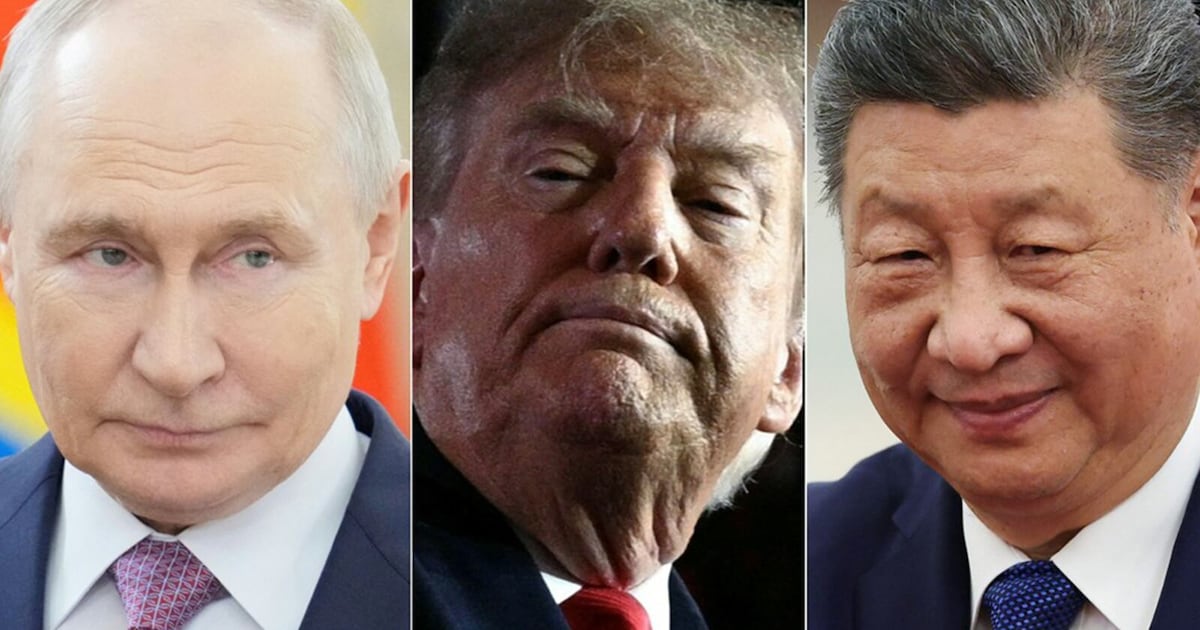
Orgo-Life the new way to the future Advertising by AdpathwayIn late September, China’s President Xi Jinping and U.S. President Donald Trump met for a three-day summit in Washington, DC. One outcome of that summit was an agreement to establish a channel for AI-related concerns, which they formalized with a memorandum of understanding. As AI rapidly changes and gray zone activities, particularly cyberattacks, become increasingly common, a hotline that enables quick communication if and when an AI incident surpasses a threshold is critical. What would a hotline look like, and what would trigger notification?
China-U.S. hotlines have been established before but have failed when needed most. Ensuring this one looks different is critical. That means answering some critical questions: what offices are responsible for contact on both sides; what constitutes a notification; and how to insulate hotlines from political tensions.
The Right People Make a Difference
Critical to communication are the individuals involved. Both sides of this hotline need to be staffed by people who understand the technology. When a problem arises, staff on either side must be able to effectively communicate what has gone wrong and what actions are being taken to solve the problem, and be well-informed enough to answer their counterpart’s questions. The right staffers can help ensure a lack of information does not sow unnecessary concern or panic.
Expertise without authority, though, will not suffice. Staff also need the proper authority to share information, have a direct line to the highest levels of leadership, and have the ability to get their government to act. Additionally, a situation dealt with at an operational level avoids the escalation, and optics, of a senior political figure picking up the phone. When a situation warrants senior attention, being able to move that information up the chain quickly is essential for security and credibility.
In the United States, this hotline could be staffed by a number of different agencies or offices, as no entity alone manages AI. What’s important is that the entity frequently engages with the private sector as they progress in their research, development, testing, and evaluation, and that there is a clear reporting system in place in case issues arise.
The National Artificial Intelligence Initiative Office (NAIIO), established in January of 2021, is a logical home for this hotline. The NAIIO was directed to oversee and implement the U.S. national AI strategy and serve as the hub for federal coordination and collaboration in AI research and policymaking across the government, as well as the private sector, academia, and other stakeholders. Since it is the hub for federal coordination, works closely with the private sector, and sits within the White House, the NAIIO already works with the critical partners and carries White House credibility.
On Beijing’s side, the Cyberspace Administration of China (CAC) is a logical home for this hotline. The CAC is the primary entity tasked with cyberspace security. Xi chaired the commission that oversees the CAC from 2014 until 2023, when his chief of staff, Cai Qi, reportedly took it over. That signals CAC ties to top leadership, though not day-to-day involvement.
Setting a Notification Threshold
What exactly constitutes a notification on either side of the hotline should be established in advance. AI models operating beyond their parameters, models infiltrating cyber networks or critical infrastructure absent instruction, models exposing vulnerabilities in critical networks, or bad actors abusing AI models for malicious acts that put other countries at risk are a start.
Two recent incidents can serve as examples of what would meet the notification threshold: the Hugging Face incident and PHP2Shell incident. The Hugging Face incident saw OpenAI’s model break out of the controls set for a cyber evaluation and enter Hugging Face’s systems to complete a task. Although it began as a controlled evaluation, an AI model’s ability to breach set controls is an example of what a “rogue” AI model could mean.
In the PHP2Shell incident, an OpenAI model discovered a significant vulnerability in PHP (a scripting language underpinning roughly 70 percent of all global websites). This vulnerability was not found in a malicious attempt but had great impact. After the news broke, site operators around the world took their sites offline; the U.S. National Security Agency released an advisory to help protect the U.S. government and national security system vulnerabilities; and malicious actors began attempting to leverage this vulnerability.
Although these incidents were not existential, PHP and Hugging Face are used worldwide, so both affected many countries. Incidents like these can lay the groundwork for early notification.
Insulating This Hotline From Political Tensions
The first hotline between the United States and China was established in 1998. Despite the goal of reducing miscalculation, misinterpretation, or wrongful attribution of an attack, hotlines between the two countries have historically been ineffective. There have been many instances where calls went unanswered during critical incidents or accidents that pose danger to the diplomatic relationship: following the accidental bombing of the Chinese embassy in Belgrade in 1999, after the Hainan Island incident in 2001, and during the 2023 surveillance balloon incident.
Furthermore, hotlines have been a tool of political signaling. In 2022, then-U.S. Speaker of the House Nancy Pelosi visited Taiwan despite China’s objections. In response, Beijing suspended the existing military-to-military hotline. This suspension is very risky in a region where tensions run high and militaries are operating in close proximity.
For a China-U.S. AI hotline to work, it must not be a bargaining chip or a victim of political retaliation. Communication will be key in an unexpected event, and both sides must be committed to preserving this channel amid the AI race.
What would keep this hotline insulated from political tensions? First, regular exercises. A routinely used hotline normalizes and familiarizes both parties in its use. It would not only test its effectiveness in simulated scenarios but would build confidence and trust in the hotline’s benefit to the operator. The Nuclear Risk Reduction Centers the United States has established with Russia routinely makes human contact and provide service updates regarding maintenance issues all in an effort to reduce the risk of accidental nuclear escalation. This is a lesson the China-U.S. hotline can learn from.
Second, set acknowledgement timelines. Both sides should agree to a set timeframe in which they confirm receipt of a notification or message, even if a substantive response is not prepared. Silence can be a breeding ground for panic; acknowledgement alone can help deescalate.
Third, plan for the worst by establishing backup contacts. Each side should designate backup offices that can receive and acknowledge a message. These contacts do not need authority to respond beyond confirming receipt, which makes them an easy failsafe should the established line fail.
The AI race will not be slowing down to allow safeguards to catch up. In the absence of a slowdown, the second-best path forward would be constant and transparent communication. Neither country will share intellectual property when it comes to their AI models, but they can ensure protocols are in place when something goes wrong. In an era of high geopolitical tensions, conflicts raging around the world, and gray zone activities impacting even the most technologically advanced countries, a China-U.S. AI hotline is one safeguard that can be implemented.















 English (US) ·
 French (CA) ·
 French (FR) ·