

 7 hours ago
1
7 hours ago
1
PROTECT YOURSELF with Orgo-Life® QUANTUM TECHNOLOGY
Orgo-Life the new way to the future Advertising by AdpathwayMany teams waste resources on citation formulas and unproven strategies while ignoring the basics. The biggest AI search myths in SEO mistake Generative Engine Optimization (GEO) and Answer Engine Optimization (AEO) for a complete replacement of traditional search foundations.
You can open Table of Contents show
In reality, AI Overviews, Perplexity, and ChatGPT rely on legacy crawling, indexation, and Retrieval-Augmented Generation (RAG) to find source content. Real AI visibility does not come from secret files or rigid templates—it requires technical crawlability, structured content chunking, and high-information-gain research that search systems can easily parse, trust, and cite.
What Neat GEO Playbooks Miss
Google, Bing, and ChatGPT do not expose the same index, controls, or reporting. Google’s generative features use Search systems, with site-level inclusion managed through Search Console. Microsoft reports citations across Copilot, Bing summaries, and selected partner integrations. ChatGPT uses OAI-SearchBot for search visibility, while GPTBot relates to model training. A publisher can allow one and block the other.
Any GEO rule that does not name a platform is incomplete. Before it enters a roadmap, ask which product it concerns, what documentation supports it, and how the result will be measured.
AI Search Myths in SEO Worth Retiring
AI Search Myths in SEO persist because platforms change faster than most publishing workflows. Some are harmless distractions; others lead teams to waste budget, split useful content into thin pages, or neglect technical basics. The eight misconceptions below deserve retiring before they become permanent parts of an SEO strategy.
1. GEO Has Replaced Traditional SEO
GEO is a useful label for a changing visibility problem. It is not a replacement for crawling, indexing, relevance, internal linking, or site quality.
Google’s generative search features rely on core Search ranking and quality systems. A supporting page in AI Overviews or AI Mode must be indexed and eligible to appear with a snippet. The site must also be included through the Search generative AI control in Search Console, which currently defaults to inclusion.
There is new work to do around conversational journeys, query fan-out, citations, and post-answer behavior. It belongs beside technical and editorial SEO, not in a separate strategy that ignores them.
2. An llms.txt File Is the Admission Ticket
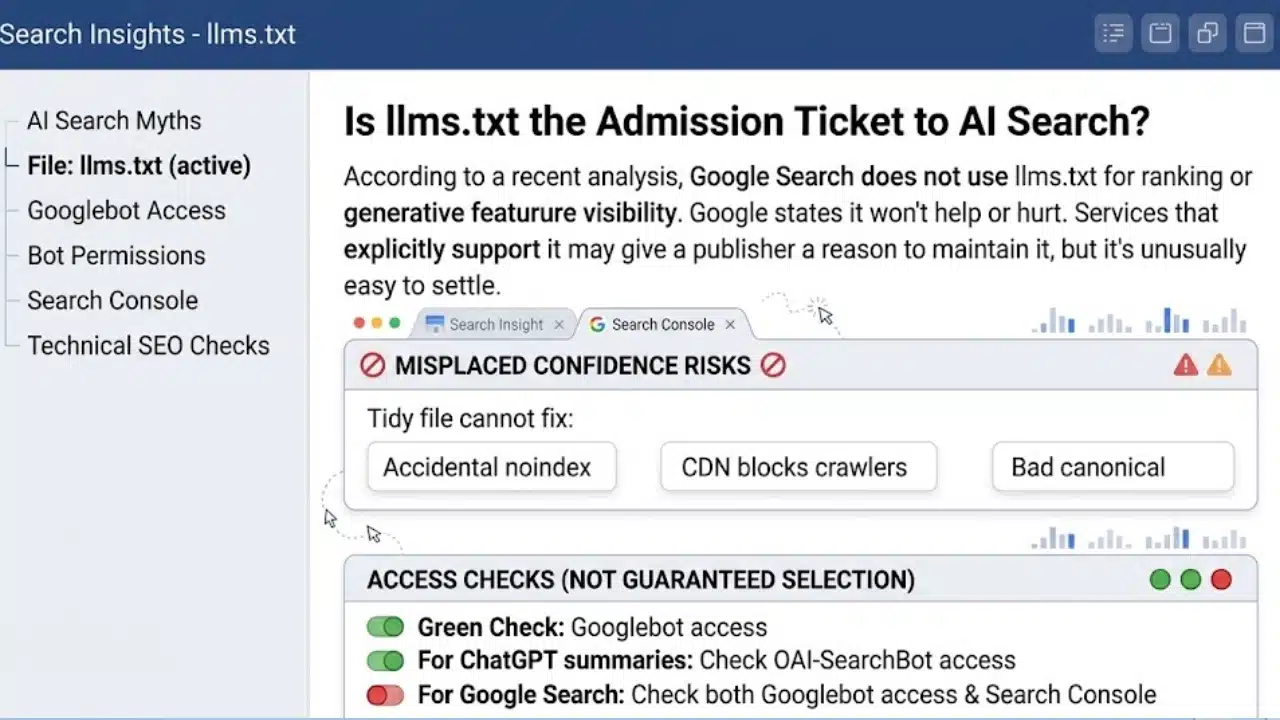
Among the AI search myths in SEO, this is unusually easy to settle for Google. Google Search does not use llms.txt, AI text files, or other special machine-readable files to determine visibility in its generative features. A service that explicitly supports the file may give a publisher another reason to maintain it, but Google says it will neither improve nor damage rankings there.
The practical risk is misplaced confidence. A tidy file cannot repair an accidental noindex, a CDN that rejects crawlers, or a bad canonical. For ChatGPT summaries and citations, check OAI-SearchBot access, although access does not guarantee selection. For Google, check both Googlebot access and the Search Console inclusion setting.
3. More Schema Markup Means More AI Citations
Structured data remains useful when it describes visible content and supports an eligible search feature. Google has not created a special schema type for AI Overviews or AI Mode, nor does its guidance promise more citations in return for more markup.
The quantity-first approach is overrated. Adding FAQ markup to an ordinary article or marking unsupported claims as reviews creates maintenance and policy risk, not expertise. Use a supported type that genuinely fits the page, validate it, and make sure the markup matches what readers can see.
4. AI Systems Need Every Article Broken Into Tiny Chunks
Clear headings, direct explanations, and useful tables can make a page easier to navigate and reference. Trouble starts when clarity becomes a compulsory template: one question per heading, a series of tiny answers, and a repetitive FAQ on every page.
Google says its systems do not require tiny content chunks. Microsoft recommends clear structure, including headings, tables, and FAQs where they help, but that is not a mandate to fragment every argument. Some explanations need context, qualifications, and sequence. There is no universal “AI-friendly” paragraph length.
5. Every Prompt or Fan-Out Query Deserves Its Own Page
Query fan-out means an AI system may issue several related searches to answer one request. It is useful research input, not an instruction to publish a page for every possible subquery.
Doing so often creates near-duplicate pages that compete for the same intent. At scale, it can also enter the territory Google identifies as abusive: producing many pages without enough original value. Group closely related questions into one strong resource. Split them only when the reader needs a different task, audience, product, or depth of treatment.
Google’s systems can connect a query with a relevant page even when the wording differs. A prompt export should inform an editorial calendar, not become one automatically.
6. Google Automatically Penalizes AI-Assisted Content
Google’s published guidance focuses on the result rather than a simple human-versus-machine test. Generative tools may assist with research or structure. The policy risk appears when automation produces pages at scale without enough accuracy, originality, or value.
The useful editorial question is who remains accountable for the claims. A reliable workflow needs source checking, subject review where the stakes justify it, removal of unsupported statements, and an owner for future updates. An “AI-free” label cannot make weak content trustworthy.
7. Only Pages Ranking in the Top 10 Can Earn Citations
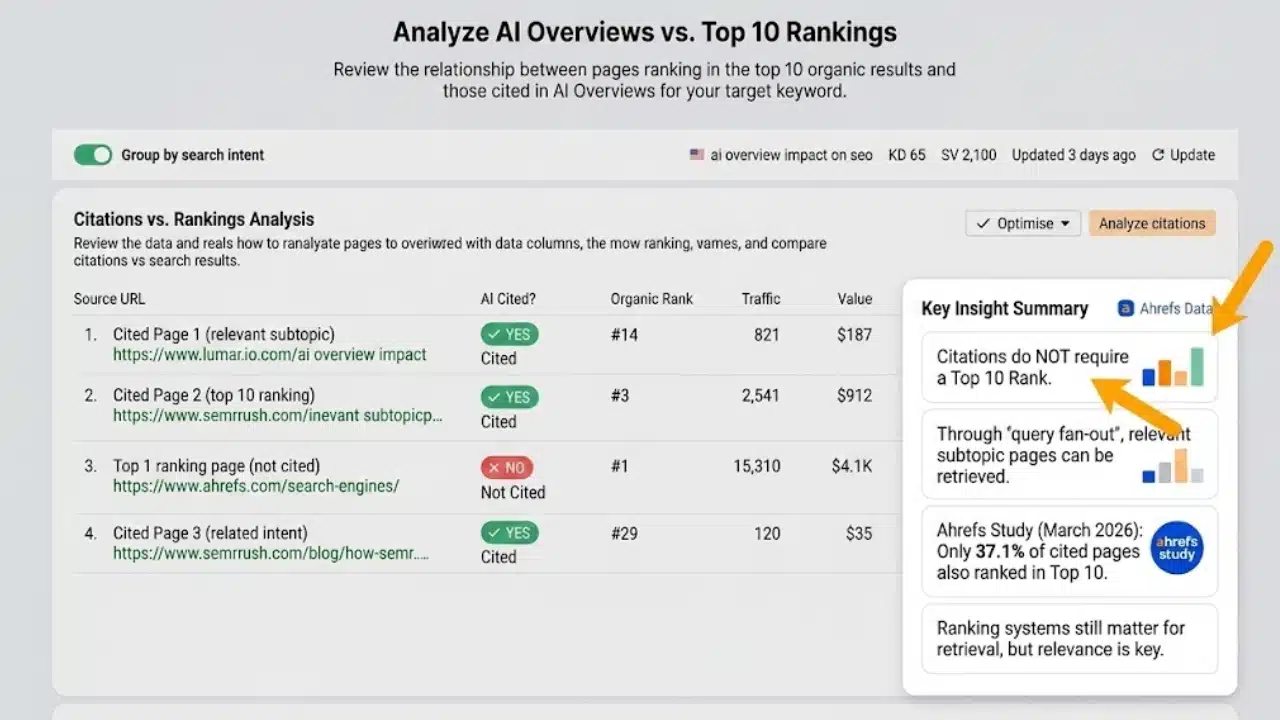
Organic visibility and AI citations overlap, but they are not identical. Through query fan-out, Google may retrieve pages for related searches rather than only the wording the user entered. A relevant subtopic page can therefore appear in an answer without ranking on page one for the original query.
A March 2026 Ahrefs analysis covering 863,000 keyword results and four million AI Overview URLs found that 37.1% of cited URLs also ranked in the top 10 organic blue links for the same query. Most did not. The data came from Ahrefs’ own visibility product, and its methodology had changed since an earlier study. Treat the figure as a point-in-time indicator, not a platform rule.
That does not make rankings irrelevant. Google still uses core Search systems for retrieval. The more useful reading is that topical relevance, crawlability, and coverage of related intents matter alongside performance for the head query.
8. AI Search Visibility Cannot Be Measured
Measurement is fragmented and less mature than conventional search reporting. It is not nonexistent. Teams create confusion when they treat screenshots as performance evidence or call every brand mention a win.
Current platform tools provide several firmer signals:
- Google provides a Generative AI performance report in Search Console, alongside a separate control for inclusion in generative Search features.
- Bing’s AI Performance public preview reports total citations, cited pages, sampled grounding queries, and trends across supported Microsoft experiences. It does not report citation placement or rank.
- OpenAI adds utm_source=chatgpt.com to ChatGPT referral links, allowing visits and downstream actions to be analyzed.
None provides a universal citation rank. Build reporting around decisions instead: qualified referral sessions, conversions, cited-page coverage, and changes over time. Controlled prompt checks can diagnose visibility, but they are not stable market-share data.
Final Thoughts
The most persistent AI search myths in SEO promise certainty where the platforms provide only controls, conditions, and partial evidence. That makes disciplined auditing more valuable than another layer of speculative optimization.
Start with the platform that matters most to the business. Confirm access and inclusion settings, separate search crawlers from training crawlers, record the pages already attracting citations or referrals, and improve the sources that contain something worth citing. New tactics still deserve testing, but they should not become policy without documentation, a measurable outcome, and a clear owner.
Frequently Asked Questions (FAQs)
Can a site leave Google’s generative Search features without leaving regular Google Search?
Yes. Google’s Search generative AI control affects the specified generative features without serving as a ranking or inclusion signal for other parts of Search. Excluding a site also removes its eligibility for traffic and impressions from those AI features.
Does blocking GPTBot remove a site from ChatGPT search?
No; GPTBot relates to model training, while OAI-SearchBot controls discovery for ChatGPT search summaries and citations, and OpenAI treats the two independently.
What should an SEO team measure before paying for a GEO tool?
Start with native platform reports, ChatGPT referral traffic, cited-page coverage, and conversions from those visits. A third-party tool may add useful monitoring. It cannot turn estimated prompt checks into an internal citation rank that the platform itself does not expose.
How often should AI search visibility be reviewed?
Monthly review is a practical starting point for active publishers. Recheck sooner after crawler changes, Search Console control changes, major site releases, or substantial updates to time-sensitive content.
























 English (US) ·
  French (CA) ·
  French (FR) ·