

 2 weeks ago
6
2 weeks ago
6
PROTECT YOURSELF with Orgo-Life® QUANTUM TECHNOLOGY
Orgo-Life the new way to the future Advertising by AdpathwayAugust 17, 2026 — 11:30am
Ukraine launched one of its largest aerial attacks of its war with Russia, sending hundreds of drones in a strike that killed at least six people and set ablaze a major warehouse of local online retailer Wildberries.
Kyiv has stepped up its attacks on Russia this year, with long-range missiles and swarms of drones targeting military industries and energy facilities. It has also increasingly pummelled giant Wildberries depots, burning billions of dollars’ worth of merchandise belonging to Russia’s version of Amazon.
Wildberries is the biggest online retailer in Russia and the repeated attacks on its facilities have brought the war home to the Russian public nearly 4½ years into Moscow’s full-scale invasion of Ukraine.
At least 20 of the company’s warehouses have been attacked since mid-July. The warehouses, some as big as 300,000 square metres, were unprotected and easy to set ablaze.
“These are not military and high-value political targets, therefore they’re not especially secured, they’re not really built to be able to shrug off drone strikes,” podcaster Mark Galeotti, a Russia expert who heads the Mayak Intelligence consultancy,said.
While there’s scarce public data, some estimates indicate that up to 20 per cent of the company’s total warehouse space has been destroyed, with assessments of losses running as high as $US6 billion.
Galeotti said the strikes reflected Kyiv’s effort to bring the war home to Russia.“It’s not just about seeing great clouds of black smoke over your cities because of some oil refinery on the outskirts being hit,” he said.
“You might be a small business whose inventory has just gone up in smoke in one of the Wildberries’ warehouses. Or else you just simply might be an ordinary consumer who just suddenly is no longer going to get the goods that you plan to buy.”
The online giant was founded by Tatyana Kim, Russia’s richest female entrepreneur with a fortune estimated at $US8.1 billion.
Kim, 50, was born in Grozny, the capital of the province of Chechnya, to an ethnic Korean family of an engineer and a teacher. She launched Wildberries in 2004 from her Moscow apartment soon after giving birth to her first child while working as an English teacher.
Wildberries initially sold clothing before expanding to appliances, household items, cosmetics, books and more. Businesses big and small use it to store, ship and deliver merchandise across Russia’s 11 time zones. An estimated 500,000 to 800,000 sellers use Wildberries and, after Western brands fled following the war in Ukraine, online retailers filled the void with merchandise from China, Turkey, the United Arab Emirates and elsewhere.
Ukrainian officials have said Wildberries sells gear and technical components, including drones, to the military. Moscow denied it, but such dual-use items as drone components, flak jackets or thermal weapon sights remain available on the platform.
Russia’s small and medium businesses have already been hit hard by tax increases, regulatory hurdles and, most recently, a fuel crisis from attacks on oil refineries. The ongoing strikes on Wildberries have further exacerbated the business environment, said Chris Weafer, CEO of consultancy Macro-Advisory.
“I wouldn’t say it’s a nail in the coffin because we’re not there yet, but it’s certainly another enormous difficulty on top of what has already been a very difficult situation for small enterprises,” Weafer said.
Some analysts also warn that instead of provoking discontent, the attacks on Wildberries could fuel stronger anti-Ukrainian and anti-Western fervour.
Pro-Kremlin political expert Sergei Markov said the attacks had played into the hands of Russian hawks who urged escalating the war. “It strengthens the view that it’s necessary to hit Europe,” he said. “And better sooner than later.”
Russia’s Ministry of Defence said it had destroyed 822 Ukrainian drones on Saturday night and early Sunday morning (Russian time). At least 600 drones were detected headed toward the Russian capital, Moscow Mayor Sergei Sobyanin said, with one-third of those destroyed over the Moscow region itself.
An 83-year-old man was killed after a Ukrainian drone hit a private home in the Moscow region, Governor Andrey Vorobyov said. He also confirmed a Ukrainian attack had sparked a blaze at a Wildberries warehouse in the town of Podolsk.
A drone attack targeted three towns in Russia’s south-western Rostov region, killing five people, Governor Yury Slyusar said. The attack by more than 150 drones damaged several homes and a train station and sparked a forest fire.
Russian strikes kill five in Ukraine
Meanwhile, Ukraine also came under Russian attack, with drone strikes destroying homes and torching Kyiv’s landmark book market.
A Russian missile attack on the Ukrainian city of Kryvyi Rih killed two people and wounded 14 others, Ukrainian President Volodymyr Zelensky wrote on social media on Sunday. He also said that one more person had been killed in the city of Sumy.
ArcelorMittal Kryvyi Rih, Ukraine’s largest steel producer, confirmed that one of its sites was hit in a missile attack and that operations were partially suspended.
Elsewhere, a man and a woman died when their home was hit by a Russian strike in Ukraine’s southern city of Zaporizhzhia, said Ivan Fedorov, the head of the local military administration.
Russian attacks also sparked fires throughout the Ukrainian capital, Kyiv, which wounded six people.
A blaze took hold at one of the city’s largest book markets, tearing through kiosks huddled close to the Pochaina metro station.
Firefighters fought back the flames, which sent plumes of black smoke across the capital, and picked their way through rubble where the market’s crowded pavilions once stood.
“Wherever the Russians can reach with their ballistic missiles, they strike civilian infrastructure,” Zelensky said.
Russia’s Ministry of Defence said on Sunday that it had targeted a metallurgical plant in Kryvyi Rih and several military-industrial sites in Kyiv, including a manufacturing facility for Ukraine’s Flamingo missiles.
The domestically produced missiles are increasingly key to Ukraine’s long-range attacks on Russia, with Zelensky announcing on Saturday that Kyiv had used the weapons to attack a rocket research and production centre in Samara, about 900 kilometres from the Ukrainian border.
NATO jet downs drone
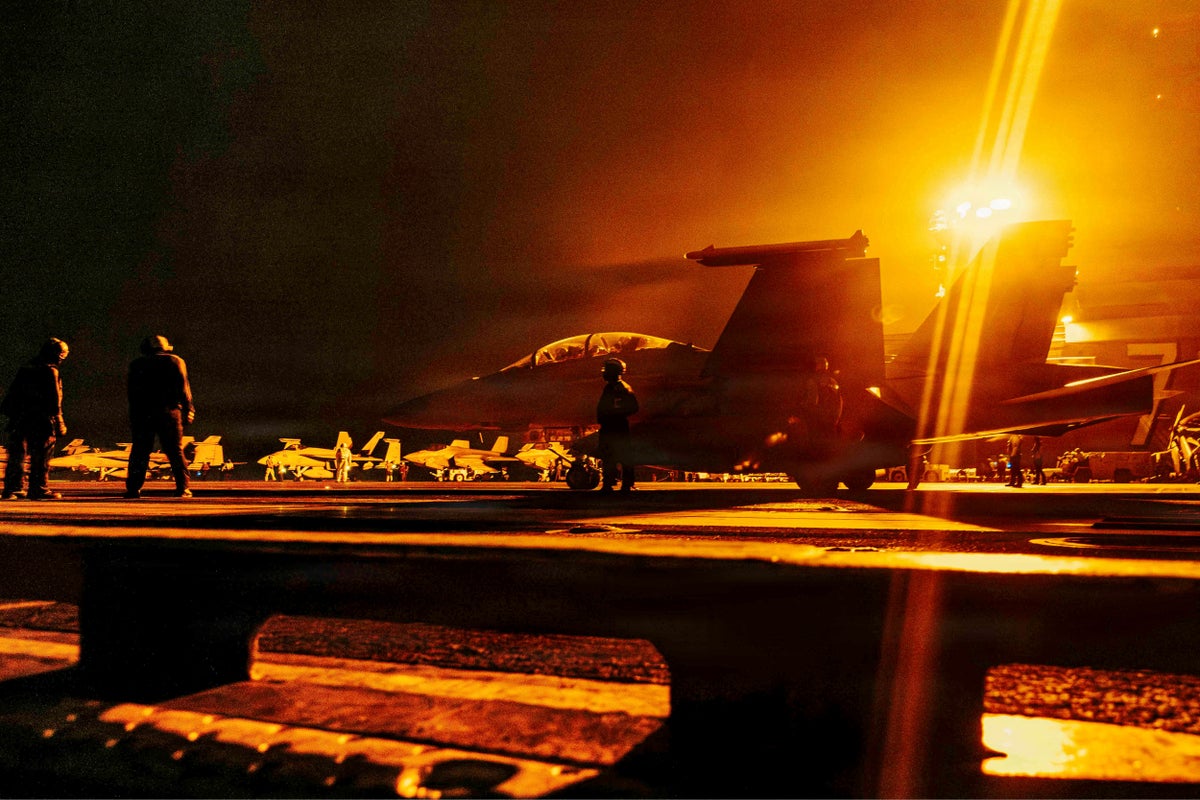
Romania’s Ministry of National Defence said on Sunday that a Spanish Air and Space Force F-18 fighter jet shot down a drone that had entered Romanian airspace.
The drone’s entry into the NATO member’s airspace was detected by surveillance systems at 4.44am (local time), about 24 kilometres north of the eastern city of Galati, which is near the border with Moldova, the ministry said. Moldova is a landlocked country between Ukraine and Romania.
A Spanish F-18 aircraft that was performing air policing duties “made radar contact with the target and received engagement approval”, the ministry said. “The drone was safely shot down by the F-18 aircraft at 5.01am.”
The ministry later said that drone debris was also reported in the Black Sea at 10am on Sunday, about 1.5 kilometres from the coastal city of Constanta. Separately, another drone fragment was found on Sunday near Constanta.
Romanian officials did not specify the drone’s origin.
However, Moldova’s Ministry of Defence said on Sunday that its army surveillance systems had detected a Geran-type Shahed drone in Moldovan airspace, which entered from Ukraine and exited toward Romania.
The spate of drone incidents comes weeks after Romanian pilots shot down three drones over three days as Russia intensified attacks against Ukraine near the border. Since Russia’s full-scale invasion of Ukraine, Romania has reported dozens of drone incidents, including some that have crashed and exploded on its territory.
Romania’s acting foreign minister, Oana Toiu, said in a post on X that the Spanish deployment in Romania was scaled up “at the request of Romania and NATO to bolster the eastern flank following prior drone incidents”, and that it was Spain’s fourth such deployment.














 English (US) ·
  French (CA) ·
  French (FR) ·