

 3 weeks ago
15
3 weeks ago
15
PROTECT YOURSELF with Orgo-Life® QUANTUM TECHNOLOGY
Orgo-Life the new way to the future Advertising by AdpathwayLarge language models are incredibly confident, even when they are entirely wrong. If you use generative tools to draft articles, summarize reports, or format code, you cannot afford to take the output at face value. A hallucination that slips into a live publication damages your credibility instantly. Before you hit publish or send that email, you need a structured system to verify AI content so you do not blindly pass off machine-generated errors as human expertise.
You can open Table of Contents show
10 Questions to Ask to Verify AI Content
1. Did the prompt require factual precision or creative brainstorming?
Language models excel at generating ideas, variations, and structural outlines. They struggle with hard, immutable facts. If you asked the tool to brainstorm five alternative headlines, the risk of failure is incredibly low. If you asked it to explain the tax implications of a new decentralized finance protocol, the risk of failure is massive. Adjust your level of skepticism based on the task.
2. What is the fastest way to verify AI content citations?
Generative tools are notorious for inventing sources. They will confidently provide a title, an author, and even a URL that looks completely legitimate. You cannot assume a link works just because it is formatted correctly.
Review this breakdown of common citation failures to watch for during your editorial review:
| Citation Issue | How It Appears | The Underlying Problem |
| The Dead URL | A perfectly formatted link to a real domain | The specific subpage was entirely invented by the model |
| The Ghost Author | A real academic paper format with realistic names | The researchers exist, but they never wrote that paper |
| The Misattributed Quote | A real, famous quote assigned to the wrong leader | The model merged two adjacent concepts in its training data |
3. Is the logic sound, or just grammatically correct?
AI writes with perfect grammar, which tricks the human brain into assuming the underlying argument is intelligent. Read the output specifically looking for leaps in logic. Sometimes a model will present two accurate facts and then draw a completely nonsensical conclusion connecting them.
4. Does this output sound exactly like my competitors?
Models tend to regress to the mean. If you ask for an article on workplace productivity, it will likely give you the same five generic tips every other blog published in 2018. If the output lacks a unique angle, specific friction points, or a distinct point of view, it is not ready for publication, even if it is technically accurate.
5. Can I independently verify the statistics provided?
Never publish a statistic generated by a chatbot without a primary source. Models frequently combine numbers from different contexts or invent percentages that sound plausible. If the AI claims that “73% of small businesses fail due to cash flow,” you must find the original study. If you cannot find it quickly, delete the statistic.
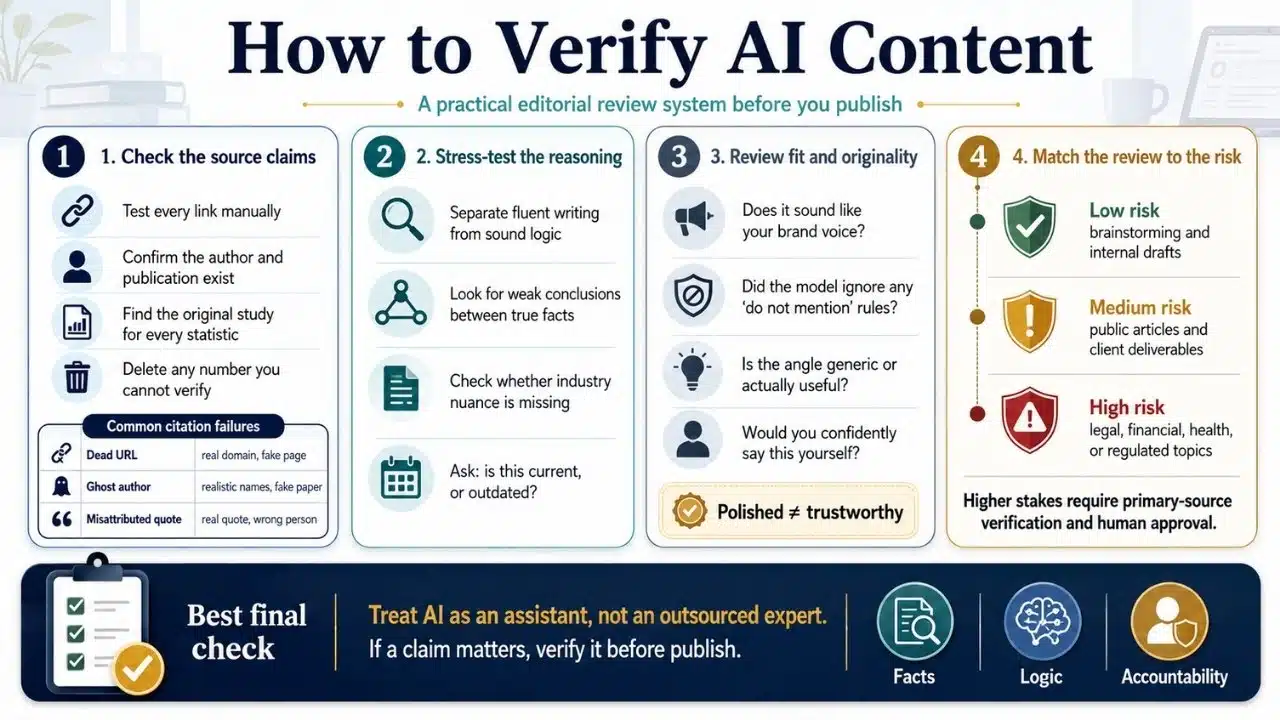 A practical AI content verification framework for checking sources, testing reasoning, reviewing originality, and applying stricter checks to high risk topics.
6. Did the tool miss the necessary nuance for this specific industry?
Generalist models struggle with highly specialized nuance. An AI might write a financially accurate explanation of a blockchain transaction but completely miss the current regulatory context in the United States. You have to provide the industry-specific judgment that the machine lacks.
7. Is the timeline accurate for current events?
Most models have knowledge cutoffs. Even those connected to the live internet can pull outdated information if the search query is not perfectly optimized. Always double-check dates, recent software updates, and breaking news details.
8. Who takes the blame if this information is wrong?
If a piece of content is purely for internal brainstorming, the stakes are low. If it is legal advice, financial guidance, or health information, the stakes are critical. Ask yourself who bears the liability if the AI is wrong. If the answer is you or your company, your editorial review needs to be ruthless.
9. Did the AI ignore my negative constraints?
Models are notoriously bad at following instructions about what not to do. If your prompt included “do not mention X,” there is still a high probability that X will appear in the output. Always scan the final text specifically for the elements you told the tool to avoid.
10. Would I actually say this myself?
If the text includes phrases like “in today’s ever-evolving digital landscape” or “it is important to remember,” it sounds like a machine. Strip out the robotic transitions and corporate filler. If the voice does not align with your brand, you have not finished editing.
Why It Is Getting Harder to Spot Machine Errors
As AI models improve, their hallucinations become much more subtle. Early generative tools made obvious errors that a quick skim could catch. Today, models weave tiny inaccuracies into deeply complex, otherwise brilliant paragraphs. This requires a much higher level of subject-matter expertise from the human editor. You can no longer rely on formatting glitches or broken English to spot a problem.
The Difference Between Assisting and Outsourcing
The fundamental mistake companies make is treating AI as an outsourced writer rather than an editorial assistant. If you outsource a task, you expect a finished product. If you use an assistant, you expect a rough draft that requires your final approval and polish. Shifting your mindset toward the latter immediately improves your quality control.
The Final Step to Verify AI Content Safely
The most practical thing you can do is assume the machine is lying to you until proven otherwise. Do not let the speed of content generation override your editorial standards. A fast publishing cycle is useless if you have to spend the next week retracting errors. Take the extra ten minutes to verify AI content, cross-check the claims, and inject your own real-world experience before the text ever sees an audience.
Frequently Asked Questions (FAQs) About How to Verify AI Content
How do I check if an AI invented a link?
You must manually click the link or copy and paste the URL into your browser. If it leads to a 404 error page or a completely unrelated article on the same domain, the AI likely hallucinated the address.
Are paid AI tools more accurate than free ones?
Paid tiers usually run on more advanced models that hallucinate less frequently, but they are not immune to making things up. You must still verify AI content regardless of how much you pay for the software.
Can I use AI to fact-check other AI output?
You can, but it is risky. While you can prompt one model to critique another, they often share similar blind spots or training data biases. A human editor cross-referencing primary sources is always the safer route for critical information.











![New Japanese convenience store rice balls taste like instant noodles [Taste test]](https://soranews24.com/wp-content/uploads/sites/3/2026/09/0_c8e809.jpg?w=1200&h=630&crop=1)





 English (US) ·
  French (CA) ·
  French (FR) ·