

PROTECT YOURSELF with Orgo-Life® QUANTUM TECHNOLOGY
Orgo-Life the new way to the future Advertising by Adpathway
There is a small painting in Saumiya Balasubramaniam’s office. I noticed it the first time the Toronto-based writer and I met, tucked into the corner of a shelf among her books. It possessed a deeply intentional presence, the kind of work worthy of a prominent place on a family refrigerator, radiating a parent’s quiet pride. I assumed immediately that her child had made it. Over the course of a month, Balasubramaniam and I spoke about everything: bonding over a shared appreciation for the Canadian snow—a feeling we would rather nurture from the warmth of locked rooms, safely removed from the chill—and discussing homes located both too far away and right here. We spoke of language, migration, and the quiet ways stories allow us to inhabit worlds beyond our own.
Balasubramanian is the 2025-2026 Mabel Pugh Taylor Writer in Residence at McMaster University. The Writer-in-Residence program, which brings a well-established Canadian author to Hamilton every year, is a collaborative initiative of the Department of English and Cultural Studies and the Hamilton Public Library. Our dialogue began just as she was winding down her tenure. She is the award-winning author of three picture books: When I Found Grandma (2019), Two Drops of Brown in a Cloud of White (2020), and When I Visited Grandma (2024). The worlds she constructs in these pages dissolve rigid boundaries, comfortably occupying the liminal spaces between “here” and “there.” Her literary career beautifully bridges the structural tech architecture of her past in computer science with the deeply affective and creative landscapes she now inhabits. Her characters are often diasporic, reaching toward belonging from liminal spaces shaped by migration, motherhood, memory, and distance.
At the writer in residence finale in April, Balasubramaniam read from a poetry collection developed during her residency. Listening to her read, I found myself recognizing fragments of my own world in her lines, just as I had in her books. Around her was a vibrant community of writers she had mentored throughout the program: a mother whose teenage daughters shouted encouragement from the audience; an older poet who filled the room with laughter; a diverse generation buoyed by the support of family and fellow literary enthusiasts. It was a room animated by the same spirit that runs through Balasubramanian’s work: a belief that writing is not simply an act of expression but a way of reaching toward one another across distances of age, experience, and home.
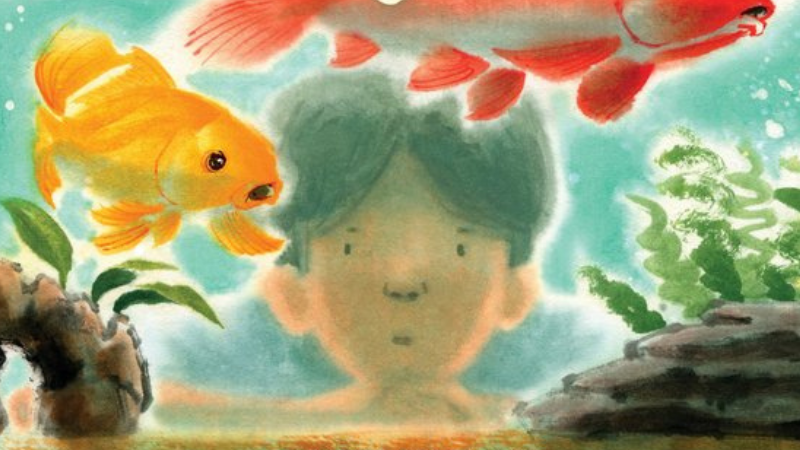
Eventually, I learned the true story of that small painting on her shelf. A young writer had come into her office for a consultation. While they spoke, the student quietly sketched the cover of one of Balasubramaniam’s books, handing it to her at the end of their meeting. She placed it carefully beside her published books in a symbolic gesture. That small drawing and its placement seemed, for me, to contain many of the questions that animate her work: what it means to be seen, how stories travel between generations, and how art returns to us transformed by the people who receive it. The conversation that follows captures more of Balasubramaniam’s warmth and generosity.
Ozichukwu Ifesie: Why do you write? And who do you imagine you are writing for?
Saumiya Balasubramaniam: Honestly, I write to make sense of life—the inner and outer worlds, as well as the physical world and my perception of it. When I write, I have no one in particular in mind, so I suppose I write for myself. I don’t visualize a specific audience; however, I believe there is a reception somewhere in the universe. A book always finds its way to the right reader at the right time.
Ifesie: Your conception of the audience allows us to trouble the idea that picture books are strictly for children. When I read your works, particularly Two Drops of Brown in a Cloud of White, as an immigrant, I could see myself in the story. Adults can locate themselves in your books. How does your work reimagine the received reality that picture books are only for children?
Balasubramaniam: In my first book, the story is narrated in the first person by a main character who happens to be a child. For that reason, it is classified as a story for children. However, picture books are often read to children by adults, bringing them into a community where they become mutual participants. When I lead workshops, I often find that adults are the most moved; there are tears and shared stories. I set out to write a story, and it finds a home with five-year-olds, seventy-five-year-olds, and everyone in between. Really, my audience is everybody.
Ifesie: What can you tell us about your writing practice?
Balasubramaniam: I try to write daily, usually first thing in the morning. These days it might be poetry or a story I’m building on. Right now, I’m hard-pressed for time, especially with this residency, so I can’t stick to a four-hour session or set number of pages. But I still try to get a few words down in a journal or notepad every morning. One of my favorite rituals when I’m deep in a project is lighting a small tea light. I force myself to sit until that light dies out, which usually takes about two or three hours. We often look at lamps as sources of light or knowledge, but for me, it’s a way of enforcing a “sit-down.” The light is here, and it is with you—so sit with it. I do this when I know I won’t be disturbed.
Ifesie: Has there been a moment in your writing life when you seriously doubted the work or yourself? What helped you move through that?
Balasubramaniam: All the damn time (laughs)! Of course, I have doubted myself. There is the overflowing recycle bin, the piling up of papers, and the stretches where nothing is in the pipeline for publishing. But when I sit to write, I never doubt the process. I never question the relationship between the page and the pen. In the moment of writing, there’s no doubt. The doubt comes later, when I get up from the desk. I doubt myself, but I never doubt the act of writing. When I sit and turn on the lamp, I just write. What helps me through those cracks of doubt is the good fortune of interacting with readers, a child, a parent, or a teacher who asks what is coming next. I don’t consciously label these interactions as “dispellers of doubt,” but they validate the work and keep the imposter syndrome at bay. Beyond that, it is simply the self that shows up.
I doubt myself, but I never doubt the act of writing.
Ifesie: You trained in computer science before turning to creative writing. In that field, there is a binary right or wrong. In storytelling, the truth is often found in the gray areas. How did you navigate that move from the precision of coding to the ambiguity of narrative?
Balasubramaniam: I love that phrasing. It’s interesting because I am an artist at heart, but I grew up in India studying a field that was highly sought after. It placed me on solid ground to make a living and provided the opportunity to migrate to the West, which I valued deeply. But while I performed well in the sciences—I even wrote entire compilers for scripting languages (chuckles)—it didn’t personally appeal to me. The precision of coding was thrilling in its own way, but the sense of accomplishment wasn’t palpable because it felt formulaic. Creative writing is the direct contrast to computation. There is no formula for poetry. The shift wasn’t a deliberate pivot so much as an organic necessity. Working with machines couldn’t sustain my inner self. As life took its course, migration, establishing a home away from home, motherhood, the need to work with words became far more compelling than pragmatism or logic.
The precision of coding was thrilling in its own way, but the sense of accomplishment wasn’t palpable because it felt formulaic. Creative writing is the direct contrast to computation. There is no formula for poetry.
Ifesie: It sounds as though writing called to you, rather than you seeking it out.
Balasubramaniam: Exactly; it wasn’t a pivot but an organic shift. I actually stayed in tech while writing my earlier pieces. What life offered me, and how I felt about it, is simply what I wrote about.
Ifesie: Given your background in computer science, do conversations around AI and literary “replication” trouble you?
Balasubramaniam: Believe it or not, I do not pay much attention to AI. I know the tools exist, but I don’t wonder about competing with them. I do what I do for self-fulfillment. There is a unique contentment that comes with completing a poem. You start with a blank page and, like sculpture or pottery, you create something out of nothing. I do not care if a machine produces something “better.” I don’t have a formula for how I do it; I could not teach you, because I don’t know how I did it myself. It isn’t deliberate avoidance of technology, it’s just who I am.
Ifesie: When you’re working on a manuscript, what are you listening for? How do you know a sentence or a story has found its right form?
Balasubramaniam: When I’m working on a manuscript, I usually write whatever comes to my mind. I eventually find my way to the “heart of the matter,” the central idea, and I try to go with the flow of what is coming to me. I spend an extraordinarily long time with an idea; it marinates in the far-out corners of my mind. During the initial writing, I don’t filter or critique. It is during the rewriting and editing that I pay close attention to the form. For example, I recently developed a new form: fifty-word poetry. Each poem is exactly fifty words, structured into ten lines of five words each. I write as it comes, but when I return to the piece after a stretch of time, I look at how it flows and falls. That is when I know it has found its form.
I recently developed a new form: fifty-word poetry. Each poem is exactly fifty words, structured into ten lines of five words each.
Ifesie: Many of your works explore the distance between generations, places, and/or times. What draws you to those in-between spaces?
Balasubramaniam: Life inadvertently placed me in this position of observing from the middle. In my first book, for instance, my two main characters are a five-year-old and a seventy-five-year-old. I always seem to be writing from the center of things. I am from India, and I still struggle with the idea of “home.” When I fly, somewhere over the mountains or the oceans, perhaps over Europe, I imagine that this might be the place to be because it is exactly between Canada and India. I feel as though I am in the middle of it all. The question then becomes: How can I bridge the gap between years, distances, and human relationships? It is a question of belonging. The pendulum swings back and forth, and my books are an attempt to bridge those gaps—to make living better for people from different spaces, times, and generations.
How can I bridge the gap between years, distances, and human relationships? It is a question of belonging.
Ifesie: Do you think writing has the power to repair distance, or does it merely help us inhabit space with more awareness?
Balasubramaniam: I think writing can do both. Distance can be acknowledged, especially in terms of belonging, and writing becomes an exploration of the how or the why. My three books explore familial relationships as well as place, specifically how the same place is perceived by two different pairs of eyes, across generations and backgrounds. In this context, the title Two Drops of Brown in a Cloud of White becomes a metaphor for the human eye; the color describes the eye itself while pointing toward what is seen and how these characters look at the world.
Ifesie: Is there anything about Two Drops of Brown in a Cloud of White that feels especially personal to you—especially how it visualizes those in-between spaces?
Balasubramaniam: It feels personal, for sure. It’s not a “true story,” in the literal sense, but it draws from the experience of finding a home so far away from home. It explores that through the lens of an evolving relationship—in this case, mother and daughter—but also from one human to another. It's about acceptance on many levels. For the daughter, this is home; she was born and raised here and doesn’t truly know the “home” of which the mother speaks. But for the mother, the process of finding home happens through the eyes of the child. There’s a sense of the child being “the father of the man” here. Because of those interpersonal relationships and physical rootings, Two Drops is probably the most personal story I’ve written.
Ifesie: When I hear the title, the immediate assumption is a metaphor for the snow: two brown people walking through a white landscape. But you’ve suggested there is a more powerful layer.
Balasubramaniam: It’s the eyes. It is the color of the eyes and how they sit against a backdrop of white. It’s how one pair of eyes looks into another—older to younger. It is the question: “Can I see what you see?” literally, but also figuratively and metaphorically.
Ifesie: If we follow that line, we see a mother who was born elsewhere, for whom home is “someplace else,” finding a sense of belonging through the eyes of her child. And perhaps the child gets a glimpse of the mother’s home by looking back into her eyes. It’s seeing “through” and being “seen through.”
Balasubramaniam: Exactly, layers. That book gets asked about a lot, maybe because there is more to it than meets the eye (laughs)!
Ifesie: You’ve worked extensively in the picture book form and won major awards in the process. What drew you to that medium? What does it allow you to do that other forms might not?
Balasubramaniam: Picture books are close to my heart because that is where I “came out” into the world as a writer. I try to be honest about my process: I was drawn to the medium partly because I was reading so many of them to my child at the time. A picture book is an intimate, beautiful exchange between an adult and a child, mediated through story, image, and sound. That interplay appeals to me deeply because my writing tends to be visual and rooted in imagery. For example, in one story:
Ma looks up, a smile sneaks around the corner of her lips. A blue-green sparkle shimmers on her nose.
I am describing a nose ring, a piece of jewelry worn by many women from the subcontinent. The mother says, “I miss the green of palm trees back home” while the child insists, “This is home.” Later, the mother sees dry, brown leaves and calls them “skeletons,” but the child sees the same brown and thinks of maple syrup, because that is the essence of home to her. She slips the leaf in her pocket. I’m interested in how two people can inhabit the same space differently, and picture books allow those tensions to emerge visually as well as through language.
I’m interested in how two people can inhabit the same space differently, and picture books allow those tensions to emerge visually as well as through language.
Ifesie: What has the writer in residence experience been like for you so far? How has it shaped your writing time?
Balasubramaniam: The experience has been rewarding. It has made me glad to be useful to people: I’ve received wonderful feedback about helping writers advance their own work. I also got to read across genres I wouldn’t have otherwise. As I mentioned, I’ve worked with everyone from a nine-year-old to an eighty-year-old retiree. In terms of my own writing, the residency has been a bit all-consuming. Managing the work and the consultations takes time, but I have been inspired to write in different ways. I wrote two picture books, one which is already finished, and I’ve been writing poetry. I participated in an open-mic event with the department here, and since then, I’ve really been developing that fifty-word poetry we discussed.
Ifesie: I understand you are also working on a memoir during your time here. What can you share about that project?
Balasubramaniam: It is a very slow-moving project because it is an exploration of personal loss. It’s a personal exploration, but I’m trying to reach the universal through the personal. Through my consultations, I’ve had people talk to me about their own experiences with loss, how hard it is to come to terms with or to verbalize it. I think it is vital for us as a society to find ways to verbalize these emotions. The memoir is my attempt to explore that.
Ifesie: You’ve chosen a very punchy, evocative title for your upcoming memoir: G Is for Grief. Is the memoir structured around this idea of “learning” a new language of loss, much like a child’s alphabet?
Balasubramaniam: The title is likely an imitation of a children’s book I saw. At that point in my life, and even now, the grief was so intense and all-consuming that G Is for Grief just felt right. Interestingly, during this residency, the memoir took a bit of a back seat, which turned out to be a good thing. It provided the distraction needed to distance myself. When I was first writing it, I was very much “inside” the experience; it felt like a personal ramble from under the rubble. Now, I’m out a little, viewing it with a slightly more objective lens. Time and space have given me a different angle from which to look at the loss. And that reminds me, I should probably go back to it (laughs). Thank you for reminding me.
Ifesie: When the residency concludes, what does “next” look like for you?
Balasubramaniam: Oh, my God. A very, very, very long walk in the woods (laughs)!














 English (US) ·
  French (CA) ·
  French (FR) ·