

 1 week ago
8
1 week ago
8
PROTECT YOURSELF with Orgo-Life® QUANTUM TECHNOLOGY
Orgo-Life the new way to the future Advertising by AdpathwayTo grow up in Venezuela means to be accustomed to the work of Carlos Cruz-Diez. It makes sense. The pioneer of kinetic art was one of the country’s most important cultural figures, particularly because his investigations into color earned him a place in museums around the world and redefined how generations of people experienced art. Yet for Venezuelans, Cruz-Diez is more than an artist. His work became part of the visual language of the country. It appeared in plazas, on the sides of buildings, in universities, and countless public spaces. His chromatic interventions were woven into everyday life.
Over time, and as the country’s prolonged crisis unfolded, many of those works acquired meanings that extended far beyond art. There is perhaps no better example than Ambientación de Color Aditivo (1974), the iconic floor of Maiquetía International Airport. Originally conceived as a public artwork, it has become one of the most recognizable images associated with Venezuela’s mass exodus and the difficult goodbyes that were said while standing on it. Today, replicas of the floor can be found everywhere: in areperas across the world, on murals, in social media posts, and even on album covers by artists such as Danny Ocean. For many Venezuelans, a photograph of those tiles evokes memory, longing, and a sense of home.
I was no exception. Like many Venezuelans of my generation, I grew up surrounded by Cruz-Diez’s legacy. I knew his name from school, understood that he was one of the country’s most celebrated artists, and knew that his work was somehow supposed to move. But I never truly understood how. That changed late last year when I met Carlos Cruz Delgado, Cruz-Diez’s son, after a comedy show in Paris. During our conversation, he invited me to visit his father’s atelier in the city, an opportunity I couldn’t refuse.
The migrant artist
A few weeks later, I found myself heading to the atelier where Cruz-Diez spent years developing his investigations into color and perception. The workshop is located in northern Paris and stands out from its largely residential street thanks to its bright green facade, which is still adorned with the perfectly preserved sign of the butcher shop that once occupied the building. I was promptly received by Carlos and Angélica, one of the employees at the Cruz-Diez Foundation, which since the artist’s death in 2019 has focused on preserving his work and keeping his legacy alive.
Upon entering, a long wooden table occupied the center of the main room, surrounded by shelves filled with pigments, chemicals, books, exhibition catalogues, and machinery. On the side, there was a small coffee table surrounded by works of the artist, next to a large bookshelf with folders labeled with decades of projects. Everything had a slight industrial paint smell and an industrial vibe mixed with the energy of a family home, particularly because of the kindness of Carlos and Angélica.
As I continued exploring the place, the details accumulated slowly. For instance, there was a sound system that Carlos later told me had been acquired in exchange for an artwork. Technical materials organized with strict precision. Machines and cans of paint carefully laid out on the top shelves. Family photographs mixed among documents and tools. It was clear important things had happened to that place, but it was also clear life continued.
After moving first to Barcelona in 1955, and after connecting with a few other Venezuelan artists, Cruz-Diez realized Paris was where he needed to be. So they decided to move there in 1960.
Carlos and I sat on the coffee table and he carefully laid out the history of the place where we were sitting. He emphasized that the history of this butcher shop-turned-atelier started in Caracas. His dad used to paint figurative works, particularly emphasizing scenes of urban poverty as a form of protest. While the paintings were commercially successful, they quickly became artistically insipid for Cruz-Diez. He mentioned that his dad no longer felt that figurative painting was an adequate vehicle for what he wanted to communicate and that Caracas, under a tumultuous transition from Pérez Jiménez to the democratic era, might not provide an adequate environment for his investigation, which quickly turned into topics of colour, perception, time and space.
After moving first to Barcelona in 1955, and after connecting with a few other Venezuelan artists, Cruz-Diez realized Paris was where he needed to be. So they decided to move there in 1960. After all, Paris was the epicenter of the art world and, if he wanted to measure himself against the leading artists of his generation, he felt he had to be there.
Carlos explained that when his family first arrived in Paris, they lived in multiple locations throughout the city. We jokingly realized that many of them were along Line 9 of the Metro. During those early years, the workshops operated out of the same apartments where the family lived. He spoke about struggling through winters in buildings with inadequate heating and the constant effort to keep production from disturbing the neighbors. It was fascinating to hear about the story of such an important figure in Venezuelan culture through the lens of migration, a frame that feels ever more present with the establishment of the Venezuelan diaspora. During the early years of the family in Paris, space was limited, materials were everywhere, and artistic work had to coexist with their daily life. Cruz Delgado said: “Family participation was always very natural…. At first, we were children and helped with simple tasks: cutting materials, preparing elements, or simply observing.”
Cruz Delgado himself also pursued artistic projects as a child. He recalled building nativity scenes and proudly mentioned that one of them was selected to be exhibited in a small gallery inside a bookstore, joking that he had shown work in a gallery before his father did.
The location we were at came in after years of moving into progressively larger spaces as Cruz-Diez’s artistic ambitions expanded. Eventually, the family acquired the former butcher shop that now houses the atelier. According to Carlos, the purchase was made through a long installment arrangement with the previous owner, which became the source of a recurring family joke. Since the payments stretched over many years, Cruz-Diez would jokingly ask about the butcher’s health and wonder how much longer they would have to keep paying for the building.
Carlos repeatedly returned to an idea that had surfaced throughout our conversation: his father understood art as an investigation. He often described him not as a painter or sculptor, but as a technician of color.
Over time, the former butcher shop became the heart of the Cruz-Diez project. Yet what struck me most was that the operation seemed to be guided as much by joy as by technical rigor. Cruz Delgado recalled that his father valued joy and that he did not trust people who never laughed because “they had to be hiding something.” Music was a constant presence. Mirtha, Cruz-Diez’s wife, often played the guitar while he sang, the atelier’s sound system was rarely silent, and tucked beside some of the machinery sat a shaved ice machine.
The same spirit extended beyond the workshop walls. When the family first moved into the former butcher shop, many neighbors assumed another butcher was opening. Yet after a TV appearance by Cruz-Diez, they realized he was an artist. Years later, local business owners still regularly stopped by, and Cruz-Diez became a familiar presence in the neighborhood.
As our conversation continued, Carlos began showing me some of the works that occupied the office section of the atelier. One that particularly caught my attention was the Chromoscope, a pair of glasses with a filter that altered the perception of colors into the artist’s signature approach. Cruz Delgado mentioned that it was optimal to see the city lights at night, but it still looks wonderfully surreal.
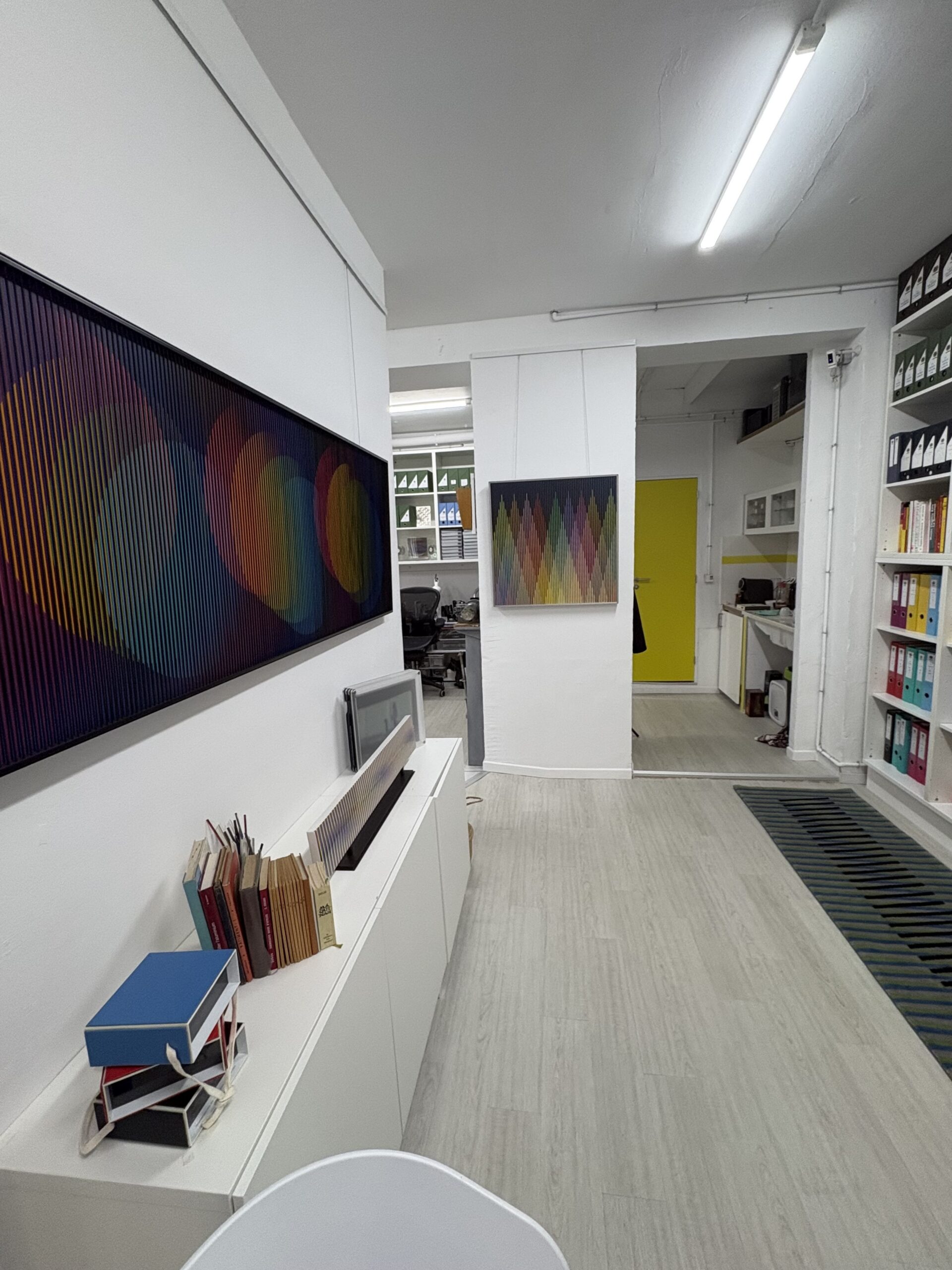 This is the view from the table where Cruz Delgado and I chatted. The blue and red boxes in the bottom left corner are the Chromoscopes.
The researcher artist
At that point, Carlos left to take our dishes to a kitchen in the back and quickly chatted with Angélica. I kept looking at one of the works that sat next to the table. While I had seen Cruz-Diez’s style hundreds of times, seeing the piece so up close felt fundamentally different. At first, it was difficult to pinpoint exactly why. The works themselves seemed deceptively simple: carefully arranged lines, geometric forms, and precisely calibrated colors. Yet as I moved around them, something unexpected happened. Colors appeared and disappeared. This time, they were particularly saturated, yet new tones emerged where none seemed to exist a moment earlier. Effects shifted depending on my position in the room.
The experience felt strangely familiar. I had spent my entire life looking at Cruz-Diez’s work, but for the first time I felt like I was actually seeing it. Carlos smiled when I mentioned this. His father, he explained, was not as fond of photography. A photograph could capture the object, but not the phenomenon. It could document the lines, the shapes, and the colors, but it wasn’t a “real” experience. This was one of the reasons Cruz-Diez preferred to describe work as “ambientations” rather than installations. The artwork was not confined to a surface. It existed in the relationship between the object, the surrounding space, and the person experiencing it and, for him, that was the most authentic form of realism.
For the entire time, I had felt like I was in Venezuela. It wasn’t because of the accents, the stories, or even the constant shared references, but because the atelier felt animated by a kind of curiosity that seemed deeply familiar.
Carlos repeatedly returned to an idea that had surfaced throughout our conversation: his father understood art as an investigation. He often described him not as a painter or sculptor, but as a technician of color. The goal was not simply to create beautiful compositions. It was to understand how color behaved, how it interacted with light, how it changed through movement, and how perception itself could become the subject of an artwork: “The studio brought together engineers, architects, industrial designers, physicists, materials manufacturers, and lighting technicians… My father also had a deep scientific curiosity, which meant that the atelier functioned almost like an interdisciplinary laboratory”, Carlos said.
Looking around the room, I saw hints of this laboratory everywhere. The machines, the pigments, and the shelves of meticulously organized project folders that lined the wall were the infrastructure of a years-long research project. Understanding the atelier as a laboratory also helped me understand what happened after Cruz-Diez’s death in 2019. The workshop never stopped functioning just because the artist was gone; it just changed its mission.
The legacy artist
Today, much of the foundation’s work revolves around preserving the results of those investigations. Carlos explained that they eventually left a larger space where Cruz-Diez spent his final years and returned to the former butcher shop to focus on safeguarding his legacy. Restoration, he told me, begins long before anyone touches the artwork itself. “The restoration always begins with a phase of documentary research.”
He stood up and pulled one of the folders from the shelf beside us. Inside were technical plans, photographs, production records, and color references that documented exactly how a work had been conceived and manufactured. Only after studying those materials can the foundation evaluate the condition of a piece, identify the effects of time, weather, humidity, or previous interventions, and determine how best to proceed while preserving what Carlos described as its “conceptual and material integrity.”
The challenge is particularly complex because many of Cruz-Diez’s works are designed to produce optical phenomena rather than simply exist as objects. During our conversation, Carlos jokingly introduced me to what he called tosicinetismo. Over time, some of the plastic elements used in certain works can warp and bend and look like bacon (tocineta in Spanish), thus losing the optical effects Cruz-Diez valued. That challenge becomes even greater in public spaces when they also have to collaborate with government agencies and engineers.
After that explanation and a brief chat about a myriad of other topics, the time for the visit’s end was approaching. So, I thanked both Cruz Delgado and Angélica for their kindness and their time and returned to the streets of Paris, slightly dizzy. For the entire time, I had felt like I was in Venezuela. It wasn’t because of the accents, the stories, or even the constant shared references, but because the atelier felt animated by a kind of curiosity that seemed deeply familiar.
The visit revealed something I had never associated with Cruz-Diez despite having grown up surrounded by his work: not the monument, but the artist driven by relentless curiosity. The colors, the machines, the collaborators, the folders, and the endless investigations all pointed to the same thing. Behind the architect of the language of Venezuelan modernity was a person who never stopped asking questions, bringing people together, and imagining new possibilities. Perhaps that is why Cruz-Diez remains so present in the Venezuelan imagination: his work reminds us not only of where we come from, but the spirit of the world we are trying to build.
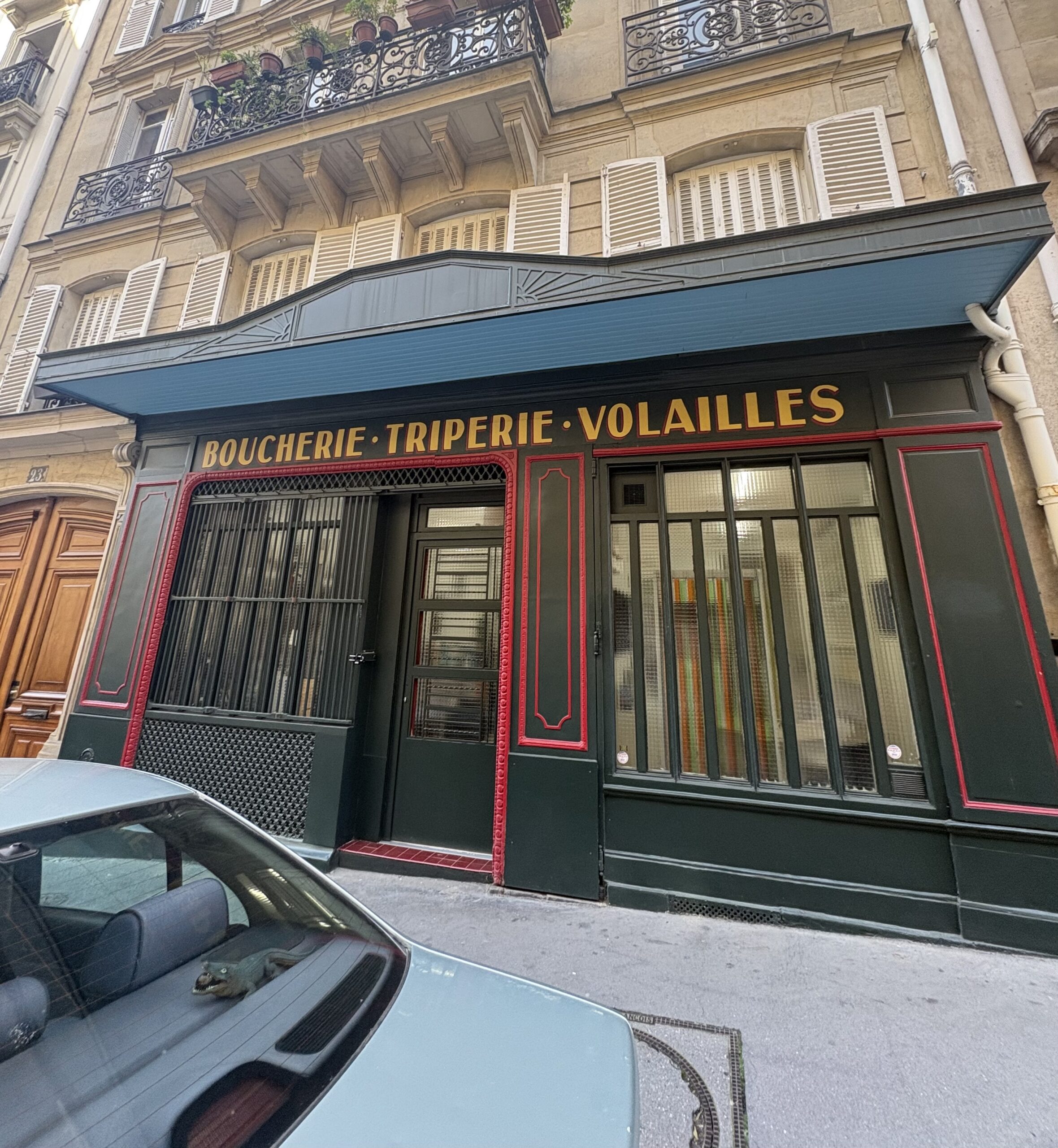 The butcher shop-turned-atelier where the Cruz Diez magic happened.










 English (US) ·
  French (CA) ·
  French (FR) ·