

PROTECT YOURSELF with Orgo-Life® QUANTUM TECHNOLOGY
Orgo-Life the new way to the future Advertising by Adpathway Superconductors are materials that allow electricity to flow without electrical resistance, eliminating energy losses caused by heat. They could transform technologies ranging from power grids and magnetic levitation trains to quantum computers. Credit: Shutterstock
Researchers have discovered that a key requirement for superconductivity can persist even at room temperature.
Scientists searching for a superconductor that works at room temperature have identified a potential way forward. New research from Utrecht, Leiden, and Munich shows that electrons can form the pairs needed for superconductivity even at room temperature. The findings, published in Science, suggest that a different requirement may be preventing these materials from conducting electricity without resistance.
The key appears to be how paired electrons behave collectively. Although the pairs can survive at much higher temperatures than previously understood, they must also act in a coordinated way for superconductivity to emerge.
Why Superconductivity Remains So Difficult to Achieve
Electrical resistance causes energy to be lost as heat whenever current passes through an ordinary conductor. This is useful in a toaster, where resistance heats a metal wire until it glows, but undesirable in power transmission and electronic devices. Superconductors eliminate electrical resistance, potentially enabling more efficient energy storage, levitating trains, and advanced quantum computers.
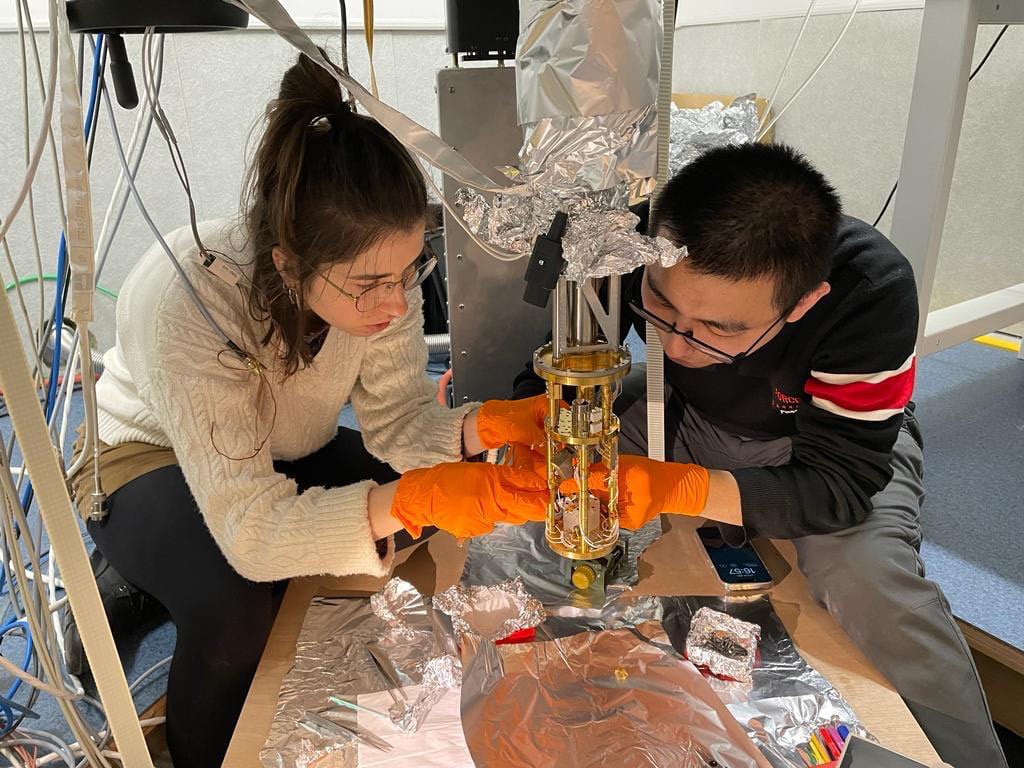 First authors Maialen Ortego Larrazabal and Jiasen Niu with the measuring equipment Credit: LMU, Faculty of Physics
The obstacle is temperature. Many superconductors must be cooled to approximately -260°C (-436°F), often using expensive liquid helium. Superconductivity was first discovered in 1911, and researchers made major progress in the mid-1980s when they identified materials that could become superconducting at temperatures around -173°C (-279°F). Yet these higher-temperature superconductors presented a mystery: the established theory explaining conventional superconductivity could not account for their behavior.
“We don’t understand superconductivity at these higher temperatures at all,” says Ingmar Swart [LINK], one of the research leaders. “And if you don’t understand it, you can’t systematically search for materials that become superconducting at room temperature, which is ultimately our goal.”
Electron Pairs Can Survive at Room Temperature
Superconductivity requires two essential conditions. First, electrons must form partnerships known as Cooper pairs. Second, those pairs must move in a coordinated quantum state called phase coherence. Without both conditions, a material cannot sustain superconductivity.
In conventional superconductors, electron pairing and phase coherence emerge together as the material cools below a critical temperature. The new research shows that these processes can occur separately in high-temperature superconductors. Electron pairs can form and remain stable at temperatures far above the point where electrical resistance disappears, including at room temperature.
“This is really good news,” says Swart. “We show that one of the two key conditions for superconductivity can be met at room temperature. If that weren’t possible, room-temperature superconductivity would be out of reach altogether.”
The Remaining Barrier to Room-Temperature Superconductivity
The findings indicate that the interaction binding electrons into pairs can remain sufficiently strong at room temperature. This shifts attention toward phase coherence, which may be the limiting factor preventing superconductivity at higher temperatures.
“The ‘glue’ that holds the pairs together is strong enough to keep them together even at room temperature,” says Swart. “This suggests that the second key ingredient, phase coherence, is the bottleneck.”
The researchers have not demonstrated room-temperature superconductivity, but their results help narrow the search for what is missing. Swart plans to investigate how phase coherence develops and what prevents electron pairs from achieving it at higher temperatures.
“If we understand phase coherence, it may point to a path toward superconductivity at higher temperatures.”
Reference: “Equivalence of pseudogap and pairing energy in a cuprate high-temperature superconductor” by Jiasen Niu, Maialen Ortego Larrazabal, Thomas Gozlinski, Yudai Sato, Koen M. Bastiaans, Tjerk Benschop, Jian-Feng Ge, Yaroslav M. Blanter, Genda Gu, Ingmar Swart and Milan P. Allan, 5 November 2026, Science.
DOI: 10.1126/science.adt3444
Never miss a breakthrough: Join the SciTechDaily newsletter.
Follow us on Google and Google News.























 English (US) ·
 French (CA) ·
 French (FR) ·