

PROTECT YOURSELF with Orgo-Life® QUANTUM TECHNOLOGY
Orgo-Life the new way to the future Advertising by Adpathway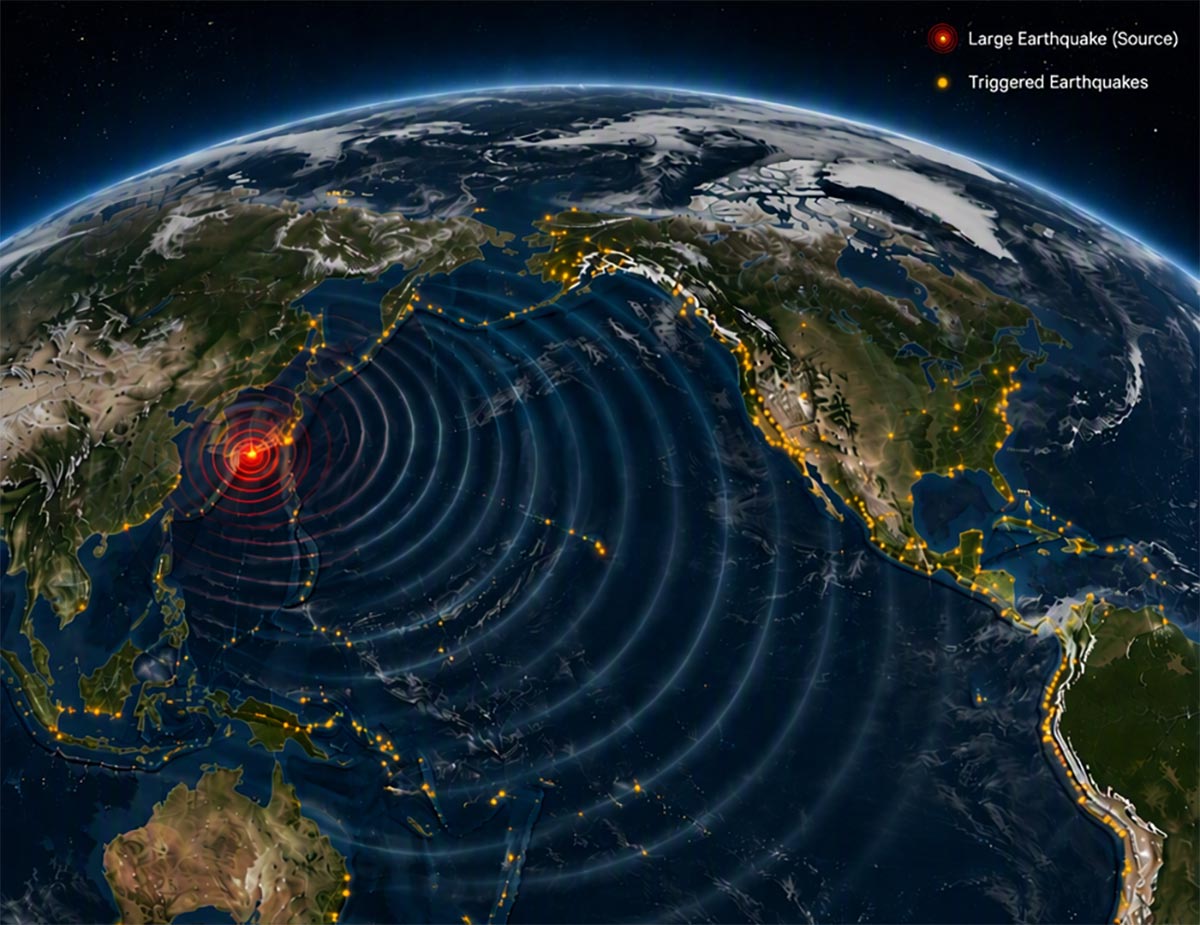 An illustration of how seismic waves from a large earthquake can travel across the globe, potentially triggering additional earthquakes thousands of kilometers from their source. Credit: HKU
Even tiny stresses from passing earthquake waves may gradually weaken distant faults by increasing fluid pressure inside the crushed rock lining them, researchers’ simulations suggest.
Earthquake waves can trigger seismic activity thousands of kilometers away, sometimes long after the shaking has stopped.
A study led by Professor Jun Yang and his team at the Department of Civil Engineering, Faculty of Engineering, The University of Hong Kong (HKU), offers an explanation for this delayed triggering and a long-standing puzzle about why some seismic waves are more effective than others.
A fault’s porous lining holds the clue
The researchers focused on fault gouge, a porous, granular material that lines fault surfaces. Using a new analysis framework based on critical-state soil mechanics, they simulated how this material responds to the stress changes caused by passing seismic waves.
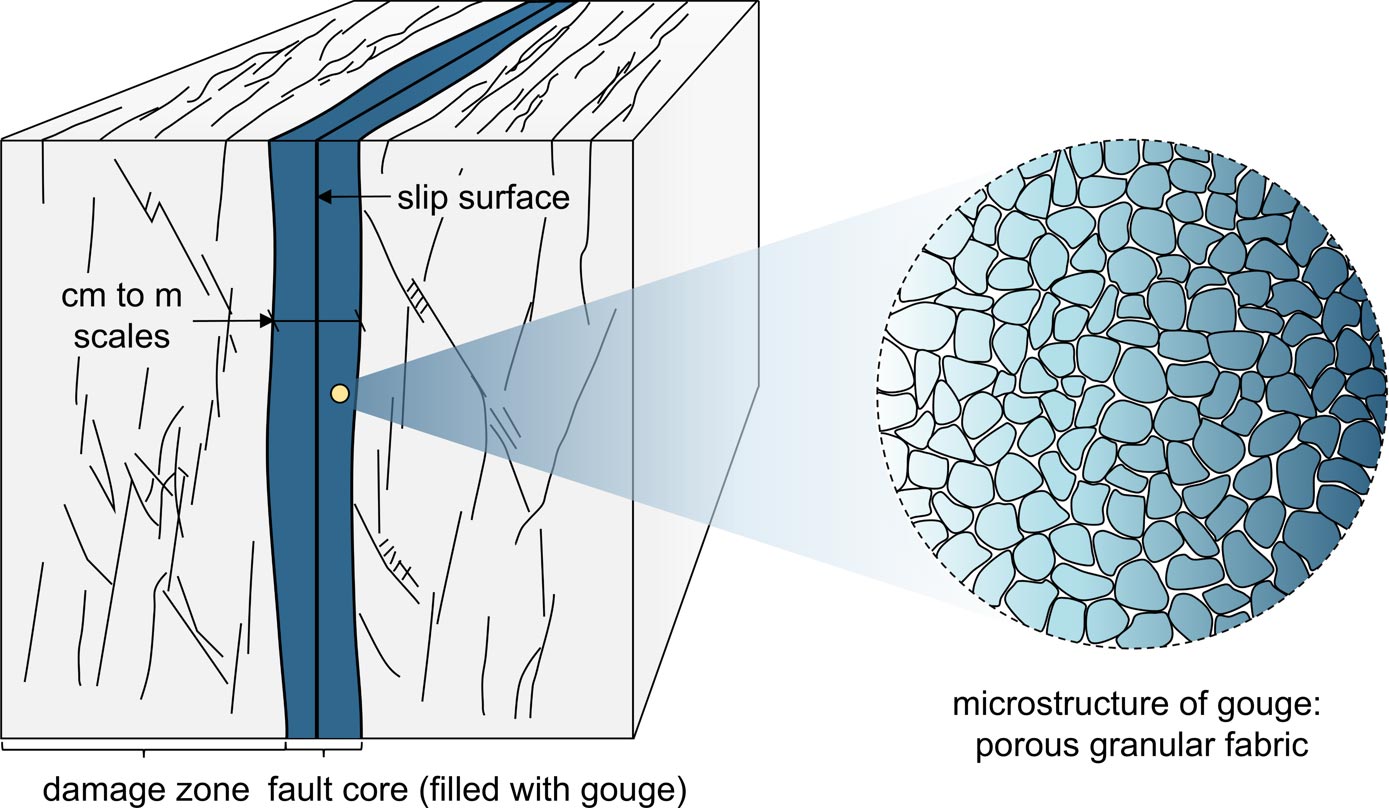 A schematic showing the internal structure of a geological fault and the porous, granular material known as fault gouge, where fluid pressure can build up and weaken the fault. Credit: HKU
Even tiny wave-induced stresses caused fluid pressure, known as pore pressure, to build up gradually inside the gouge. As pressure increased, it reduced the effective normal stress, the force pressing the two sides of a fault together. This weakened the fault and made it more susceptible to rupture.
The findings offer an alternative to the traditional view that seismic waves must generate enough direct stress to push an already vulnerable fault into failure. Instead, waves may trigger earthquakes indirectly by increasing pore pressure. Because that pressure does not disappear immediately after the waves pass, the fault can remain weakened long enough for an earthquake to occur later.
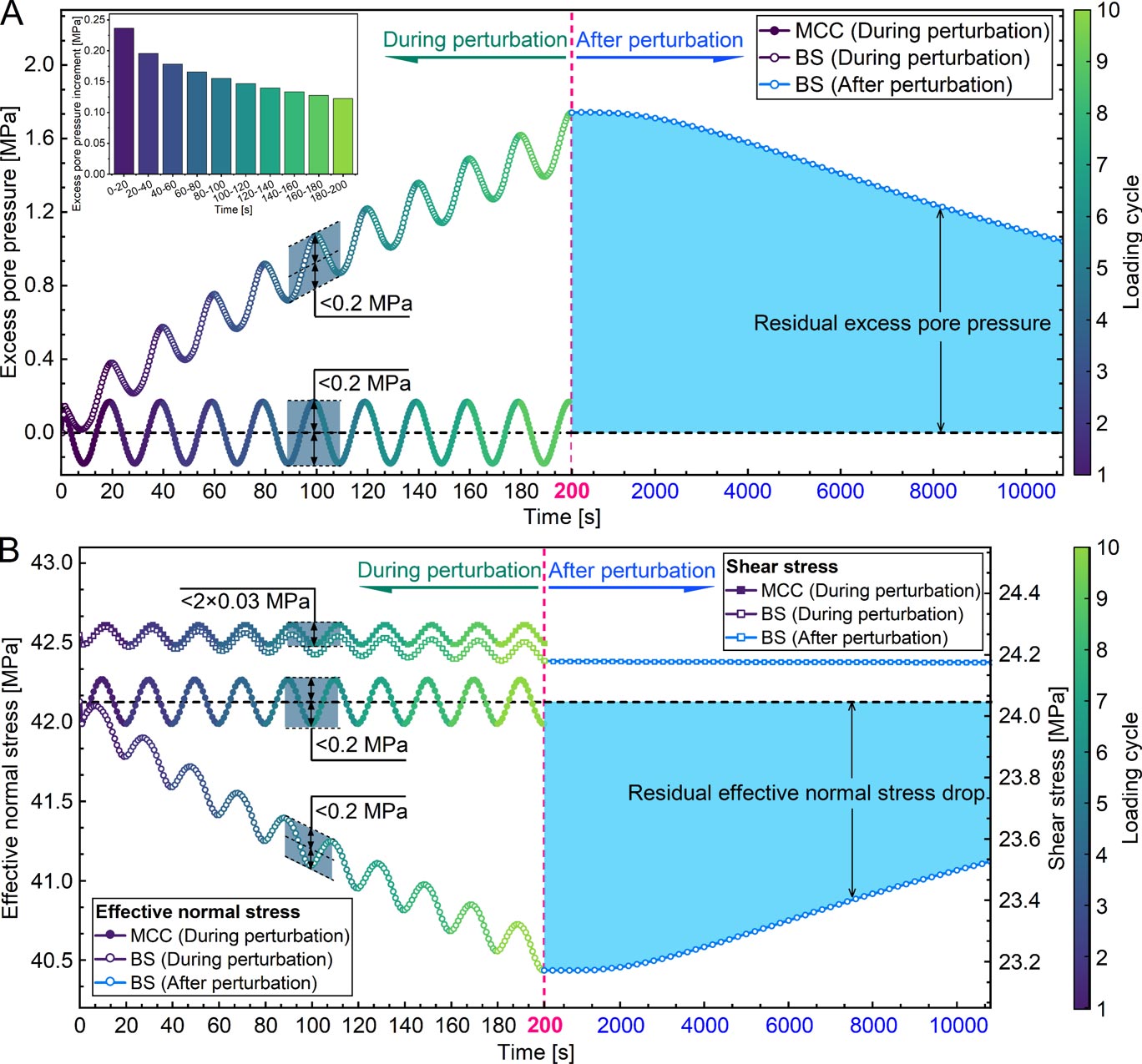 Numerical simulations showing how small seismic disturbances can progressively increase pore pressure (A) and reduce effective normal stress (B). These effects persist long after the shaking stops, potentially explaining delayed earthquake triggering. Credit: HKU
Compression may explain Rayleigh waves’ advantage
The simulations also help explain why Rayleigh waves appear more effective at triggering distant earthquakes than Love waves, despite the latter producing stronger theoretical shear stresses. The researchers found that the compressional, or dilatational, component of seismic waves builds pore pressure much more efficiently than their shear component.
“The core significance of this work extends beyond proposing a novel remote triggering mechanism,” Professor Yang explained. “It transforms the remote-triggering problem from a classical stress-amplitude question into a coupled problem involving material rheology, fluid dynamics, and wave propagation.”
Reference: “What triggers seismicity thousands of kilometers away from a mainshock?” by Chao Huang and Jun Yang, 24 June 2026, Science Advances.
DOI: 10.1126/sciadv.aec4754
Support from Research Grants Council of Hong Kong under grant nos. 17214724 and N-HKU723/23 (awarded to J.Y.).
Never miss a breakthrough: Join the SciTechDaily newsletter.
Follow us on Google and Google News.


















 English (US) ·
 French (CA) ·
 French (FR) ·