

.svg) 1 hour ago
3
1 hour ago
3
PROTECT YOURSELF with Orgo-Life® QUANTUM TECHNOLOGY
Orgo-Life the new way to the future Advertising by Adpathway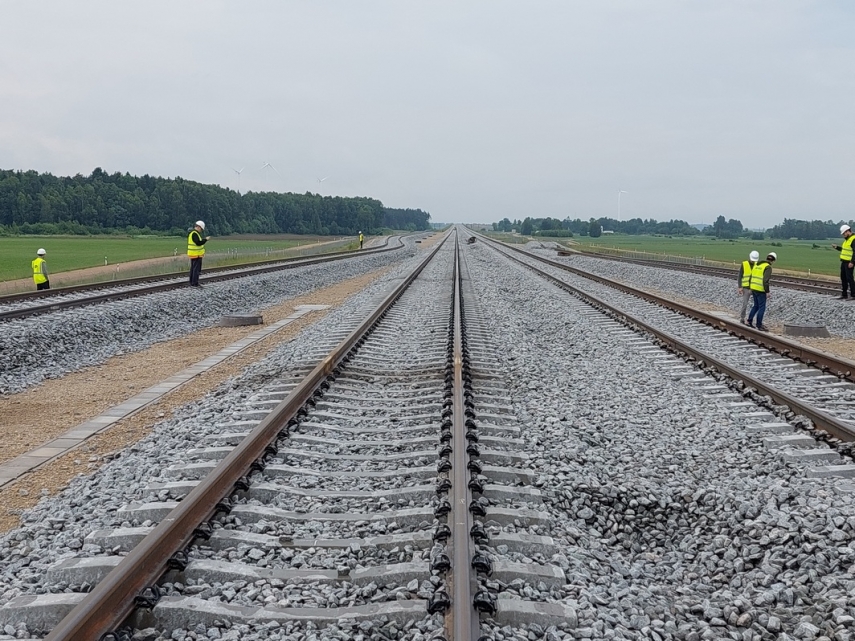
Photo: Rail Baltica and Port Polska workshop
Last week, technical experts from Rail Baltica and a delegation from Port Polska held a joint workshop at the RB Rail AS office in Vilnius, focused on the engineering and operational requirements for high-speed rail infrastructure. The workshop is part of a broadening, working-level cooperation between Rail Baltica and its Polish partners.
Port Polska is the programme behind Poland's largest-ever rail and airport investment, led by Centralny Port Komunikacyjny company. It includes a new central hub airport between Warsaw and Łódź and a national high-speed rail network anchored by a 480-kilometre "Y" line connecting Warsaw, Łódź, Poznań and Wrocław, designed to integrate Poland with Europe's wider transport corridors, including the Baltic states.
The visit reflected Port Polska's strong interest in Rail Baltica. Beyond the workshop, the delegation toured the Palemonas intermodal terminal and active construction sites in Lithuania, where they saw the installation of the track superstructure first-hand.
Discussions covered solutions for turnouts, selection of technologies for catenary power supply and support structures, comparing driven piles and bored cast-in-place piles for foundations, and the design of frame-type engineering structures, including the application of transverse can’t and the management of track stiffness variations in transition zones. The exchange also extended to environmental and logistical infrastructure: acoustic barrier materials and emergency-exit solutions, standard cross-sections for trackside cable routing and maintenance access roads, hydraulic calculation methods for railway drainage systems, and the technical properties of fibre in fire-resistant concrete. Furthermore, the topics included transition zones or technical blocks associated with cross-drainage structures, guard rails and their use on high-speed railway lines, as well as railway clearance gauge requirements and dual-use considerations.
"Rail Baltica project only makes sense with a seamless crossborder operation with Poland to fullfill the vision to connect and strenghen the Baltics countries integration to Europe. Regular cooperation and joint technical workshops provide significant benefits for all participating organisations. Technical workshops are not only an opportunity to discuss engineering solutions but also a mechanism for reducing project risks, improving long-term infrastructure performance, and ensuring that decisions taken today support efficient operations for decades to come," says Emilien Dang, Member of the Management Board and CTO, RB Rail AS.
"The relationships established through these exchanges create a foundation for effective cross-border cooperation throughout the entire lifecycle of the Rail Baltica corridor. They create opportunities to compare engineering approaches, exchange lessons learned from ongoing projects, and identify best practices that can improve the efficiency, quality, and safety of infrastructure delivery," says Marius Narmontas, Member of the Management Board and COO, RB Rail AS.
“In my view, this first workshop bringing together exclusively technical departments was extremely valuable. It allowed us to exchange knowledge, discuss ongoing challenges and identify issues shared by our respective high-speed rail projects. The entire Port Polska team returned from the meeting highly satisfied, and we hope that similar workshops between both technical teams can be organised at least once a year”, says David Pozo Rubio, Deputy Director in Design Department, Centralny Port Komunikacyjny company.
“Rail Baltica and Port Polska programme constitute flagship investments in our region. Although developed in different countries, they will form part of the same transport network, in particular along North Sea – Baltic European Transport Corridor. As our projects move from design into construction, the cooperation becomes crucial for long-term success that will ultimately be measured not only by the infrastructure we deliver, but by how effectively it improves the movement of people and goods across the region and Europe as a whole, says Piotr Rachwalski, Member of the Management Board, Centralny Port Komunikacyjny”
The overall working-level cooperation with Poland's infrastructure manager, PKP PLK, is also progressing. Rail Baltica is synchronising with PKP PLK, which is building the line up to the border, on both the technical interface and construction, through regular working groups covering electrification and signalling. The aim is to agree a draft interface specification by the end of this year, aligning the key technical parameters so that the Polish and Lithuanian sides match precisely at the border.












 English (US) ·
  French (CA) ·
  French (FR) ·