

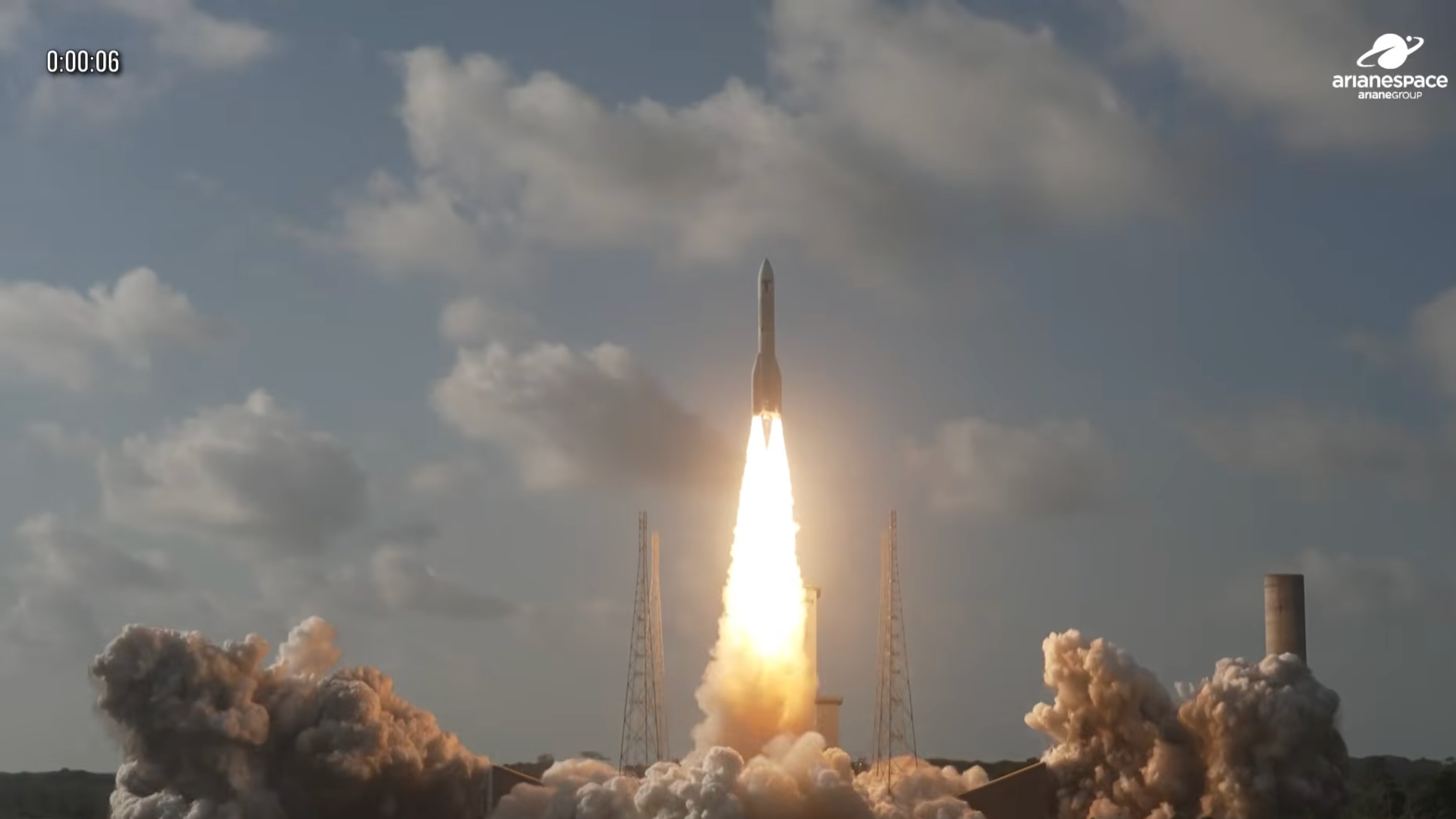
Europe's most powerful rocket flew again today (Aug. 27).
An Ariane 6 launched the MTG-I2 weather satellite from Europe's Spaceport in Kourou, French Guiana today (Aug. 27) at 4:10 p.m. EDT (2010 GMT; 5:10 p.m. local time in Kourou), right at the beginning of a 2.5-hour window.
Everything went according to plan today: The Ariane 6 released MTG-I2 into geostationary transfer orbit (GTO) 36 minutes after liftoff.
The 8,400-pound (3,800 kilograms) MTG-I2 is the second imaging satellite in the Meteosat Third Generation network (hence the name). It will complete the three-spacecraft constellation in geostationary orbit, which lies 22,236 miles (35,786 kilometers) above Earth.
Its companions, MTG-I1 and MTS-S1, launched in December 2022 and July 2025, respectively. MTG-I1 is an imaging craft and MTS-S1 is a "sounder," using an infrared instrument to probe different layers of Earth's atmosphere.
The MTG satellites are operated by the European Organisation for the Exploitation of Meteorological Satellites (EUMETSAT), an international group based in Germany. And they're very capable, according to Arianespace.
"The MTG system is part of a new generation of geostationary satellites providing imagery for the early detection of fast-developing severe storms, weather forecasting and climate monitoring," the company wrote in the MTG-I2 press kit, which you can find here.
Arianespace went on to describe MTG as "the most complex and innovative meteorological geostationary system ever built," citing its potential to improve the prediction and early detection of severe weather events.
"The data gathered will have a wide range of uses, from enabling aircraft to avoid storms and for earlier alerts of flooding, through to more precise monitoring of fires and fog," the company wrote.
Today's launch was the ninth to date for the Ariane 6, which can deliver up to 12.7 tons (11.5 metric tons) to GTO in its burliest configuration. For comparison, SpaceX's workhorse Falcon 9 rocket has a GTO payload capacity of 9.15 tons (8.3 metric tons).
The Ariane 6 debuted in July 2024. Before today, the rocket last flew this past June, when it successfully sent 36 of Amazon's broadband satellites to low Earth orbit.
Editor's note: This story was updated at 4:20 p.m. ET on Aug. 27 with news of successful liftoff, then again at 4:50 p.m. ET with news of satellite deployment.






















 English (US) ·
  French (CA) ·
  French (FR) ·