

 19 hours ago
1
19 hours ago
1
PROTECT YOURSELF with Orgo-Life® QUANTUM TECHNOLOGY
Orgo-Life the new way to the future Advertising by AdpathwayHistory rarely moves in a straight line; instead, it pivots on singular dates where treaties are signed, revolutions take flight, disasters reshape skylines, and extraordinary minds enter or leave the world. September 2 is one of the most consequential days on the Gregorian calendar.
You can open Table of Contents show
From the deck of a battleship in Tokyo Bay that brought an end to humanity’s deadliest conflict to the spark in a London bakery that erased a medieval capital, September 2 has repeatedly served as a dividing line between eras. Across South Asia, Europe, the Americas, Africa, and East Asia, this day carries political milestones, cultural treasures, scientific breakthroughs, and sobering lessons in human resilience.
Here is an exhaustive, deeply researched chronicle of the events, lives, and cultural milestones that define September 2.
The Bangalee Sphere & The Indian Subcontinent
South Asian history on September 2 is defined by the twilight of British imperial rule, the intense diplomatic maneuvers surrounding independence, and pivotal contributions to the subcontinent’s performing arts, public administration, and politics.
The 1946 Interim Government of India
On September 2, 1946, the Interim Government of India was formally inaugurated, marking the definitive beginning of the end of the British Raj. Formed under the recommendations of the Cabinet Mission, the executive council was led by Jawaharlal Nehru as Vice President of the Viceroy’s Executive Council.
This transitional council was tasked with steering a subcontinent in deep social and communal ferment toward self-governance. It carried immense weight for Bengal and Punjab, regions already experiencing violent civil unrest following the Muslim League’s “Direct Action Day” two weeks prior. The council laid the groundwork for the Constituent Assembly, which would eventually draft the Constitution of India.
1971 Bangladesh Liberation War: Escalating Diplomatic Warfare
By September 2, 1971, the Bangladesh Liberation War had reached a crucial tipping point. Across the border in West Bengal, Tripura, and Assam, millions of Bengali refugees were fleeing the brutal military crackdown of Operation Searchlight.
On this day, diplomatic cables between New Delhi, Washington, Moscow, and Dhaka reflected escalating international scrutiny. Guerrilla fighters of the Mukti Bahini launched coordinated ambushes against Pakistani military outposts across riverine sectors, disrupting communication lines. Simultaneously, prominent Bengali intellectuals, cultural activists, and overseas diplomats rallied global public opinion to recognize the provisional government of the People’s Republic of Bangladesh (the Mujibnagar Government).
Subcontinental Births & Deaths
-
Birth of Pawan Kalyan (1971): Born Konidela Kalyan Babu in Chirala, Andhra Pradesh, he rose to prominence as one of Telugu cinema’s most dynamic stars before establishing the Jana Sena Party and playing a leading role in regional governance.
-
Birth of Ishant Sharma (1988): Born in Delhi, this tall fast bowler became only the second Indian pacer (after Kapil Dev) to play 100 Test matches, capturing over 300 Test wickets and anchoring India’s pace revolution overseas.
-
Death of Y. S. Rajasekhara Reddy (2009): Widely known as YSR, the two-time Chief Minister of Andhra Pradesh died in a tragic helicopter crash in the dense Nallamala Forest. His tenure reshaped agrarian policy through landmark rural health insurance and free power schemes.
-
Death of Sidharth Shukla (2021): The charismatic model, actor, and Bigg Boss 13 winner passed away suddenly at age 40, sparking national conversations regarding modern lifestyle pressures, cardiovascular health, and celebrity culture.
International Observances & National Holidays
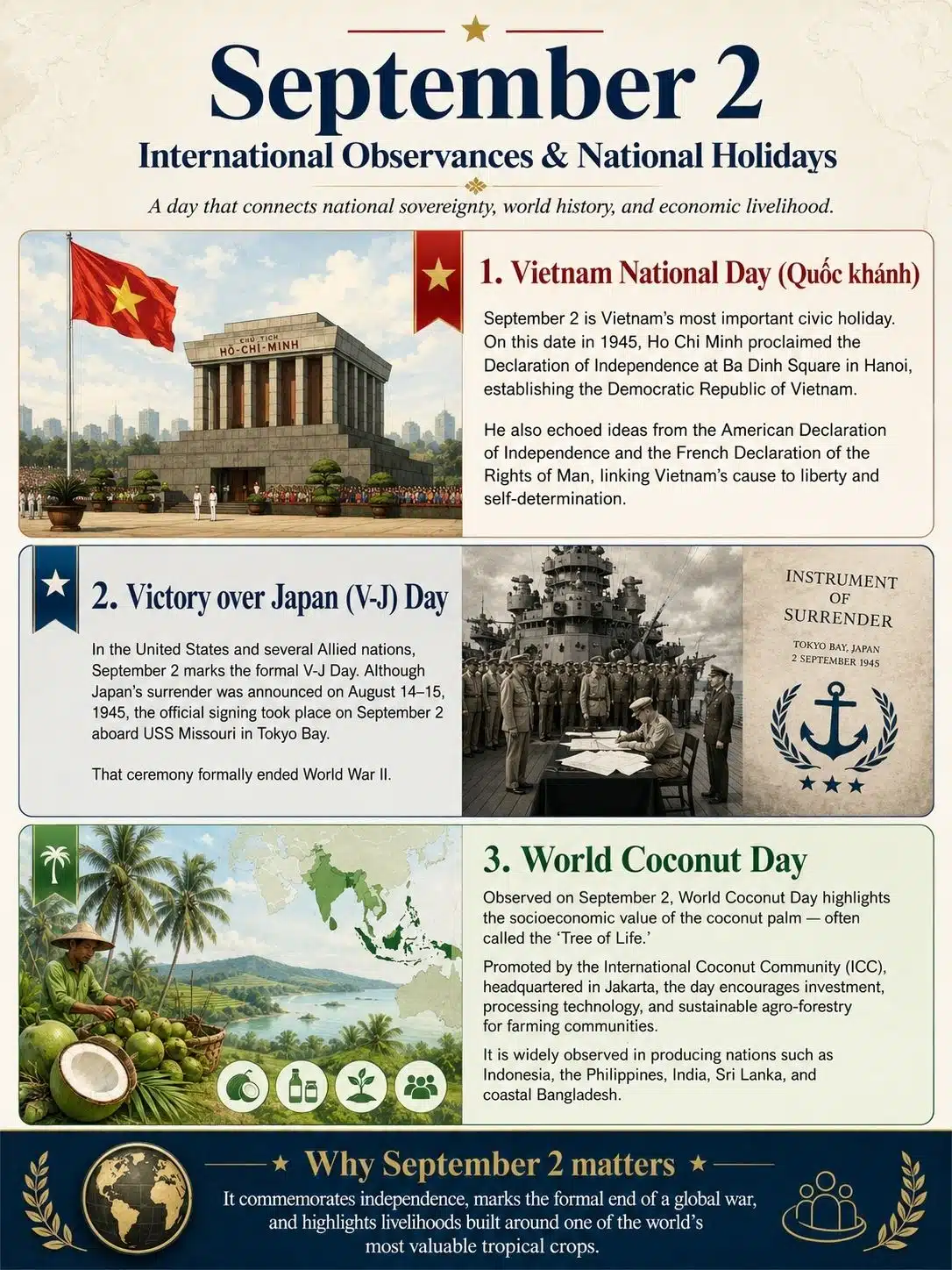
September 2 brings together international economic observances with foundational celebrations of national sovereignty.
Vietnam National Day (Quốc khánh)
September 2 is the most significant civic holiday in Vietnam. On this date in 1945, revolutionary leader Ho Chi Minh stood before hundreds of thousands of citizens at Ba Đình Square in Hanoi and proclaimed the Declaration of Independence, establishing the Democratic Republic of Vietnam.
Ho Chi Minh intentionally quoted the American Declaration of Independence and the French Declaration of the Rights of Man to appeal to international values of liberty and self-determination, initiating decades of anti-colonial struggle across Indochina.
Victory over Japan (V-J) Day
In the United States and several Allied nations, September 2 is observed as the formal V-J Day (Victory over Japan Day). While August 14/15 marked the initial announcement of Japan’s willingness to surrender, September 2 marks the day the signatures were inked, ending the global hostilities of World War II.
World Coconut Day
Initiated by the International Coconut Community (ICC) (headquartered in Jakarta), World Coconut Day highlights the socioeconomic value of the coconut palm—the “Tree of Life.” Observed throughout major producing nations such as Indonesia, the Philippines, India, Sri Lanka, and coastal Bangladesh, the day promotes investment, processing technology, and sustainable agro-forestry for smallholder farming communities.
Global History: The Turning Points
Ancient History: The Battle of Actium (31 BCE)
Off the western coast of Greece, the naval Battle of Actium unfolded between the fleet of Octavian (commanded by Marcus Vipsanius Agrippa) and the combined forces of Mark Antony and Queen Cleopatra VII of Egypt.
Agrippa’s maneuverable galleys outflanked Antony’s heavier vessels. When Cleopatra fled with her Egyptian squadron, Antony followed, abandoning his land and naval legions. The battle destroyed the final challenge to Octavian, ended the Ptolemaic Kingdom of Egypt, terminated the Roman Republic, and gave birth to the Roman Empire, with Octavian crowned as Emperor Augustus.
Europe & The United Kingdom
The Great Fire of London (1666)
In the early morning hours of September 2, 1666, a spark in Thomas Farriner’s bakery on Pudding Lane ignited the Great Fire of London. Driven by a dry summer and high easterly winds, the inferno consumed the timber-framed, pitch-covered structures of the walled medieval city over four days.
-
Impact: Over 13,200 houses, 87 parish churches, the Royal Exchange, and old St. Paul’s Cathedral were destroyed, leaving 70,000 of the city’s 80,000 residents homeless.
-
Legacy: The catastrophe prompted the world’s first municipal building codes, mandated stone and brick construction, laid the groundwork for modern urban fire departments, and allowed architect Sir Christopher Wren to redesign London’s skyline.
The 11-Day Time Leap (1752)
Under the British Calendar Act of 1751, Great Britain and its overseas colonies (including the 13 American colonies) officially discarded the Julian calendar in favor of the more astronomically accurate Gregorian calendar. To align the civic year with the seasons, September 2, 1752, was followed immediately by September 14, 1752. Eleven days vanished from civil records, sparking popular folklore about crowds demanding the return of their “stolen eleven days.”
The French Revolution: The September Massacres (1792)
Driven by paranoia over Prussian and Austrian invasions and rumors of royalist prison conspiracies, revolutionary mobs in Paris stormed city prisons from September 2 to September 7, 1792. Over 1,200 prisoners—including refractory Catholic priests, political detainees, and common criminals—were summarily executed, foreshadowing the Reign of Terror.
North America (United States & Canada)
-
Establishment of the U.S. Treasury (1789): President George Washington signed the act establishing the Department of the Treasury, appointing Alexander Hamilton as its first Secretary. Hamilton set out to consolidate revolutionary war debts, build the national bank, and establish the creditworthiness of the young republic.
-
“Speak Softly and Carry a Big Stick” (1901): Speaking at the Minnesota State Fair, Vice President Theodore Roosevelt used the proverb: “Speak softly and carry a big stick; you will go far.” Just twelve days later, following the assassination of President William McKinley, Roosevelt assumed the presidency and implemented this philosophy as the cornerstone of American foreign policy.
-
The Dawn of Automated Banking (1969): Chemical Bank installed America’s first automated teller machine (ATM) at its branch in Rockville Centre, Long Island, New York, transforming global retail banking.
-
Swissair Flight 111 Disaster (1998): En route from New York City to Geneva, a McDonnell Douglas MD-11 suffered a catastrophic in-flight electrical fire in its entertainment wiring, crashing into the Atlantic Ocean near Peggy’s Cove, Nova Scotia. All 229 passengers and crew perished. The Canadian Transportation Safety Board’s investigation led to major worldwide aviation safety reforms regarding flammable aircraft materials.
East Asia & The Pacific: The Formal End of World War II (1945)
At 9:04 AM on September 2, 1945, anchored in Tokyo Bay, the battleship USS Missouri hosted the formal signing of the Japanese Instrument of Surrender.
Japanese Foreign Minister Mamoru Shigemitsu and General Yoshijirō Umezu signed on behalf of the Emperor and the Imperial General Headquarters. Supreme Allied Commander General Douglas MacArthur, accompanied by representatives from the United States, China, the United Kingdom, the Soviet Union, Australia, Canada, France, the Netherlands, and New Zealand, countersigned. The ceremony formally closed six years of global warfare that claimed an estimated 70 to 85 million lives.
Africa & International Justice: The Akayesu Verdict (1998)
In Arusha, Tanzania, the International Criminal Tribunal for Rwanda (ICTR) delivered a historic verdict in the case of The Prosecutor v. Jean-Paul Akayesu. Akayesu, the former mayor of Taba commune, was convicted of genocide and crimes against humanity.
This marked the first time in history that the 1948 Genocide Convention was applied by an international court, and the first time international jurisprudence recognized systematic sexual violence and rape as acts of genocide.
Notable Births on September 2
Queen Liliʻuokalani (1838–1917)
Born Lydia Liliʻu Loloku Walania Wewehi Kamakaʻeha, Liliʻuokalani was the last sovereign monarch of the Kingdom of Hawaii. An accomplished author and composer (she penned the enduring anthem “Aloha ʻOe”), she ascended the throne in 1891. When she attempted to draft a new constitution restoring voting rights to native Hawaiians and disenfranchised Asian immigrants, she was overthrown in an 1893 coup led by American business interests. Her calm defiance and devotion to her people made her an enduring symbol of Hawaiian sovereignty.
Wilhelm Ostwald (1853–1932)
A Baltic German chemist, Wilhelm Ostwald won the 1909 Nobel Prize in Chemistry for his groundbreaking work on catalysis, chemical equilibria, and reaction rates. Alongside J.H. van ‘t Hoff and Svante Arrhenius, Ostwald is considered one of the founding fathers of modern physical chemistry. He also developed the Ostwald process, a chemical method for producing nitric acid that remains essential for industrial fertilizer manufacturing.
Keanu Reeves (1964–Present)
Born in Beirut, Lebanon, and raised in Toronto, Canada, Keanu Reeves became one of the most culturally recognizable and universally respected actors in modern cinema. Known for his versatility across indie cinema (My Own Private Idaho) and genre-defining blockbusters (Speed, The Matrix franchise, and John Wick), Reeves is equally celebrated for his philanthropy, humility, and quiet dedication to charitable causes.
Salma Hayek (1966–Present)
Born in Coatzacoalcos, Veracruz, Mexico, Salma Hayek broke through Hollywood barriers to become one of the industry’s most influential Latina powerhouses. Her passionate, self-funded production of the 2002 biographical film Frida earned her an Academy Award nomination for Best Actress, cementing her legacy as a trailblazing artist, producer, and outspoken advocate for women’s rights.
Notable Deaths on September 2
J.R.R. Tolkien (1892–1973)
John Ronald Reuel Tolkien, an English philologist, Oxford professor, and author, transformed world literature. His foundational masterworks—The Hobbit, The Lord of the Rings, and The Silmarillion—created modern fantasy worldbuilding, complete with complex constructed languages (Elvish, Dwarvish), detailed genealogies, and deep mythic themes of fellowship, sacrifice, and the corrupting nature of absolute power.
Ho Chi Minh (1890–1969)
The preeminent leader of Vietnam’s national liberation movement died of heart failure in Hanoi on September 2, 1969, at the age of 79. Because his death coincided with the anniversary of his 1945 Declaration of Independence, the North Vietnamese government initially announced his passing as having occurred on September 3 to avoid dampening National Day celebrations. His leadership guided the defeat of French colonial rule at Dien Bien Phu and set the foundation for the eventual reunification of Vietnam.
Dr. Christiaan Barnard (1922–2001)
The South African cardiac surgeon achieved global medical history on December 3, 1967, by performing the world’s first successful human-to-human heart transplant on patient Louis Washkansky at Groote Schuur Hospital in Cape Town. Barnard passed away on September 2, 2001, while on vacation in Paphos, Cyprus, following an acute asthma attack.
“Did You Know?” Historical Trivia
-
The World’s Smallest Micronation Founded on an Abandoned Fort: On September 2, 1967, Paddy Roy Bates, a British former army major and pirate radio broadcaster, boarded HM Fort Roughs—a disused World War II Maunsell naval sea fort located in international waters off the coast of Suffolk, England. He declared it the independent Principality of Sealand, creating the world’s best-known micronation.
-
The Double Identity of September 2 in Vietnam: Ho Chi Minh declared independence on September 2, 1945, and died on September 2, 1969. For twenty years, his official death date was listed as September 3 by the Politburo to preserve National Day celebrations, until the official record was formally corrected in 1989.
-
A Calendar Shift That Cut 11 Days: In 1752, people living in the British Empire went to sleep on the evening of Wednesday, September 2, and woke up on Thursday, September 14. Financial markets adjusted their tax years (giving birth to the modern UK April 6 tax year start), and historical dates had to be categorized as “Old Style” (O.S.) or “New Style” (N.S.).
Quote of the Day
“A leader is one who knows the way, goes the way, and shows the way… Speak softly and carry a big stick; you will go far.”
— Theodore Roosevelt, delivered in a speech at the Minnesota State Fair on September 2, 1901.
Final Thoughts
September 2 stands out across world history as a day of dramatic beginnings, momentous endings, and enduring legacies. On this day, the ashes of Pudding Lane catalyzed the birth of modern architecture and fire safety; the deck of the USS Missouri offered relief to a world exhausted by global war; and Ho Chi Minh’s address altered the course of Southeast Asian independence.
At the same time, the transition of the 1946 Indian Interim Government, the literary legacy of J.R.R. Tolkien, the medical bravery of Dr. Christiaan Barnard, and the cultural presence of modern icons like Keanu Reeves and Salma Hayek remind us how individuals shape the course of history. Looking back across the centuries, September 2 offers a profound mirror into human ambition, conflict, resilience, and the relentless drive to build a better tomorrow.















 English (US) ·
  French (CA) ·
  French (FR) ·