

 2 weeks ago
35
2 weeks ago
35
PROTECT YOURSELF with Orgo-Life® QUANTUM TECHNOLOGY
Orgo-Life the new way to the future Advertising by Adpathway- Former Nigerian power minister Saleh Mamman was arrested after receiving a 75-year prison sentence for laundering twenty-four million dollars.
- Nigeria’s justice system struggles with corruption cases, with over 60% of cases pending and many taking decades to conclude.
- Elected officials face fewer convictions than appointed ones, exploiting systemic loopholes and using political connections to delay their legal proceedings.
Saleh Mamman, a former Nigerian minister of power was arrested on Tuesday, days after he was sentenced in absentia to 75 years in prison for laundering 33.8 billion naira ($24.6 million), in what was widely described as a rare high-profile conviction.
Prosecutors said the funds were proceeds of unlawful activity linked to government-financed hydroelectric projects, including Nigeria’s Mambilla and Zungeru power plants.
Economic and Financial Crimes Commission (EFCC) chief Ola Olukoyede said that Mamman, who had been in hiding since his 7 May conviction, was arrested in the northern Nigerian city of Kaduna and was now in custody.
Mamman had served as minister of power between 2015 and 2021, at a time when then-President Muhammadu Buhari’s administration had vowed to fight corruption.
The judge also ordered him to pay back an outstanding sum of 22 billion naira to the state.
Do convictions signal real accountability?
Weeks earlier, former acting accountant-general Chukwunyere Nwabuoku was handed a 72-year prison sentence after being convicted of money laundering.
They joined a growing list of former public officials prosecuted over corruption allegations running into billions of naira.
Nigeria’s anti-graft agency, the EFCC, recently declared the former Humanitarian Affairs Minister wanted over alleged abuse of office and diversion of public funds.
But beyond this, there are broader questions about who actually gets convicted in Nigeria’s justice system.
Backlog of cases
Corruption cases against public officials in Nigeria often stall in the courts, sometimes taking years - or even decades - to conclude.
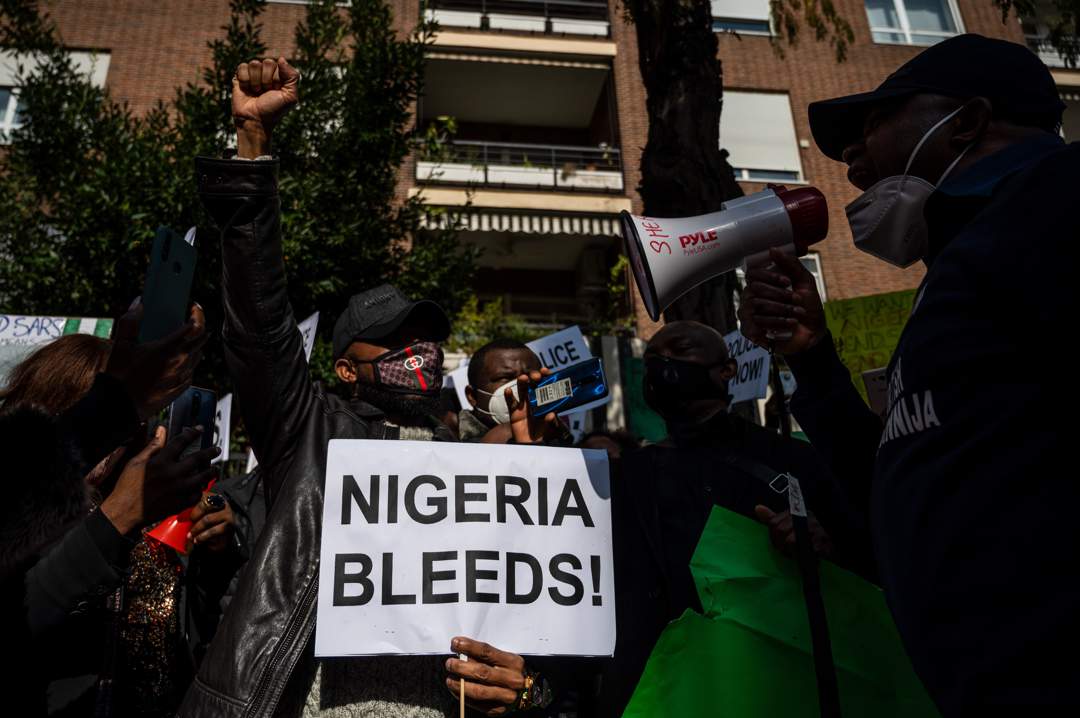
A man holds a placard raising his fist during a protest where Nigerian community in Madrid demonstrate demanding the end of SARS (Special Anti-Robbery Squad), the end of police brutality and the end of corruption in Nigeria.
Marcos del Mazo/LightRocket via Getty Images
According to a review of 393 corruption cases between 2013 and 2026 by Dataphyte, a research organisation, only 144 have reached final judgment, leaving more than 60% still pending at various stages of trial.
These cases, spanning 14 years, are linked to 3.61 trillion naira, $1.33 billion, and €26 170 in alleged corruption.
“Further analysis shows that most cases concluded so far involve appointed officials, suggesting that convictions are less common among those elected into office than those appointed,” Dataphyte said.
Reporting by Nigerian news portal TheCable underscores this disparity.
READ | Nigeria’s kidnappers exploit online public empathy to extract higher ransoms
While 33 former governors have been prosecuted, only six have been convicted.
Some convictions were later overturned on appeal or pardoned.
Analysts say recent convictions of senior public officials may signal a push toward greater accountability efforts.
However, David Alechenu, a team lead at the Nigeria Anti-Corruption Agencies Strengthening Project, cautioned that “isolated convictions alone are not enough to conclude that the anti-corruption fight has become fully effective”.
“The real test is whether these efforts are becoming systematic, preventive, or institutionalised,” he added.
Why corruption cases stall in Nigeria
Dataphyte’s analysis points to a wide disparity in prosecutions: “324 appointed officials have been charged, compared with just 35 former governors, and many high-profile cases have taken between six and 15 years to conclude,” it said.
Because of the structure of Nigeria’s justice system, cases involving elected officials are often more layered and rigorous than those against appointed officials - a gap often exploited to the advantage of the former, analysts have noted.
“Where there is clear evidence of a crime, the strategy is often to keep delaying until they can negotiate a settlement or until a favourable government comes into power and offers some form of relief,” said Amina Umaru Miango, a legal expert and project manager at the Centre for Journalism Innovation and Development (CJID).
“That is what we often see,” she told DW.
She added:
These individuals can afford top lawyers, are politically exposed, and have the connections needed to prolong the process.
Meanwhile, Alechenu argues that it’s more of a structural issue than a single institutional weakness.
He said elected officials control larger budgets and patronage networks, meaning cases often “involve multiple accounts, agencies and sometimes cross-border transactions and complex assets tracing that naturally extend investigations and prosecutorial timelines”.
Alechenu added that those involving appointed officials are usually more administratively contained.
The analysts said these loopholes allow for sustained political influence and undermine the overall anti-corruption efforts.
This, they say, also reduces public confidence in the justice system.
Ahmad Adedimeji Amobi, a writer based in the Nigerian city of Osogbo, said that corruption allegations involving high-profile government officials often generate attention on social media, but the outcomes of their cases are rarely publicised.
“In fact, those faces plastered on their EFCC platforms eventually go on to hold even higher political offices,” Amobi told DW.
The wider cost of corruption
Nigeria loses an estimated $18 billion annually to corruption and financial crimes, much of it linked to public procurement, according to The Guardian, while contract fraud accounts for roughly 90% of corruption cases in the sector, reported Nairametrics.
Analysts said that addressing endemic corruption in the country would require reforms that tackle both the bottlenecks in the justice system and the broader governance environment.
Alechenu, from the Nigeria Anti-Corruption Agencies Strengthening Project, recommends a specialised fast-track court for corruption cases with dedicated judges and “streamlined procedures”.
Such a system “would help reduce the delays common in general courts, including congestion and repeated adjournments”, he said, adding that there’s a need to enhance the investigative capacity and forensic tools needed for financial investigations.
















 English (US) ·
  French (CA) ·
  French (FR) ·