

 2 months ago
14
2 months ago
14
PROTECT YOURSELF with Orgo-Life® QUANTUM TECHNOLOGY
Orgo-Life the new way to the future Advertising by AdpathwayTrump considering plans to occupy or blockade Iran's Kharg Island - report
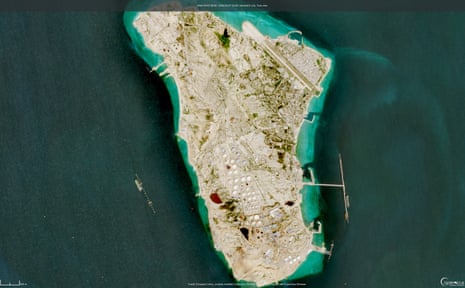
According to a report in Axios, the Trump administration is considering occupying or blockading Iran’s Kharg Island to pressure Iran into reopening the strait of Hormuz. The report, which we have not yet been able to independently verify, cited four sources who all spoke under the condition of anonymity.
“He wants Hormuz open. If he has to take Kharg Island to make it happen, that’s going to happen. If he decides to have a coastal invasion, that’s going to happen. But that decision hasn’t been made,” a senior administration official told Axios.
“We’ve always had boots on the ground in conflicts under every president, including Trump. I know this is a fixation in the media, and I get the politics, but the president is going to do what’s right,” a second senior official said. No decision has been made yet, the official said.
Kharg, a five-mile-long coral island in the Persian Gulf about 16 miles from the mainland, is a key processing hub for Iran, through which 90% of the country’s oil exports typically flow. The island had been largely left untouched by the US-Israeli attacks during the first two weeks of the war.
But the US president, Donald Trump, claimed on Saturday that US strikes had “totally demolished” most of Kharg Island, telling NBC News that its military may hit site “a few more times just for fun”.
Key events Show key events only Please turn on JavaScript to use this feature
Hundreds of Muslims gathered outside the walls of the Old City in occupied East Jerusalem for Eid al-Fitr prayers on Friday after al-Aqsa mosque was closed by Israeli authorities:
Iran tells UK that providing military bases for the US is considered 'participation in aggression'
Iran’s foreign minister, Abbas Araghchi, warned his British counterpart, Yvette Cooper, that the UK allowing the US to use British military bases would be treated as “participation in aggression” as he insisted on his country’s right to self-defence.
“These actions will definitely be considered as participation in aggression and will be recorded in the history of relations between the two countries. At the same time, we reserve our inherent right to defend the country’s sovereignty and independence,” Araghchi said, according to a statement posted on his official Telegram channel.
The Iranian foreign minister said the US and Israel started the war while diplomatic negotiations were under way and condemned the “biased” response from Britain and other European countries towards what he described as “blatant aggression” in breach of international law.
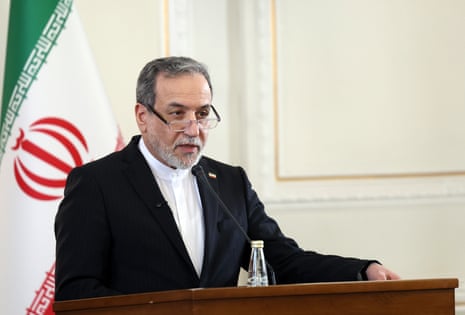
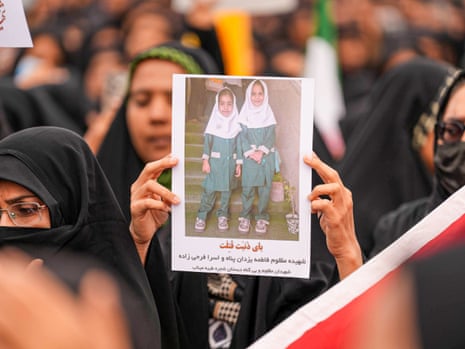
He also pointed to the 28 February bombing of an Iranian girls’ school in Minab, in southern Iran, in which more than 165 people, mostly children, were killed, describing the attack as “cowardly”.
The US president, Donald Trump, has suggested Iran was to blame for the deadly strike, without offering evidence. But as my colleague Hugo Lowell reports in this story, an ongoing Pentagon investigation into the strike has found that the missile in question was a Tomahawk fired by the US military. We are yet to hear from the UK government about the phone call with Araghchi but will bring you a summary if we do.
Both sides in US-Israeli war on Iran may have committed war crimes, UN chief suggests
In an interview with Politico, the UN secretary general, António Guterres, said there were “reasonable grounds” to believe both sides in the US-Israeli war on Iran may have committed war crimes.
Guterres said: “If there are attacks either on Iran or from Iran on energy infrastructure, I think that there are reasonable grounds to think that they might constitute a war crime.”
Earlier this week Israel’s attack on Iran’s massive South Pars gasfield – which it shares with Qatar – triggered Iranian retaliatory strikes on Qatar’s Ras Laffan gas complex, in a major escalation of the conflict.
“I don’t see any difference. It doesn’t matter who targets civilians. It is totally unacceptable,” he added.
On Thursday, the Lebanese health ministry said that 1,001 people, including 118 children, had been killed by Israeli attacks on Lebanon since 2 March. The Israeli assault began after the Lebanese militant group Hezbollah launched rockets into northern Israel in response to the killing of the former Iranian supreme leader, Ali Khamenei, in joint US-Israeli airstrikes.
Iran’s ambassador to the UN told the UN security council last week that US-Israeli strikes on Iran have killed more than 1,348 civilians. Thirteen US servicemen have died in the war and 16 civilians have reportedly been killed in Israel and the occupied West Bank.
Iran has launched thousands of drones and missiles against Gulf countries, claiming they are targeting American assets but have also killed civilians. As of 16 March, the attacks resulted in at least 11 civilian deaths, according to Human Rights Watch. Speaking to Politico Europe’s EU Confidential podcast, Guterres added:
I am convinced that Israel, as a strategy, wants to achieve a total destruction of the military capacity of Iran and regime change. And I believe Iran has a strategy, which is to resist for as much time as possible and to cause as much harm as possible. So the key to solve the problem is that the US decides to claim that they have done their job.
IRGC spokesperson killed in US-Israeli airstrikes, Iranian media reports
A spokesperson for the Islamic Revolutionary Guards Corp (IRGC), Ali Mohammad Naeini, has been killed in US-Israeli airstrikes, Iranian media has been reporting, including the Tasnim news agency.
Before his death, Naeini issued a statement insisting Tehran was still able to build missiles despite the attacks coming from Israel and the US. We have not yet been able to independently verify this information.
Targeted Israeli/US-Israeli attacks have already killed the former supreme leader Ali Khamenei, the security chief Ali Larijani, head of the paramilitary Basij force, Gholamreza Soleimani, and the intelligence minister, Esmail Khatib, among others.
China’s foreign ministry spokesperson, Lin Jian, has urged all sides involved in the US-Israeli war on Iran to ensure a stable and unimpeded oil supply. He did not name any countries in his comments to the media.
The comments come after the US indicated it may soon remove sanctions on Iranian oil in order to make more oil available to global buyers and reduce oil prices, which have surged since the start of the war as Iran has closed the strait of Hormuz to shipping and attacked tankers.
The move could free up 140m barrels of Iranian oil for global use, the US treasury secretary Scott Bessent claimed. “In essence, we will be using the Iranian barrels against the Iranians to keep the price down for the next 10 or 14 days, as we continue this campaign,” he said on Fox Business.
The treasury recently took a similar step to temporarily allow the sale of sanctioned Russian oil stranded on tankers, which Bessent said added around 130m barrels to global supplies.
If proceeded with, the move would be a significant reversal of longstanding American policy towards Iran. Experts say it could have a limited effect on prices and could actually help Iran fund its war effort against the US.
Sri Lanka, which has strong economic and diplomatic ties with both Iran and the US, refused to allow the US to station two of its warplanes at an airport in the island’s south in early March, the country’s president, Anura Kumara Dissanayake, told parliament earlier today.
“They wanted to bring two warplanes armed with eight anti-ship missiles from a base in Djibouti to the Mattala International Airport from March 4 to 8 and we said ’no’,” Dissanayake was quoted by the AFP news agency as having said.
Sri Lanka, an island nation in the Indian Ocean more than 2,000 miles from the Persian Gulf, has had a policy of non-alignment since it became independent in 1948.
But the country found itself in the diplomatic crossfire of the US-Israeli war on Iran after an American submarine strike sank an Iranian warship off the south coast of Sri Lanka in early March, killing at least 87 Iranian sailors.
Interim summary
Hello and welcome to our live coverage of events in the Middle East.
If you are just joining us, here is a quick recap of the latest developments:
-
Israel pounded Tehran with airstrikes on Friday as Iranians marked Nowruz, or the Persian New Year. Activists reported hearing strikes around Iran’s capital. The attacks occurred a day after Israel pledged to refrain from more strikes on a key Iranian gas field and Iran intensified attacks on oil and natural gas facilities around the Gulf.
-
Benjamin Netanyahu denied that Donald Trump was “dragged” into the war by Israel, as he tried to pour cold water on suggestions that Israel influenced the US’s decision to attack Iran and amid growing signs that the US and Israel are not aligned on their war aims. “Does anyone really think that someone can tell President Trump what to do,” the Israeli prime minister said, adding: “I misled no one.”
-
Netanyahu also stated that Israel “acted alone” in striking Iran’s South Pars gasfield, though he didn’t address whether or not he had told Trump about the attack beforehand. “President Trump asked us to hold off on future attacks, and we’re holding out,” he added. Trump has distanced himself from Israel’s attack on the world’s largest gasfield (which he claimed on Wednesday that Washington “knew nothing” about), and confirmed today that he told Netanyahu to stop attacking Iran’s energy facilities.
-
Netanyahu also claimed that Iran has “no ability to enrich uranium at the moment and no capability of manufacturing ballistic missiles”. He said that the war would take “as long as is necessary”, adding: “We will crush them entirely, all those capabilities.”
-
The spokesman for Iran’s paramilitary Revolutionary Guard insisted Friday that Tehran was still building missiles, seeking to counter a claim by Israeli Prime Minister Benjamin Netanyahu that it no longer could.
-
Kuwait’s state oil firm KPC said its Mina Al-Ahmadi refinery was hit by multiple drone attacks early on Friday, causing a fire in some units, with no initial casualties reported, the state news agency said.
-
Iranian attacks on Ras Laffan Industrial City in Qatar have reduced the country’s liquefied natural gas (LNG) export capacity by 17%, according to QatarEnergy, the state-run energy giant. The “extensive damage” could reduce its annual revenues by $20bn and take “up to five years” to repair, Saad al-Kaabi, the Qatari energy minister and CEO of QatarEnergy, said in a statement.
-
US Central Command said that it has destroyed the Iranian regime’s surface-to-surface missile plant in Karaj. The plant was used to “assemble ballistic missiles that threatened Americans, neighboring countries, and commercial shipping,” Centcom said.
-
France will double its humanitarian aid to Lebanon to the value of €17m ($19.7m), foreign minister Jean-Noel Barrot said, as Lebanon grapples with Israel’s latest military assault. Israeli strikes on Beirut and its ground invasion of southern Lebanon have killed over 1,000 people, including 118 children, and wounded more than 2,500 since Tel Aviv’s renewed offensive on 2 March. More than one million – roughly one in five – of the population have been displaced.
-
An Iranian missile attack hit Israel’s oil refineries in the northern port city of Haifa but did not cause “significant damage“, Israel’s energy ministry said. Energy minister Eli Cohen said power was briefly disrupted, with electricity restored to most of those who were affected, Reuters reported.
-
Petrol prices have surged in some regions, including in Vietnam where the cost of fuel was up 20% on Friday amid fears of oil and gas shortages caused by the war.
Iran’s Revolutionary Guard says Tehran still building missiles
The spokesman for Iran’s paramilitary Revolutionary Guard insisted Friday that Tehran was still building missiles, seeking to counter a claim by Israeli prime minister Benjamin Netanyahu that it no longer could.
Gen. Ali Mohammad Naeini made the comments in a report quoted by Iran’s state-run IRAN newspaper.
Referencing how Iranian schools consider a 20 as a perfect score, the general said:
Our missile industry score is 20 and there is no concern in this regard because we are producing missiles even during war conditions, which is amazing, and there is no particular problem in stockpiling.”
He also said the war would go on.
“These people expect the war to continue until the enemy is completely exhausted,” the general said of the Iranian public. “This war must end when the shadow of war is lifted from the country.”
The leaders of some Pacific countries have appealed for help with oil supplies while others urge against “panic buying” as the import-reliant nations grapple with fears over possible fuel shortages and escalating costs caused by war in the Middle East.
Oil prices have surged to nearly $110 a barrel after strikes against energy infrastructure in Iran and the Gulf states.
Read more about the impacts here:
Asian shares were mixed on Friday following Wall Street losses, and oil prices pared earlier gains on the intensifying Iran war, falling back to about $107 a barrel. US futures were higher.
Oil prices had a rollercoaster day on Thursday with the Brent crude, the international standard, briefly surging to about $119 per barrel as attacks by Iran on oil and gas facilities around the Gulf escalated after Israel’s attack of Iran’s key natural gas field.
In early Friday trading, Brent crude fell 1.6% to $106.90 a barrel, following Israeli prime minister Benjamin Netanyahu’s remarks that he would hold off on further attacks on Iran’s gas field at the request of US President Donald Trump. Benchmark US crude was down 2% to $93.63 a barrel.
The cost of petrol was up by more than 20% in Vietnam on Friday after the government announced an overnight hike amid fears of oil and gas shortages caused by the Middle East war.
South-east Asian countries have borne the brunt of surging diesel prices after strikes against energy infrastructure in Iran and the Gulf states.
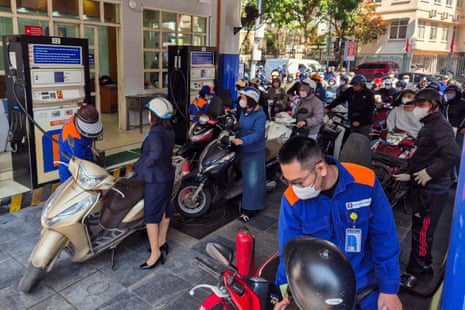
Just before midnight Thursday, the Vietnamese government announced an increase in the price of 95-octane gasoline by 20% from the weekend to 30,690 Vietnamese dong ($1.20) per litre, while diesel was up by nearly 34% to 33,420 dong.
More than 3,000 people are believed to have been killed across Iran so far, and the Pentagon says more than 15,000 targets in the country have been hit in the first two weeks. A girls’ school in the south-eastern Iranian city of Minab lies in rubble, with about 175 children and teachers killed in a strike that the US is believed to have carried out. The strait of Hormuz, the narrow sea passage turned chokepoint for the Gulf’s oil and the world, is, in effect, closed.
And the bill, according to analysts at the Center for Strategic and International Studies, is growing by roughly half a billion dollars every day.
Read this clever interactive piece on the cost of Operation Epic Fury.














 English (US) ·
  French (CA) ·
  French (FR) ·