

.png) 3 hours ago
10
PROTECT YOURSELF with Orgo-Life® QUANTUM TECHNOLOGY
Orgo-Life the new way to the future Advertising by Adpathway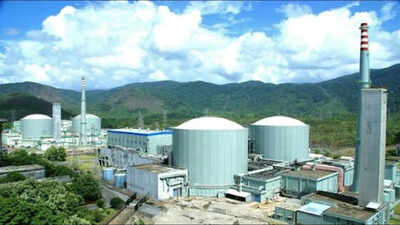
A unit attaining criticality means it has reached a self-sustaining, controlled nuclear fission chain reaction inside its reactor core
NEW DELHI: In a big milestone for the country’s nuclear sector, Kaiga Generating Station Unit-1 (KGS-1) in Karnataka successfully attained criticality early Sunday for the second time, giving a new lease of life to the nuclear power unit that had been taken offline for life-extension work after 25 years of operation.
The disclosure was made on Sunday by Nuclear Power Corporation of India Limited (NPCIL), the PSU that designs, builds, commissions and operates nuclear power plants across India.A unit attaining criticality means it has reached a self-sustaining, controlled nuclear fission chain reaction inside its reactor core.KGS-1 had reached first criticality on Sept 26, 2000, and had supplied 37,670 million units before it was shut down for refurbishment activities in April last year.
The same unit had set a world record for 962 days of continuous operation on Dec 31, 2018, operating at a 99.3% plant load factor, surpassing the previous global record of 940 days held by Heysham II (Unit 8/Reactor 2) in the UK.“The accomplishing this in just 600 days following its shutdown for major refurbishment activities of EMCCR (en-masse coolant channel replacement) and EMFR (en-masse feeder replacement) on April 1, 2025, KGS-1 has set a new fleet-wide benchmark as the first NPCIL reactor to reach criticality in such a short span,” NPCIL said on X on Sunday.
It said, “This remarkable success stands as a reflection of extraordinary dedication, technical excellence, and unified teamwork.
”Kaiga generating station has four operational nuclear units totalling 880 MW and two additional units (5 and 6) under construction, adding 1,400 MW and bringing the total planned capacity to 2,280 MW across six units.
Kaiga Units-5 & 6 are state-of-the-art, indigenous 700 MW pressurized heavy-water reactors (PHWRs), which incorporate advanced safety features and are among the safest in the world.
Three such PHWRs — KAPS-3&4 and RAPP-7 — are successfully operating in the states of Gujarat and Rajasthan respectively. The components and equipment for the project are supplied by domestic industry partners and works are being executed by Indian contractors, aligning with the Atmanirbhar initiatives of the Modi govt.Just days before, in another development, Atomic Energy Regulatory Board (AERB) granted permission for the first approach to criticality of Rajasthan atomic power project unit-8 (RAPP-8) at Rawatbhata, following satisfactory completion of safety reviews.
















 English (US) ·
 French (CA) ·
 French (FR) ·