

PROTECT YOURSELF with Orgo-Life® QUANTUM TECHNOLOGY
Orgo-Life the new way to the future Advertising by AdpathwayWashington currently estimates that Americans spend 12 billion hours a year filling out government forms, meaning the average person spends six 8-hour workdays filing their taxes, signing up for Medicaid, renewing their driver’s licenses, and applying for government loans. At prevailing wages, this uncompensated labor is worth $430 billion a year. If Washington were to create a Department of Bureaucracy to take on the paperwork it shunts to citizens, the agency would require 5.9 million employees, making it four times the size of the active-duty military. The DOB’s payroll would be larger than that of every other federal department combined.
Article continues after advertisement
The nation’s paperwork regime frustrates every resident, and particularly lower-income residents who use more government programs and interact more frequently with public officials. The political scientist Elizabeth Cohen has done seminal work exploring time as a potent, if obscure, form of political currency. “The devaluation of a person or group’s political time is a structural obstacle to equality,” she writes. Yet we can’t measure time and effort as easily as we measure dollars, and we don’t even try. The 12-billion-hour estimate is an undercount, and an egregious one.
Pamela Herd and Donald Moynihan, two of the foremost scholars of American public administration, have identified three key types of administrative costs the government imposes on citizens. First are learning or research costs. People need to figure out what is out there, from emergency shelters to passport agencies. They need to determine what they qualify for and how to apply. The United States has no measure of—and little appreciation for—the research costs it imposes. The government doesn’t do a lot of outreach. It doesn’t centralize information, create cross-enrollment pathways, or distribute benefits automatically. Politicians focus intently on whether something exists, not whether it is accessible.
We can’t measure time and effort as easily as we measure dollars, and we don’t even try.
Policy changes create research costs too. Consider how American families have negotiated the end of Roe v. Wade. In a shock decision in 2022, the Supreme Court revoked the Constitutional right to an abortion and allowed states to ban the procedure. Old local statutes enjoined by Roe went into sudden effect. (Wisconsin began observing a criminal abortion law passed in 1849.) Red-state legislatures rushed to pass stringent prohibitions.
The country’s jurists and lawmakers did not just make abortion illegal. They brewed up a climate of intense uncertainty, increasing learning costs exponentially. Women needed to figure out whether they lived in a state with a total ban, a ban after a certain number of weeks of pregnancy, or a “heartbeat” ban. Hospitals needed to figure out if their workers could provide an abortion to a minor or to a victim of rape or incest. Physicians needed to decide what to do if a pregnant woman came to the ER suffering from organ failure, or carrying a fetus with a fatal abnormality.
“What actually counts as the life of the mother?” Jennifer Jury McIntosh, an obstetrician and spokesperson for the Society for Maternal-Fetal Medicine, asked me. “Is that her life today? Is that her life during this pregnancy? How close to losing her life does she have to be for us to decide to terminate? That feels really weighty, because my interpretation of what I feel is lifesaving—does that align with a particular prosecutor’s interpretation?” She feared situations in which not ending a patient’s pregnancy might constitute medical malpractice, but doing so might open a provider up to criminal prosecution. Her fears were fast borne out. In 2023, an Oklahoma woman with a cancerous molar pregnancy was asked to wait, decompensating, in a hospital parking lot until doctors decided that she was sick enough to receive a termination.
Next there are compliance costs, “the time and effort spent on the often tedious task of filling out forms, documenting status, or responding to bureaucratic directives,” as Moynihan and Herd put it. These are the most obvious and easiest to understand time taxes. And Uncle Sam keeps but a chimeric tally of them.
The Paperwork Reduction Act of 1980 obligates Washington to measure and reduce regulatory burdens. Rules applying to businesses have to provide a net social good, as proven through rigorous cost-benefit analysis. Uncle Sam weighs the value of clean air against the value of gas to commuters. He scores the hassle of Department of Labor safety-equipment mandates against the hassle of lost limbs. But for regulations to even get a cost-benefit test, they need to have an annual cost estimated at $200 million or more, or “adversely affect in a material way” jobs, productivity, competition, public health, or the government itself. The Office of Information and Regulatory Affairs, or OIRA, doesn’t require that agencies perform cost-benefit analyses of regulations imposed on individuals. Making a company spend $300 million on fire-retardant materials counts. Making someone miserable with a forty-one-page application does not.
OIRA does produce an estimate of how long it takes the average person to finish a given government form: eight hours for the IRS’s Form 1040, for instance. These estimates are often unreliable. “OIRA sometimes does field studies, where they observe actual live humans collecting information, keeping records, that type of thing,” a longtime OIRA staffer told me. “But sometimes, the numbers just fall out of the sky and you have no idea where they came from.”
Plus, OIRA only counts the time people spend doing federal paperwork, not forms put out by states or municipalities. Imagine being a mother in Louisiana struggling to pay your bills. You decide to apply for SNAP, better known as food stamps. You receive an 8,350-word application. Page one instructs you to distinguish between SNAP and two other programs, the Family Independence Temporary Assistance Program and the Kinship Care Subsidy Program; a schematic lets you know what to fill out, depending on what you think you qualify for and what you want to try to enroll in. Page three instructs you to collect paperwork or data in up to thirteen different categories: pharmacy printouts from the past three months, four pay stubs, baptismal certificates, proof of who lives in your home. Page six includes details on drug court and “alternatives to abortion”; page seven outlines the penalties if you spend your benefits on a cruise ship or at a psychic. Page fifteen asks you to recount your income from twenty-four different sources; page sixteen asks about fourteen different housing expenses; page nineteen asks about ten types of assets members of your family might own.
The government does not account for compliance burdens that do not involve forms. Yet these burdens can be extreme. To qualify for disability insurance, a person needs to go to a doctor, explain their health condition, get a diagnosis, have the physician fill out a form, fill out some forms themselves, take the documents to a Social Security office, and apply. Many also need to litigate their disability with a special judge. This time does not count, in a literal sense. Nobody is counting it.
We do have some ways to measure the compliance burdens, however. Some programs keep a count of “procedural denials”: the number and share of applicants refused a benefit because they did not or could not get the paperwork done right. In Louisiana, one in four SNAP recipients “churns” on and off the program every year due to bureaucratic troubles. The state closes 15 percent of welfare cases annually for procedural reasons. In 2018, it disenrolled 15,689 children—children!—from its public health insurance program due to “failure to comply.”
The work of the political scientist Carolyn Barnes explores a third type of cost: redemption costs, or the time and effort it takes to use a benefit or exercise a right. Medicare imposes very light costs. Seniors go to a provider, hand their insurance card over at the front desk, and get the care they need. Other initiatives are impossibly fussy. Women fleeing domestic violence cannot find a landlord who will accept their emergency housing voucher. Hurricane survivors cannot find hotels participating in the Transitional Shelter Assistance program. Parents on WIC, a nutrition program for women, infants, and children, have to sort out which cartons of eggs and types of grapes they can buy at the grocery store. “If you pick a different grocery store, you can’t find the brand, you get the wrong brand, you get the wrong size, you’ve got to be doing math,” one mother told Barnes.
Finally, there are psychological costs. Difficult interactions with the government intensify the sickness of sickness and the trauma of trauma. They make a person feel worse about themselves and this country. They change a person’s politics and alter their sense of civic responsibility. The government does not track the emotional burden of waiting for your spouse to join you in this country, struggling to get help as a teenage parent, pleading for medical care for a dying family member from an insurer, or waiting in a polling line in a state that used to consider your ancestors property. Thus, it is hard to believe that Uncle Sam really cares. As the political philosopher Martha Nussbaum has written, “What cannot be numbered remains vague and unbounded, evading human grasp.” As McKinsey consultants like to put it, you cannot manage what you cannot measure.
*
While Washington bungles its way through the task of public administration, Silicon Valley has devoted hundreds of billions of dollars to making transactions effortless. With a few swipes of my thumb, I can call up any media imaginable in seconds, summon a black car to my doorstep in minutes, have a meal prepared and dropped off within an hour, and buy a closet’s worth of clothes for overnight delivery. In contrast, I have spent hours nursing a migraine while figuring out my taxes. And I have spent countless days as a reporter watching people struggle to navigate Medicaid, the construction-permit system, veteran’s benefits, the farm-loan program, and SNAP.
The situation is not as simple as “business good, government bad” or “business elegant, government clunky.” Companies use fine print to their own ends. They create a frictionless experience for people looking to spend, and a frictional experience for people looking to quit spending. They make purchases easy and instantaneous, and cancellations difficult and slow. They underscore that administrative burdens are a flexible, powerful tool.
Not long ago I tried to get out of a gym membership. The manager asked me to send in a doctor’s note, or rental or mortgage paperwork demonstrating that I had moved. (I objected; she relented.) I noticed that I had signed up for several “free trials” I had forgotten to cancel, meaning that I was spending $40 a month on apps I did not want. Months earlier, my family had stayed in an Airbnb-type rental without a locking front door. I had to dig up the city’s tenancy code and research acceptable-housing rules to get the owner to give us our money back.
In each case, I was purchasing a service, not a tangible good. I was entering into a contract, instead of taking ownership of an object. Thus, I was encountering a central conduit for the bureaucratization of modern life and an incubator for modern time taxes. We have become a nation of subscribers and sublessees and members, with simple transactions becoming extended, legalized affairs. As of 2018, the country had 826,537,000 consumer-arbitration agreements in force—a significant undercount, the academics who performed the study noted. Another paper found that 99 percent of consumers did not read the contracts they signed, thus handing over “their constitutional rights lock, stock, and barrel,” as Shennan Kavanagh of the National Consumer Law Center put it.
We have become a nation of debtors and policyholders, working with intermediaries and guarantors as well as with sellers and the thousands of firms providing homeowner’s insurance, auto insurance, health insurance, title insurance, mortgages, credit scores, and loans. Signature boxes and document portals have become costs of and barriers to transport, shelter, and medical care.
We have become a nation of credentials. The share of jobs requiring a postsecondary education has climbed to 68 percent, up from one quarter half a century ago. The share of jobs demanding an occupational license has climbed to 22 percent, up from 5 percent in the 1950s. In many cases, such certificates are unnecessary. Washington, DC, recently passed a rule requiring that day care teachers obtain a two-year associate’s degree, though there’s no evidence that day care teachers need a two-year associate’s degree to do their jobs successfully. “Even though I have a lot of experiential learning, I don’t meet what is now the current standard,” one veteran teacher explained.
We have become a nation of middle managers, with companies and nonprofits adding millions of employees to monitor compliance, track performance, design training modules, and administer benefits. Between 1987 and 2012, colleges and universities added eighty-seven professional staffers every working day, pushing up the ratio of administrators to academics and down the ratio of students to staff members. The trend is the same across nonprofits, for-profits, and public offices. One in six workers exists to push paperwork around for other workers. This kudzu costs the country $3 trillion a year, the business consultants Gary Hamel and Michele Zanini have estimated.
Administrative procedures might be a necessary tool of sound government. But administrative burdens are a technology of annoyance, degradation, discrimination, and needless extraction.
We might live in a world of frictionless consumption. Yet we also live in a world of “total bureaucratization,” a term coined by the anthropologist David Graeber. We deal with more forms and longer forms, more subscriptions and rebates and reimbursements and applications and enrollment periods. We are tasked with bureaucratic work by institutions public and private. Indeed, our public institutions encourage the promulgation of private paperwork. The government “provides the legal framework,” Graeber argues, as well as “all of the elaborate mechanisms of enforcement.” Uncle Sam allows insurers to deny necessary procedures to their beneficiaries. He allows companies to foist forced-arbitration agreements and extortionate contract terms on unsuspecting consumers. The government shuffles citizens into private contracts too. Instead of offering a sufficient number of public housing units, it offers an unlimited number of guaranteed mortgages. Instead of opening community colleges, it expands its student loan portfolio.
Citizens are fed up. Just 36 percent of Americans describe the government’s processes as “intuitive.” Only 41 percent agree that they are “clear” and “understandable.” More than half find it frustrating to access or use public services. A large majority believe that the government is incompetent, given the amount of work they do on its behalf. A majority of voters in both parties want Uncle Sam to deliver them from life’s daily, unnecessary annoyances.
*
The German sociologist Max Weber described the ideal bureaucracy as hierarchical, disciplined, rules-driven, professional, impersonal, and meritocratic. It should protect citizens from partisan vengeance. It should apply general rules to specific cases, ensuring that policy outcomes are predictable and just.
The country’s public servants are disciplined, rules-driven, and professional. Yet the outcomes they generate can be wildly unpredictable and at times extremely unfair. Low-income mothers in Vermont are eighteen times more likely to receive welfare than low-income mothers in Mississippi. Austin approves nearly thirty times as many building permits as Providence, adjusting for population size. And, of course, many successful applicants for welfare benefits or building permits spend hours and hours struggling with red tape.
Administrative procedures might be a necessary tool of sound government. But administrative burdens are a technology of annoyance, degradation, discrimination, and needless extraction. They are a subtle way that the government achieves certain policy outcomes, including shrinking the size of the safety net, discouraging outgroups from voting, preventing construction, and motivating the sick and the poor to work.
In the past decade, Washington has started to wake up to this ongoing catastrophe. Academic interest in the time tax has exploded, with Moynihan, Herd, Barnes, and other professors examining its cancerous effect on American life. Public servants have become cognizant of the disaster they have wrought too. The Obama official Cass Sunstein begins his book Sludge by confessing that he failed as the head of OIRA. He focused on “large and dramatic issues,” such as healthcare reform, rather than the granular and overlooked issue of enrollment processes and fine print. Thus, he let himself and the country down.
When Donald Trump returned to the White House, he sounded like he wanted to succeed where Sunstein had failed. He vowed to modernize the government, implement agile information-technology systems, axe unnecessary employees, and save taxpayers billions of dollars a year. To do this, he created DOGE, an acronym for the Department of Government Efficiency and a reference to an internet meme about a shiba inu. He tasked the tech titan Elon Musk with leading the effort. He called it the Manhattan Project of our time.
Yet DOGE was not Los Alamos. It wasn’t a best-of-the-best professional effort, for one. The agency was a pseudo-governmental commission with no legal authority, staffed by grossly unqualified appointees, including a teenage programmer known as Big Balls. It was not a novel effort either. In 1912, William Howard Taft performed a root-to-stem evaluation of public agencies to ensure “business of the Government” is conducted in “the most efficient and economical manner.” In 1993, Bill Clinton signed the Government Performance and Results Act, ordering federal agencies to create strategic plans and weigh their success against predetermined targets. A number of long-standing bodies gauge how the civil service is functioning and how programs are spending taxpayer dollars. The Government Accountability Office provides voluminous reports on inefficiency and waste; inspectors general search for graft and incompetence; congressional committees call in agency heads and interrogate them, ensuring that they are meeting their missions.
DOGE might have been redundant and unnecessary. Nevertheless, it had an explosive impact. Trump eliminated the United States Digital Service, a little-known and highly respected agency with a track record of making government websites work. Musk’s officials infiltrated department after department, canceling contracts, firing employees, viewing sensitive data, and kneecapping programs related to diversity, equity, and inclusion, as well as foreign aid. The agency made the government less efficient. DOGE fired the IT staffers keeping important programs up and running. It forced federal workers to send standard contracts and long-approved projects to political appointees for review. It made civil servants justify “even the most basic purchases”: fastening bolts for National Aeronautics and Space Administration, lab supplies for the Food and Drug Adminstration. Contrary to its stated mission, DOGE swelled the deficit, hampering tax collection and ginning up millions in legal fees.
Worst of all, perhaps, DOGE failed to reduce the time tax, or even to address it. Musk and Trump scarcely mentioned the citizen’s customer-service experience as they blathered about draining the swamp. DOGE could have cut the amount of time it takes to fill out the FAFSA, which students use to access college loans. It could have standardized the application processes for Medicaid, SNAP, and housing aid. It could have gotten rid of ancient interfaces and slashed absurd waiting times. It did not.
_______________________________
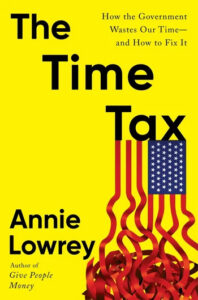
From The Time Tax: How the Government Wastes Our Time—and How to Fix It by Annie Lowrey. Copyright © 2026. Available from Ecco, an imprint of HarperCollins Publishers.















 English (US) ·
  French (CA) ·
  French (FR) ·