

PROTECT YOURSELF with Orgo-Life® QUANTUM TECHNOLOGY
Orgo-Life the new way to the future Advertising by AdpathwayThe carton of vegetable broth has sat in the pantry for months without a problem. Then you open it for tonight’s soup, use a cup, and stare at the rest. Does it go in the refrigerator? What about the jar of stock you simmered from carrot ends last weekend? The answer depends on which kind of broth you have and whether it has been opened. Here is what USDA, extension and brand guidance says, and how to read your label.
Does vegetable broth need to be refrigerated?
The Short Answer: Opened vegetable broth needs to be refrigerated, and so does homemade broth. Unopened shelf-stable broth, the kind sold on the ordinary pantry shelf, doesn’t need refrigeration until it is opened. Broth labeled Keep Refrigerated or Keep Frozen needs cold storage even before opening. After opening, refrigerate it promptly and follow the time on your label. With no label time, 3 to 4 days is a conservative default based on USDA’s general guidance, which has no separate time for opened broth cartons. Refrigerate homemade broth within 2 hours, or 1 hour when the air is above 90°F. Extension recipes give it 3 to 4 days.
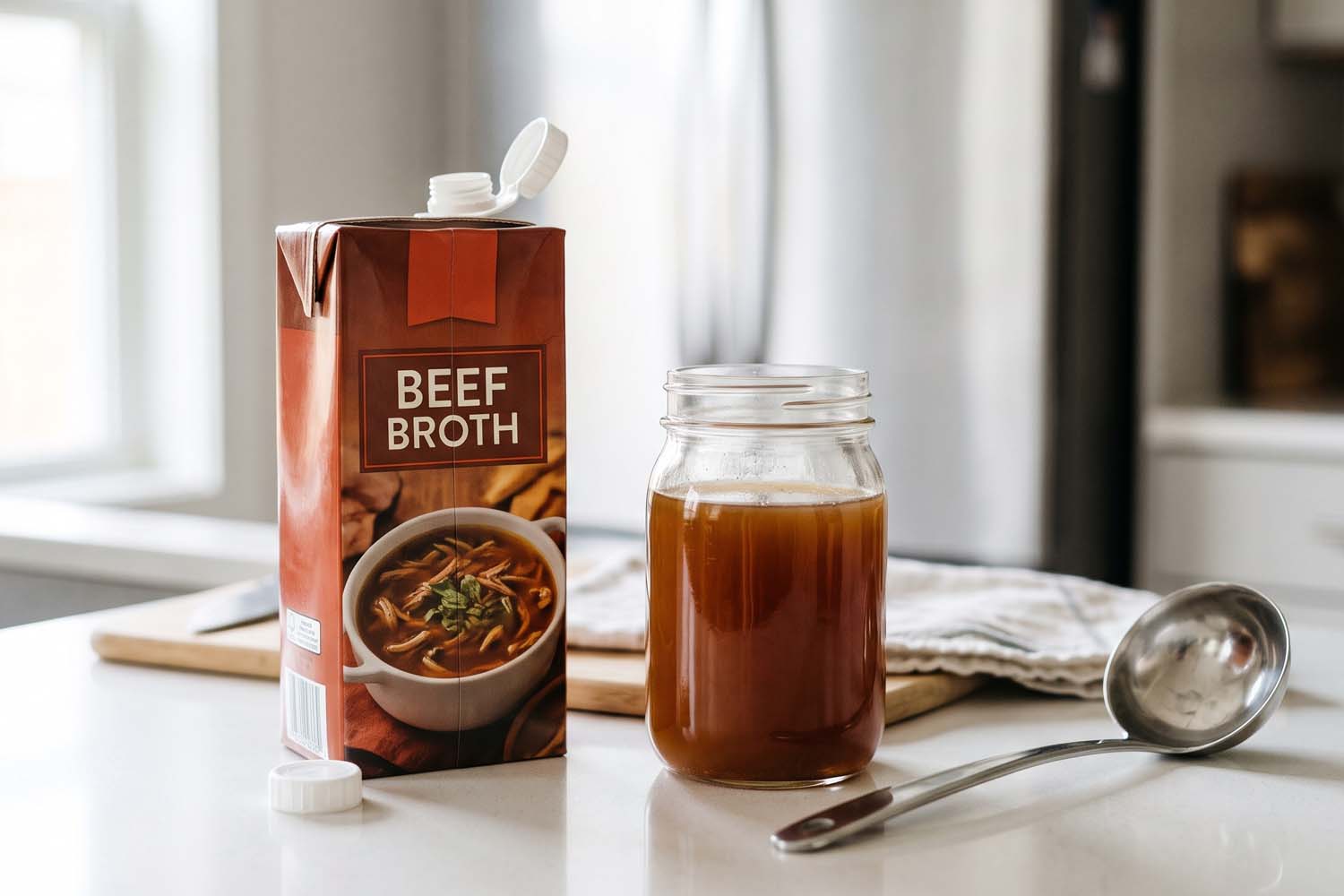
For a complete pantry and fridge reference, see our Food Storage Guide. For how long broth lasts once it is open, see whether vegetable broth goes bad. The same rules apply to chicken broth and beef broth, though USDA lists meat broth separately.
📋 Refrigerating Vegetable Broth: At a Glance
| Unopened, shelf-stable carton or can | Pantry. No refrigeration needed until opened |
| Unopened, labeled Keep Refrigerated or Keep Frozen | Keep it cold, as directed on the package. Do not treat a product sold frozen as shelf-stable |
| Opened | Refrigerate promptly. Use the label time, or 3 to 4 days as a conservative default if there is none |
| Homemade broth or stock | Refrigerate within 2 hours, or 1 hour when the air is above 90°F. 3 to 4 days per extension recipes |
| Vegetable scraps saved for broth | Oregon State and University of Maine Extension: a freezer container or bag |
| Pantry temperature | USDA: below 85°F is best for canned goods. Swanson: rarely above 70°F. Pacific: 32 to 80°F for its products |
| Refrigerator temperature | 40°F or below, per USDA |
| Mold, sour smell, bulging or leaking package | Discard it |
Key Takeaways
- USDA’s Shelf-Stable Food Safety page defines aseptic packaging as a process that keeps microorganisms out of a package: a commercially sterile food is filled into a sterilized package and sealed in a hygienic environment. It names soups and broths among aseptically packaged products and says to store shelf-stable foods in a cool, dry place.
- The same page says unused portions of opened canned food must be refrigerated and may stay in the can, though glass or plastic is better for quality. It lists opened low-acid canned food, which includes soups, at 3 to 4 days.
- USDA’s Keep Food Safe chart has no vegetable broth row. It lists soups and stews at 3 to 4 days in the refrigerator, and it says to refrigerate perishable food within 2 hours, or 1 hour above 90°F.
- Oregon State Extension and a University of Maine Extension recipe sheet both give homemade vegetable broth or stock 3 to 4 days in the refrigerator. Both say to save vegetable scraps for broth in the freezer.
- The manufacturer FAQs and product-label directions we read give opened times of 4 to 14 days. These are product-specific manufacturer directions, so follow your own label.
- USDA says hot food can go directly into the refrigerator or into an ice or cold water bath first, so homemade broth doesn’t need to cool on the counter. It also says to divide a large pot into smaller containers.
How to Tell Which Kind You Have
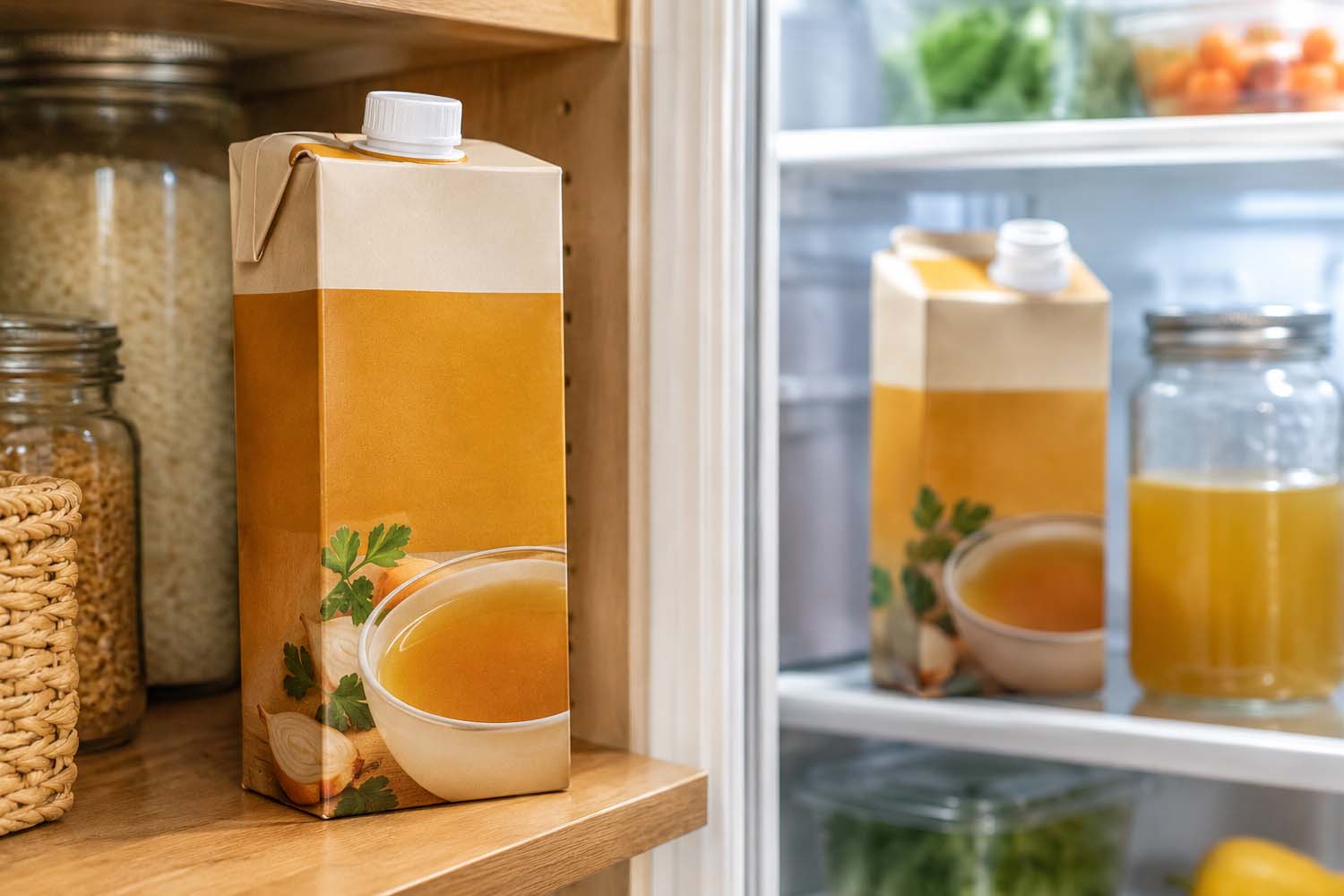
As a rule of thumb, which is our own reading, a carton on an ordinary shelf whose label says to refrigerate after opening is shelf-stable. A carton whose label says keep refrigerated or keep frozen needs to stay cold even before opening. Store placement alone doesn’t settle it. If you can’t tell, read the label, and if it still isn’t clear, we’d keep it cold while you check with the manufacturer, which is our own suggestion. Concentrates, pastes and bouillon are different products with their own labels. For a related staple, see whether gravy needs to be refrigerated.
Does Unopened Vegetable Broth Need to Be Refrigerated?
Not if it is shelf-stable. USDA’s Shelf-Stable Food Safety page defines aseptic packaging as a process that keeps microorganisms out of a package during and after packaging. A sterilized package is filled with a commercially sterile food and sealed in a hygienic environment. In the cartons USDA describes, a thin aluminum layer also blocks light and oxygen. Together, the sterile food and the intact, sealed package are why an unopened carton can sit in the pantry, which is our plain-language summary of USDA’s description. The page lists soups and broths among aseptically packaged products and says to store canned and shelf-stable foods in a cool, dry place. USDA also lists soups other than tomato among low-acid canned goods, so we apply the same pantry rule to canned broth. Pacific Foods’ FAQ says its products are shelf stable and don’t need refrigeration before opening, though the answer covers its products in general. A retailer listing for Publix’s GreenWise organic vegetable broth says to store the unopened carton at room temperature.
USDA also says not all canned goods are shelf stable. Some, such as some canned ham and seafood, are labeled Keep Refrigerated and are not safe at room temperature. That is a canned-food example, but it shows why the label matters. Broth labeled Keep Refrigerated or Keep Frozen is a different product and needs cold storage. Store placement alone doesn’t settle it, so go by the label. USDA’s shelf-stable page says dating is for quality, not safety. A best-by date concerns the unopened product, and it doesn’t override refrigeration instructions or the manufacturer’s time limit after opening.
Does Vegetable Broth Need to Be Refrigerated After Opening?
Yes. USDA says unused portions of opened canned food must be refrigerated, and its chart lists opened low-acid canned food, a category that includes soups, at 3 to 4 days in the refrigerator. USDA’s Keep Food Safe page lists soups and stews at 3 to 4 days in the refrigerator and 2 to 3 months in the freezer. It says to refrigerate perishable food within 2 hours, or 1 hour when the air temperature is above 90°F, and that the refrigerator should be at 40°F or below. USDA has no row for vegetable broth, so applying these rows to an opened carton is our own reading. Every manufacturer direction in the table below that we could open also says to refrigerate after opening. Pour out what you need and put the rest back promptly. See our vegetable broth shelf-life guide for how many days it lasts.
| USDA, opened low-acid canned food | 3 to 4 days in the refrigerator | Shelf-Stable Food Safety page |
| USDA, soups and stews | 3 to 4 days in the refrigerator | Keep Food Safe cold storage chart |
| Oregon State Extension, homemade vegetable broth | 3 to 4 days in the refrigerator. Use frozen broth within 2 to 3 months for best quality | Kitchen scraps vegetable broth recipe |
| Swanson vegetable broth, 32 oz | Refrigerate promptly below 41°F and use within 14 days | Retailer listing of the label (Hannaford) |
| Publix GreenWise organic vegetable broth | Store in a separate container, refrigerate promptly after each use and use within 14 days | Retailer listing of the label (Publix) |
| College Inn broths | Use within 4 to 5 days if refrigerated | College Inn FAQ |
| Pacific Foods products | Refrigerate and use within 7 to 10 days | Pacific Foods FAQ, which covers its products in general |
| Kitchen Basics stock | Keep in the refrigerator once opened and use within 7 days (brand FAQ, so other products may differ) | Kitchen Basics FAQ |
These directions come from manufacturer FAQs and package directions where we could open them, plus retailer listings for Swanson and Publix, all checked in November 2026. Labels change, so treat the table as a reason to check your package, not as a time for your product. Swanson’s FAQ says that once the product is opened, you should follow the directions on the label for storage and disposal. A time on a package is the manufacturer’s direction for that product, not a USDA recommendation. If the label gives no after-opening time, 3 to 4 days in the refrigerator is a conservative default based on USDA’s general guidance for opened low-acid canned food, soups and leftovers. USDA doesn’t publish a separate time for opened broth cartons.
Should You Keep Opened Broth in the Carton or Pour It Into a Container?
Follow any container directions on your package first. The Publix GreenWise listing above, for example, says to store opened broth in a separate container. Opened canned broth can stay in the can in the refrigerator, per USDA, but USDA says to place the unused portion in a glass or plastic storage container to preserve quality and flavor. For a carton with no such direction, USDA’s page doesn’t say. We’d keep it in the carton only if it reseals tightly, and otherwise pour it into a clean jar or airtight container. Either way, write the date you opened it on the container. Those tips are our own.
How Should You Store Unopened Broth in the Pantry?
Somewhere cool and dry, away from heat. USDA says not to put canned and shelf-stable goods above or beside the stove, under the sink, or in a damp garage or basement. It says temperatures below 85°F are best, that temperatures over 100°F are harmful to canned goods, and that the risk of spoilage jumps sharply as storage temperatures rise. Swanson’s FAQ is stricter and recommends a spot where temperatures rarely exceed 70°F, while Pacific Foods’ FAQ gives a range of 32 to 80°F for its products. We’d aim for the cooler end. These are different organizations’ recommendations for different products, not one universal standard.
In winter, don’t leave broth where it could freeze. A Swanson direction reproduced in a retailer listing says not to microwave or freeze the broth in its carton and to discard a damaged or unusually inflated carton. For cans, USDA says frozen cans could swell because the food expanded, but swelling can also come from contamination, so swollen cans should be discarded. It also says to discard frozen cans that are not swollen but thawed at 40°F or higher. Those rules are for cans, and for a carton that froze we’d discard it if it is swollen or leaking, which is our own judgment. If a carton that froze looks intact, follow the manufacturer’s instructions, or ask the manufacturer if you’re unsure.
Does Homemade Vegetable Broth or Stock Need to Be Refrigerated?
Yes, promptly. Oregon State Extension’s vegetable broth recipe says that if you aren’t using the broth right away, you should store it in the refrigerator or freezer. It describes cooling the pot in an ice bath for about 15 minutes, stirring every few minutes. USDA’s leftovers guidance says to divide large amounts into shallow containers and to divide a pot of soup into smaller containers so it cools quickly. It also says hot food can be placed directly in the refrigerator or rapidly chilled in an ice or cold water bath first. You don’t need to wait for a pot to cool on the stove. The 2-hour rule applies here too, or 1 hour when the air is above 90°F.
Oregon State says homemade broth can be stored safely in the refrigerator for 3 to 4 days, and a University of Maine Extension recipe sheet says the same for vegetable stock. We’d plan on 3, which is our own conservative lean. Stock and broth follow the same rules, as far as we found.
Do Vegetable Scraps for Broth Need to Be Refrigerated?
The two extension sources we read say to freeze them. Oregon State Extension says to label a freezer container “Broth Scraps” with the date and to save scraps in it over the next several days or weeks, until you have enough for broth. The University of Maine sheet keeps a resealable bag of washed raw scraps in the freezer. Neither recipe gives a refrigerator holding time for scraps. University of Maine Extension’s guidance on storing fresh produce says cut or peeled produce kept in covered containers in the refrigerator should be eaten within 3 to 4 days. That is general produce guidance and not a rule for broth scraps, but it is why we’d freeze a bag meant to collect over a week. Oregon State says scraps that are moldy, slimy or otherwise unsafe to eat should not be used.
How Long Can Vegetable Broth Sit Out While You Cook?
Perishable broth shouldn’t sit at room temperature for more than 2 hours, or 1 hour when the air is above 90°F. USDA’s Danger Zone guidance says bacteria grow most rapidly between 40°F and 140°F and that food shouldn’t be left out of refrigeration over 2 hours. That applies to perishable broth: opened, homemade or refrigerated. An unopened shelf-stable carton in the pantry is a different case. So is broth kept hot at 140°F or above, and the CDC says to keep food heated to 140°F or hotter until serving, or cold at 40°F or below. A pot cooling on the stove is not hot holding. If you leave opened broth out overnight, we would pour it out.
What Can You Make With Opened Vegetable Broth?
Soup is the easiest way to use up an open carton within its days. We have red lentil soup, tortilla soup, cauliflower soup with scallops, clam corn chowder and New Orleans seafood gumbo. Check each recipe for the type and amount of broth it calls for. If a soup comes out thin, see how to thicken soup without cream, and for more on soup, see common soup mistakes. Cooking rice or grains in broth instead of water is our own suggestion. Refrigerate the finished dish promptly and see our guides to how long leftovers last and whether rice needs to be refrigerated.
Signs Something Is Wrong
- Visible mold on or in the broth. USDA says not to sniff a moldy item because it can cause respiratory trouble. Discard it.
- A sour, rancid or off smell. USDA lists a foul odor as a warning sign for canned food. For broth in general, this is our own checklist, not an agency list.
- A bulging, swollen, leaking or deeply dented can. USDA says to discard swollen cans, not to use food from leaking, bulging or badly dented cans, and to discard cans with a deep dent, especially on a seam.
- A damaged or unusually inflated carton. A Swanson vegetable broth carton direction reproduced in a retailer listing says to discard it.
- A can that hisses loudly or spurts liquid when opened. USDA says not to taste or use such food.
- Left out more than 2 hours (1 hour above 90°F). Throw it out, even if it looks fine.
- Opened longer than the label allows. With no label time, we use 3 to 4 days.
- Prolonged heat. USDA says temperatures over 100°F are harmful to canned goods and that the risk of spoilage jumps sharply as storage temperatures rise. Discard swollen, leaking or damaged packages. For an intact carton that sat in significant heat, we’d check with the manufacturer rather than rely on appearance.
We don’t suggest tasting broth to test it. A good look and smell don’t prove it is safe, so count the days.
Things That Don’t Automatically Mean Trouble
- An unopened shelf-stable carton stored in the pantry instead of the refrigerator. USDA names broths among aseptically packaged products, which don’t need refrigeration before opening.
- A color that differs from the last carton or batch. Color can reflect the vegetables used, but color alone doesn’t show broth is safe, so count the days and check the other signs.
- A best-by date that has passed on a sealed carton with no bulge, leak or damage. USDA says dates are about quality.
These are quality observations, not safety tests. Days since opening and storage matter more.
Quick Storage Reference
- Unopened shelf-stable: Pantry, cool and dry, away from the stove and sink.
- Labeled Keep Refrigerated or Keep Frozen: Keep cold, even before opening.
- Opened store-bought: Refrigerate promptly. Label time, or 3 to 4 days if none.
- Homemade: Refrigerate within 2 hours, in shallow containers. Plan on 3 days, up to 4.
- Scraps for broth: A labeled freezer container or bag.
- Counter: 2 hours at most, 1 hour above 90°F.
- Refrigerator: 40°F or below.
| Sealed shelf-stable carton, kept in the pantry | Fine as it is, if the package is intact. USDA names broths among aseptically packaged products, which don’t need refrigeration before opening. |
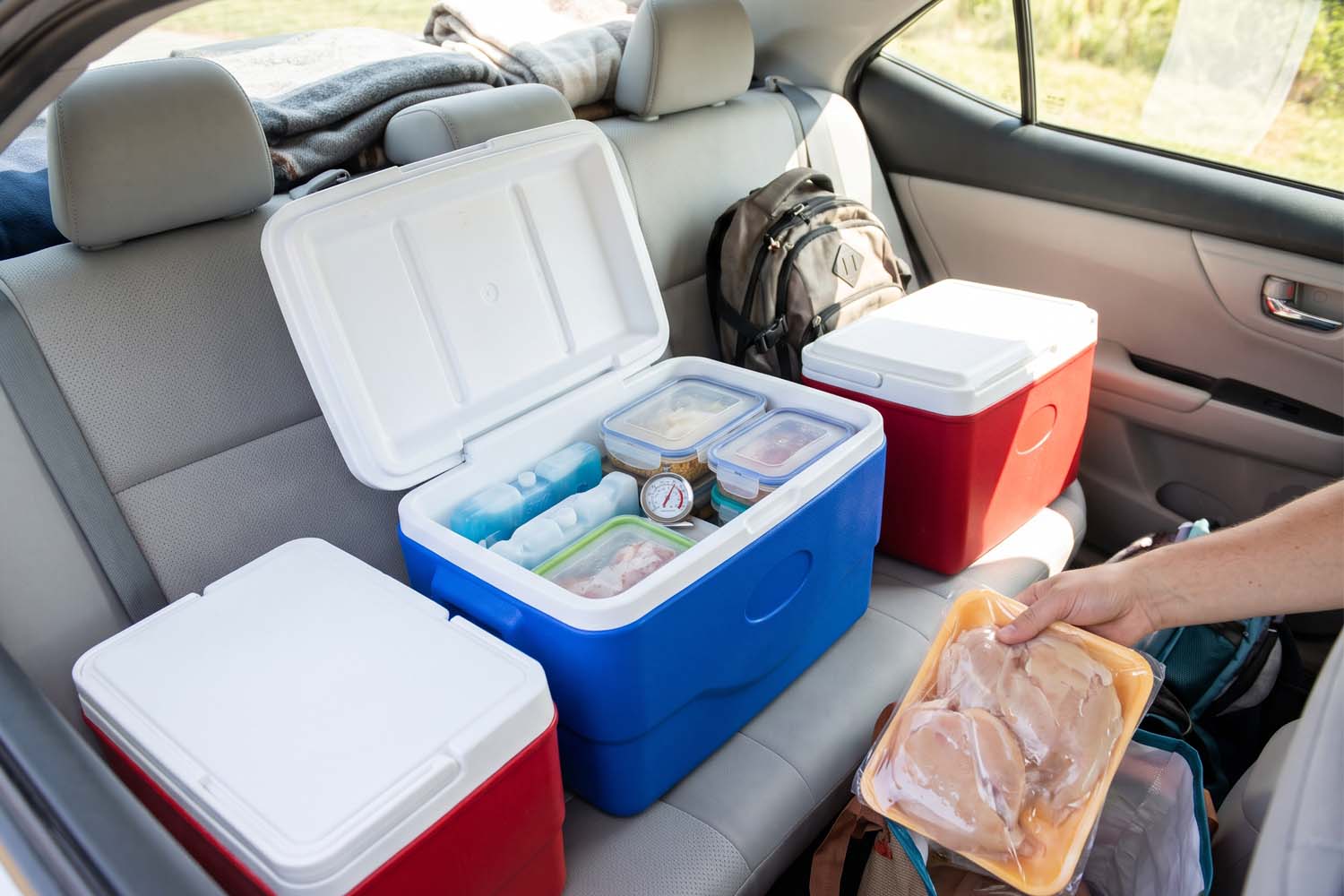
| Sealed carton labeled Keep Refrigerated, left in the car for 3 hours with no cooler | Discard it. USDA says perishable food shouldn’t stay at room temperature more than 2 hours, or 1 hour above 90°F. If it was kept at 40°F or below in a cooler, that is a different case. |
| Opened carton, put back in the pantry | Discard it if it sat out more than 2 hours, or 1 hour above 90°F. Opened broth needs to be refrigerated. |
| Opened carton, 2 days in the refrigerator, label says 7 days | Within the label’s time if it was refrigerated promptly and kept cold. Follow the label. |
| Opened carton, 6 days in the refrigerator, no time on the label | Discard it. That is past the 3 to 4 day default with no label time. |
| Pot of homemade stock cooled on the stove for 4 hours | Discard it. USDA says perishable food left out more than 2 hours should be thrown away. |
| Carton that froze in an unheated garage and looks swollen | Discard it. A Swanson direction says to discard a damaged or unusually inflated carton, and USDA says to discard swollen cans. |
| Scraps for broth, collected in the refrigerator for a week | Both recipes collect scraps in the freezer. University of Maine’s general produce guidance gives cut or peeled produce 3 to 4 days in the refrigerator, so a week is long. Scraps that are moldy or slimy should not be used. |
How We Checked This
In November 2026 we read USDA’s Shelf-Stable Food Safety page, its Keep Food Safe page and cold storage chart, its leftovers guidance and its Danger Zone page. We also read its Molds on Food page and its food product dating guidance. We read Oregon State Extension’s kitchen scraps vegetable broth recipe, published in 2021, an undated University of Maine Extension recipe sheet for vegetable stock, its guidance on storing fresh produce and the CDC’s C. perfringens prevention page. We read Swanson’s FAQ and the FAQs of Pacific Foods, Kitchen Basics and College Inn. We also read retailer listings for Swanson vegetable broth (Hannaford) and Publix GreenWise organic vegetable broth, which we did not link. USDA’s charts have no vegetable broth row, so we use its figures for opened canned soup, soups and stews and leftovers. The cooling steps come from USDA and Oregon State, and the pantry locations and temperatures come from USDA and manufacturer guidance. The container tips, the opening-date tip, the 3-day lean for homemade broth and the smell checklist are our own judgment. Our own suggestions say we’d or we suggest. This article is general information, not medical advice.
Does Vegetable Broth Need to Be Refrigerated FAQ
Does vegetable broth need to be refrigerated?
Not while it is sealed and shelf-stable. Once opened, yes. Broth labeled Keep Refrigerated or Keep Frozen, and homemade broth, need to stay cold.
Does unopened vegetable broth need to be refrigerated?
Not if it is shelf-stable. USDA lists soups and broths among aseptically packaged products, which are filled into sterilized packages with commercially sterile food. If the label says keep refrigerated or keep frozen, keep it cold. Store placement alone doesn’t settle it.
Does vegetable broth need to be refrigerated after opening?
Yes. USDA says unused portions of opened canned food must be refrigerated. Use the time on the label, or 3 to 4 days as a conservative default if it gives none.
Does vegetable stock need to be refrigerated?
Opened or homemade vegetable stock does. We found no guidance that stores stock and broth differently, and a University of Maine Extension recipe sheet says to refrigerate vegetable stock for 3 to 4 days.
Does homemade vegetable broth need to be refrigerated?
Yes, within 2 hours, or 1 hour when the air is above 90°F. Divide a large batch into shallow containers. USDA says hot food can go directly into the refrigerator or into an ice or cold water bath first, and Oregon State Extension gives it 3 to 4 days.
Do you have to cool vegetable broth before refrigerating it?
No. USDA says hot food can be placed directly in the refrigerator or rapidly chilled in an ice or cold water bath first. Dividing it into shallow containers helps it cool quickly. Don’t leave the pot on the stove to reach room temperature.
Can you store unopened vegetable broth in the refrigerator?
You can. We found no source that says a shelf-stable carton must be refrigerated or that it is unsafe to, so the pantry is the usual spot and the fridge is a matter of space. That is our own reading, so check the label.
Can opened vegetable broth stay in the carton in the refrigerator?
Follow any container direction on the package first. The Publix GreenWise listing says to store opened broth in a separate container. Otherwise, if the carton reseals tightly, we’d say yes, and if not, pour it into a clean airtight container. Mark the date you opened it.
How long can vegetable broth sit out?
Perishable broth shouldn’t sit at room temperature more than 2 hours, or 1 hour when the air is above 90°F, per USDA. After that, discard it. Broth kept hot at 140°F or above, or cold at 40°F or below, is a different situation.
Can you leave vegetable broth out overnight?
No. Perishable broth left out overnight is well past USDA’s 2-hour limit, and boiling it again doesn’t change that, so we’d pour it out. An unopened shelf-stable carton in the pantry is a different case.
See also
Where in the refrigerator should opened vegetable broth go?
USDA’s guidance is about the refrigerator’s temperature, 40°F or below, and we found no agency guidance on which shelf. We’d keep it on an interior shelf rather than in the door, which is opened often. That is our own judgment.
What temperature should the refrigerator be for vegetable broth?
40°F or below, per USDA, and the freezer at 0°F or below.
What happens if you don’t refrigerate opened vegetable broth?
It becomes a perishable food sitting in the temperature range where bacteria grow fastest. USDA says bacteria grow most rapidly between 40°F and 140°F and that perishable food left out more than 2 hours, or 1 hour above 90°F, should be thrown away. USDA also says you can’t see, smell or taste harmful bacteria, so appearance isn’t a test.
Why is some vegetable broth on the shelf and some in the refrigerated aisle?
They are usually different products. Shelf-stable broth is commercially processed and sealed in cans or aseptic cartons, and USDA names broths among aseptically packaged products. Broth labeled Keep Refrigerated or Keep Frozen needs cold storage. We found no source on store placement, so go by the storage line on the label.
Where should you store unopened vegetable broth?
In a cool, dry place away from the stove and sink. USDA says below 85°F is best, Swanson recommends a spot rarely above 70°F, and Pacific Foods gives 32 to 80°F for its products.
How long does opened vegetable broth last in the refrigerator?
Follow the label if it gives a time. With none, 3 to 4 days is a conservative default based on USDA’s general guidance for opened canned food, soups and leftovers. USDA doesn’t publish a separate time for opened broth cartons. See our guide to whether vegetable broth goes bad for the full breakdown.
Why do labels give different times after opening?
Manufacturers set their own directions for their products, and the FAQs and package directions we read range from 4 to 14 days. College Inn’s FAQ says 4 to 5 days, while retailer listings for Swanson and Publix vegetable broth say 14. These are product-specific directions, not USDA recommendations.
Does Swanson vegetable broth need to be refrigerated?
Not while it is sealed, if it is the shelf-stable carton. Swanson’s FAQ says to store non-refrigerated items in a cool, dry place and, once opened, to follow the directions on the label. A retailer listing of the 32 oz Swanson vegetable broth carton reproduces the direction to refrigerate promptly below 41°F and use within 14 days of opening. Check your own carton, because directions can differ by product.
Does Pacific Foods vegetable broth need to be refrigerated?
Pacific Foods’ FAQ says its products are shelf stable and don’t need refrigeration before opening, and that opened products should be refrigerated and used within 7 to 10 days. The answer covers its products in general, so check the carton in your hand.
Does canned vegetable broth need to be refrigerated?
Not until it is opened. USDA lists soups other than tomato among low-acid canned goods and says to store them in a cool, dry place. Once opened, refrigerate the unused portion. USDA says it may stay in the can but recommends a glass or plastic container for quality.
What kind of container should opened broth go in?
A clean, airtight one. USDA says opened canned food may stay in the can but recommends a glass or plastic storage container, and says to cover leftovers or seal them in storage containers. The University of Maine sheet says to divide stock into smaller containers if you freeze it.
Do vegetable scraps for broth need to be refrigerated?
The extension sources we read say to freeze them. Oregon State Extension says to save scraps in a labeled freezer container over several days or weeks, and the University of Maine sheet keeps washed raw scraps in a resealable bag in the freezer. Neither gives a refrigerator holding time for scraps.
How long can unopened vegetable broth stay in the pantry, and what do the dates mean?
For cartons, follow the best-by date and storage directions on the package. USDA says that apart from infant formula, product dates are not an indicator of safety. It lists low-acid canned soups at 2 to 5 years. A best-by date concerns the unopened product and doesn’t override refrigeration instructions or the manufacturer’s time limit after opening. See our guide to whether vegetable broth goes bad for more.
Can you freeze vegetable broth in the carton?
Not if the label says not to. A Swanson direction reproduced in a retailer listing says not to microwave or freeze in the carton and suggests an ice cube tray, and the Publix GreenWise listing suggests ice cube trays too. Oregon State Extension says to freeze broth in recipe-sized freezer-safe containers labeled with the date.
Do soups made with vegetable broth need to be refrigerated?
Yes, promptly. USDA says to refrigerate perishable food within 2 hours, and its chart lists soups and stews at 3 to 4 days in the refrigerator. Divide a big pot into smaller containers so it cools quickly.
Further Reading

Better Living may earn commissions through affiliate links and may occasionally feature sponsored or partner content. If you make a purchase through our links, we may receive a small commission at no cost to you.













 English (US) ·
 French (CA) ·
 French (FR) ·