

 1 month ago
32
1 month ago
32
PROTECT YOURSELF with Orgo-Life® QUANTUM TECHNOLOGY
Orgo-Life the new way to the future Advertising by AdpathwayThis post appears as part of New Mandala’s ARTSEA series on art, design and architecture in Southeast Asia.
• • • • • •
In Singapore, renewal is not merely an urban strategy; it is a moral and temporal orientation that underpins both nation-building and the city-state’s self-image. The new is not simply desirable, it is often framed as necessary. Much has been written about Singapore’s history of transformation: the continuous remaking of land, infrastructure, and social life in the name of progress and self-governance. From swamp to port, from colonial outpost to industrial hub, from manufacturing to finance, and now to the vision of a “Smart Nation”, the city-state has been repeatedly reimagined through cycles of redevelopment and sociotechnical reinvention.
This ethos is perhaps most visible in the built environment, where it becomes part of the city’s everyday visual and material texture. Vertical housing and high-rise office towers rise where swampy villages (kampungs) once stood, and more recently on reclaimed land extending into the sea. Neighbourhoods are demolished and rebuilt within a generation, while infrastructures are continuously redesigned to optimise circulation and efficiency. Moving through the city, renewal feels less like a single project than a continuous condition—embedded in the material and moral fabric of the urban ensemble.
The Singapore Art Museum (SAM) is itself part of this logic. With its original home on Bras Basah Road closed for a major revamp, the museum relocated in 2022 to a new contemporary art space in a former warehouse at Tanjong Pagar Distripark, nestled within a bustling port area that connects Singapore to global flows of goods and capital. The repurposing of this industrial structure into a contemporary art “container”—transforming logistical infrastructure into cultural capital—forms part of the district’s broader ambition to develop into a new arts cluster. The complex also houses Artspace@Helutrans, a commercial gallery space hosting exhibitions drawn from private collections.
The building’s minimalist interior, high ceilings, column grid, and exposed concrete and metal beams retain traces of its industrial past, revealing a space originally designed for storage and large-scale handling, now adapted for exhibitions. The relocation of SAM into a former warehouse within this logistical corridor thus situates contemporary art within the material infrastructures that made the city-state’s economic prosperity possible. Transformation here appears not simply as a curatorial theme, but as a spatial condition grounded in material flows and redevelopment.
This attention to land and its transformation appeared in Syahrul Anuar’s installation The Mountain Lovers Club, shown as part of SAM Contemporaries: How to Dream Worlds, which reflects on Singapore’s relationship with a landscape reshaped by resource extraction, urban expansion, and the costs of economic prosperity. Through a video installation, the work directs attention to an urban landscape in constant motion, showing the erection of high-rise residential blocks and infrastructural structures across flattened terrain. Cranes, concrete frames, and rising facades dominate the visual field, emphasising how constructed elevations—public housing estates and skyscrapers—have come to replace natural topography in Singapore.
Oscillating between historical and contemporary registers, the installation reveals the spatial logic of urban transformation: a city without mountains that nonetheless produces ever-higher elevations. As the artist-authored text accompanying the work explains, Singapore’s vertical landscape is tied to a longer history of colonial extraction and commodity circulation, where “the landscape is always seen as capital, and capital is consequently the landscape”.
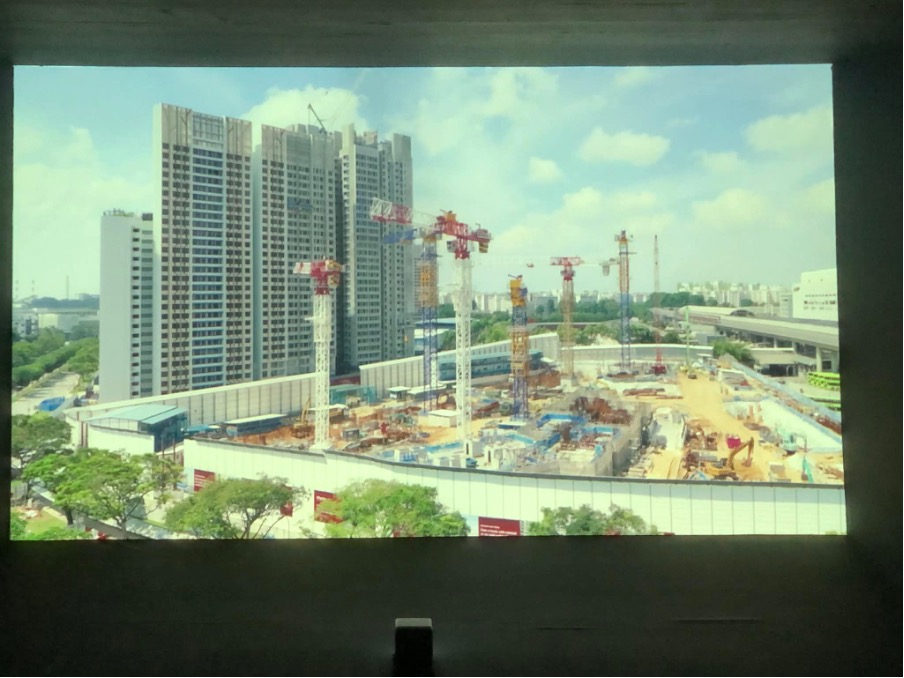
Still from the video installation The Mountain Lovers Club by Syahrul Anuar, Singapore Art Museum, Singapore (Photo: author)
If Syahrul Anuar’s artwork foregrounds the transformation of land and the material and ecological costs underpinning Singapore’s vertical urbanism, this concern with height and elevation returns in a more playful and explicitly forward-looking register in Wong Shih Yaw’s work, shown in Continuity, Fluidity, and Unity: An Exhibition of Collecting and Creating at Artspace@Helutrans. Drawn from the private collection of Singapore pioneer architect and art collector Koh Seow Chuan, Wong Shih Yaw’s painting Vibrant Youth depicts young figures soaring confidently above Singapore’s contemporary skyline. Here, verticality no longer appears as the outcome of complex historical processes, it is instead embodied in youthful movement and aspiration. The built environment recedes into the background, becoming a stage upon which young people are imagined pursuing opportunity, their upward motion reflecting broader narratives of progress.
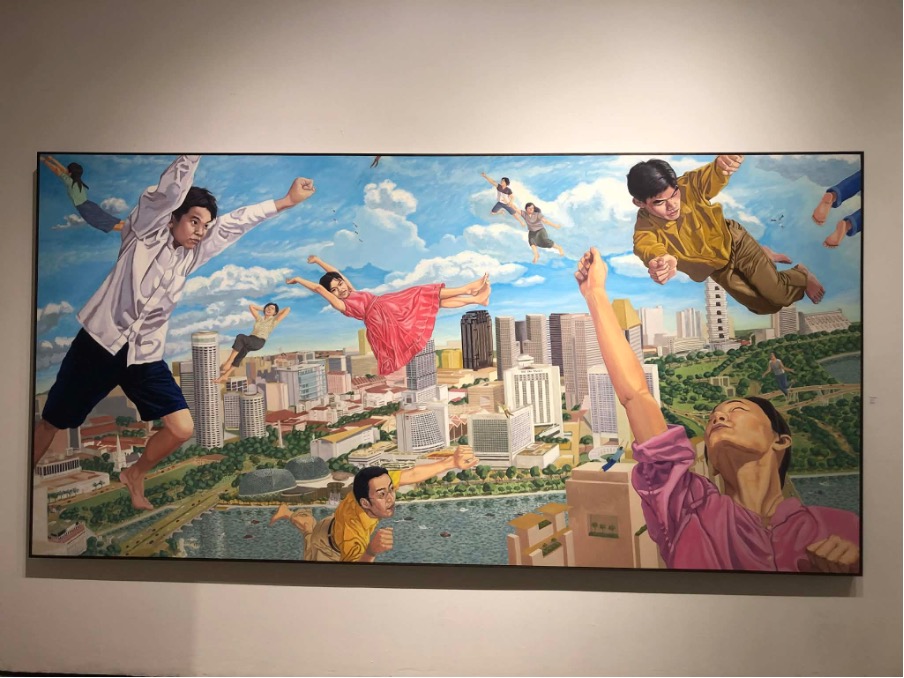
Vibrant Youth by Wong Shih Yaw. Installation view, Artspace@Helutrans, Singapore (Photo: author)
In a related work, Marina Bay Triptych, babies appear to descend from the sky over Marina Bay, one of Singapore’s most emblematic urban landscapes, built on reclaimed land. Among the landmarks visible in the skyline is the Esplanade—Theatres on the Bay, designed by DP Architects, the architectural firm founded by Koh Seow Chuan. While the earlier painting evokes ascent and uplift, this work stages renewal as descent: the future arriving from above, bright, unblemished, and seemingly purposeful.
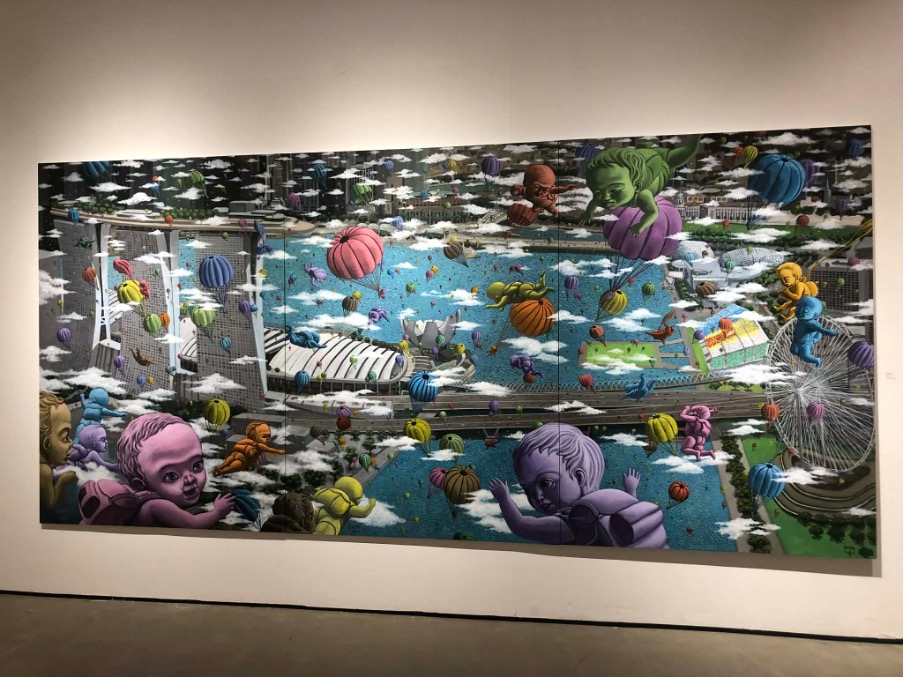
Marina Bay Triptych by Wong Shih Yaw. Installation view, Artspace@Helutrans, Singapore (Photo: author)
Together, the works translate Singapore’s vertical urbanism into a visual language of generational renewal, casting youth and childhood as both the product and the promise of the city-state’s continual remaking. As noted in the wall text accompanying Wong Shih Yaw’s work, Koh Seow Chuan, who owns both pieces, describes these paintings as “metaphors for Singapore: young, dynamic, and open to renewal”. In contrast to the historically grounded framing of landscape change in the public museum setting of SAM’s installation by Syahrul Anuar, Wong’s paintings present the skyline less as the outcome of contested transformations than as the stage for an ongoing narrative of becoming.
This exuberant imagery of youth as the force of renewal sits somewhat uneasily alongside Singapore’s demographic reality of a rapidly ageing population, raising questions about which lives—and which temporalities—remain largely out of view. In this sense, renewal appears not only as a promise of continuity, but also as a selective process, one that foregrounds certain futures while rendering others less visible.
What, then, of those who built the city’s infrastructure, who lived through war, independence, and postcolonial transformation, yet rarely appear within these forward-looking imaginaries? While Wong Shih Yaw’s paintings cast buoyant youth and childhood as emblems of Singapore’s renewal, Nguan’s photographic series Singapore, displayed in SAM’s Learning Gallery, introduces figures who occupy a different temporal position within the city-state. Lingering on moments of stillness, ordinariness, and solitude, Nguan’s images focus on elderly figures moving through—or pausing within—the city’s everyday architectures: a lone man lying across a children’s slide in a public playground, or an elderly man using a public payphone at a coffeeshop.
These scenes are quiet and deeply suggestive. The man on the slide occupies a space designed for youthful play, yet his body appears suspended in inactivity, out of sync with the tempo of the surrounding city. The payphone, itself an ageing technology in an increasingly digitised society, mirrors the temporal position of its user. The juxtaposition of an ageing body and an ageing technology suggests that obsolescence in Singapore is not only technical, but also social. Together, the photographs gesture towards forms of loneliness, solitude, and quiet alienation that permeate urban life in Singapore—conditions that feel especially pronounced in a city so strongly oriented towards speed, productivity, and renewal.
Looking at Nguan’s photographs, I was reminded of the characters in Merdeka Generation Groovers and Other Stories, Josephine Chia’s collection of short fiction portraying the everyday lives of Singapore’s post-independence generation. The book traces figures who spent decades working, raising children, and making sacrifices for both their families and the nation in making. In later life, many of Chia’s characters find themselves inhabiting a world that has changed: children grown, routines slowed, social circles thinned. As one character observes, “now we are seen as old. A silver tsunami. Almost as if we are a burden to society”. The solitude that runs through Chia’s fictional portraits resonates strongly with the stillness captured in Nguan’s photographs. Here, loneliness is not dramatic or catastrophic, but mundane and lingering, a condition that emerges after a lifetime of giving all to the making of the nation.
The Learning Gallery space where Nguan’s photographs are displayed is described by its curators as a place that invites visitors to “explore contemporary art with the uninhibited spirit of a child“. This language is telling. In a nation oriented towards progress and renewal, even art education is framed through metaphors of perpetual rejuvenation—a call to rediscover the curiosity and joy of learning. At the centre of this space stood a striking installation by David Chan titled Animal Roulette—a collection of plastic toy animals displayed in glass cabinets. The figures were hybrids: animals assembled from mismatched parts: a pig with a gorilla body, a dolphin with butterfly wings, a crocodile with crab claws. At first, the installation appeared playful and toy-like, echoing the gallery’s pedagogical tone. Yet the longer I looked, the more unsettling it became—a game of chance in which, as the artist notes, “science, technology, and society meet”. The speculative hybrids evoke broader questions about technological intervention and environmental transformation.
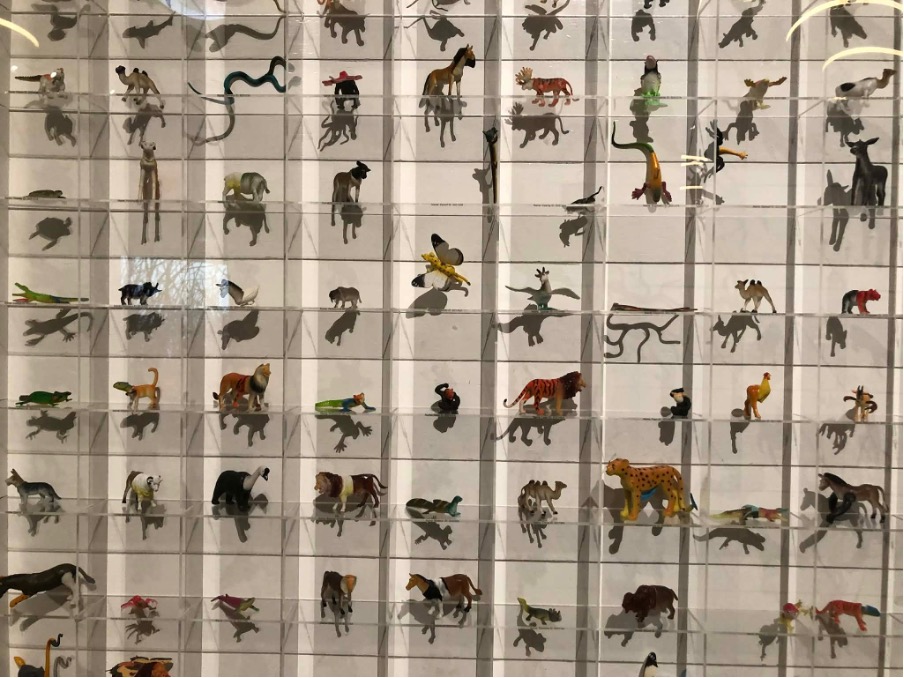
Animal Roulette by David Chan. Installation view, Singapore Art Museum, Singapore (Photo: author)
As I studied the details of Animal Roulette, an elderly museum attendant approached me. “What do you think of it?” he asked, with warmth and curiosity. Judging by his appearance, he was likely born in the 1950s, part of the generation that had lived through Singapore’s post-war transformations and the relentless pace of national development that followed. We spoke about the sculptures. “It’s playful and the artist is very clever”, he said. Then he pointed out that one of the animals was actually whole, not artificially spliced like the others. It took me a moment to find it—a mule, itself a hybrid by birth, born of a horse and a donkey. A hybrid hiding in plain sight.
I asked him about another figure: a sheep that looked almost ordinary, yet subtly wrong. “What do you think is wrong with this one?” I asked. He seemed delighted by the question—and by the conversation it opened. Instead of answering directly, he paused, took out his phone, and said, “Let’s ask Cici”, speaking of the AI assistant as one might speak of a familiar companion. Rather than repeating my question verbatim, he rephrased it: Why is this a hybrid? A better question, really. Cici replied that the sheep’s eyes and wool colour do not occur in nature. The attendant added reflectively, “Perhaps this is the artist’s reference to Dolly”, the cloned sheep and an emblem of scientific innovation. The moment was quietly striking.
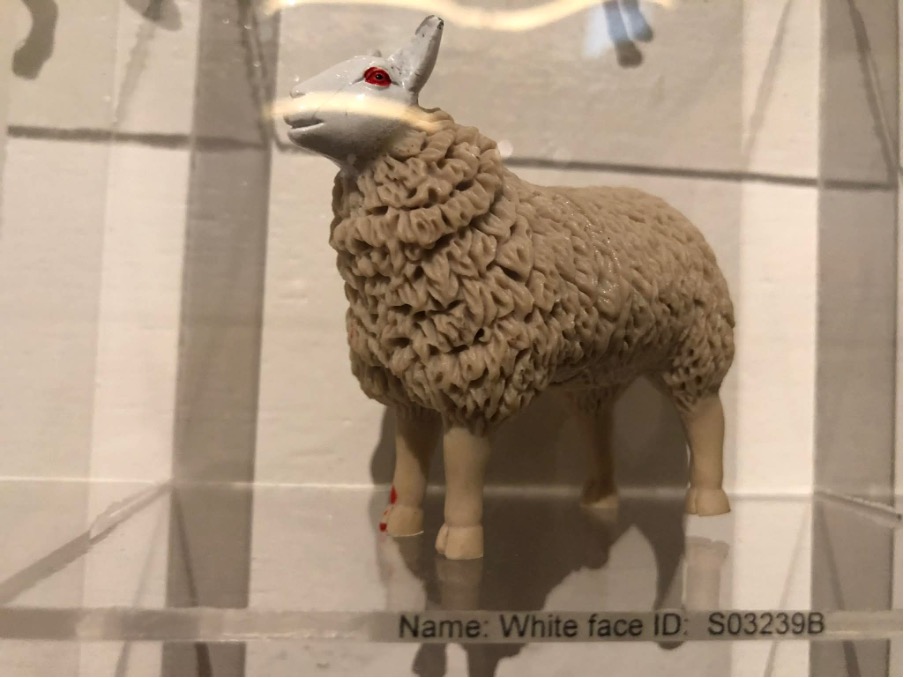
Detail from David Chan’s installation Animal Roulette, Singapore Art Museum, Singapore (Photo: author).
What stayed with me was not the answer itself, but the encounter it enabled: two people, a digital system, and a speculative artwork meeting in shared curiosity. Here, technology did not appear as a force of acceleration or alienation, but as a modest bridge—less between myself and the artwork than between the attendant and a city that increasingly imagines its future through digital optimisation and youthful aspiration. His gentle presence suggested that renewal is not only about rebuilding cities, reinventing technologies, or even adapting to change, something his ease with Cici made evident. It also lies in sustaining conversation, wonder, and care across generations, especially in a place where the pace of change risks rendering such relations fragile or easily overlooked. In this sense, the encounter itself seemed to echo what the curators of the Learning Gallery space set out to cultivate.










 English (US) ·
  French (CA) ·
  French (FR) ·