

.png) 2 months ago
59
2 months ago
59
PROTECT YOURSELF with Orgo-Life® QUANTUM TECHNOLOGY
Orgo-Life the new way to the future Advertising by Adpathway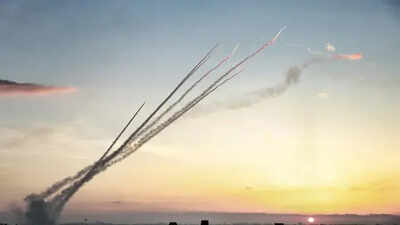
Jerusalem/Tehran, June 8 (IANS) Iran on Sunday evening launched several waves of missiles against Israel and warned the latter not to retaliate, in the first such strikes since a ceasefire was reached in April.
As the April 8 ceasefire came into effect, the skies over Iran became clear of US and Israeli warplanes. Since then, Iran has used the ceasefire to shore up its military capabilities.
Despite the damage it sustained during the conflict, Tehran has managed to reopen the entrances to tunnels and caves where it stored missiles and drones.According to a CNN report, Iran has reopened 50 of the 69 tunnels that had been bombed shut during the war. The United States alone struck more than 13,000 targets, including excavation equipment that could have been used to access the subterranean missile and drone storage sites.
With no fear of US or Israeli warplanes operating overhead, Iranian forces have repaired damaged facilities, reorganised logistics networks and accelerated production lines that were disrupted during the kinetic phase of the conflict.Intelligence assessments suggest that only about half of Iran's missile and drone arsenal was depleted during the fighting, leaving thousands of Shahed drones and dozens of missile launchers intact, according to a DW report.
Iran adapted its tactics by reducing launch rates to conserve inventory while simultaneously improving strike precision, targeting the energy and water infrastructure of neighbouring Gulf nations.This shift demonstrated not only the preservation of capability but also an evolution in operational effectiveness. Drone production proved particularly advantageous, with Iran capable of manufacturing up to 10,000 units per month before the war, according to the same DW report.The relatively low cost of drones compared with the high expense of intercepting them created a cost asymmetry that favoured Tehran. It also enabled Iran to supply drones to regional proxies and Russia, extending its influence beyond its borders.Missile production also continued despite strikes on factories, with estimates ranging from 40 to 300 missiles per month depending on wartime conditions. Foreign support, particularly from China and Russia in the form of precision components and machine tools, helped sustain Iran's missile industry despite sanctions, according to another CNN report.Beyond replenishment, Iran leveraged its ability to disrupt shipping through the Strait of Hormuz, threatening global oil flows and using that pressure as leverage in indirect negotiations.The ceasefire, therefore, became less a step towards peace and more a calculated opportunity for Iran to repair tunnels, replenish drone stocks and restart missile production in its subterranean facilities.















 English (US) ·
  French (CA) ·
  French (FR) ·