

 2 hours ago
3
2 hours ago
3
PROTECT YOURSELF with Orgo-Life® QUANTUM TECHNOLOGY
Orgo-Life the new way to the future Advertising by AdpathwayExperts say the two new border crossings signal an era of closer cooperation between Pyongyang, Beijing and Moscow.
Satellite imagery analyzed by Radio Free Asia shows rapid progress on a new road bridge connecting North Korea and Russia across the Tumen River, while construction is also accelerating on a long-delayed bridge linking North Korea and China.
Experts told RFA the bridges will help expand Pyongyang’s economic and strategic options as it draws closer to Beijing and Moscow.
The two bridges could also symbolize Pyongyang’s growing strategic leverage as cooperation among North Korea, China and Russia deepens, analysts said.
“Now, through these two bridges, North Korea is gaining access to China and Russia as vast economic and logistical backyards,” Im Eul-chul, a professor at the Institute for Far Eastern Studies at Kyungnam University in Seoul, told RFA. “This can also be interpreted as a message to the United States that North Korea has less reason to denuclearize or make major concessions simply to secure economic benefits through negotiations with Washington.”
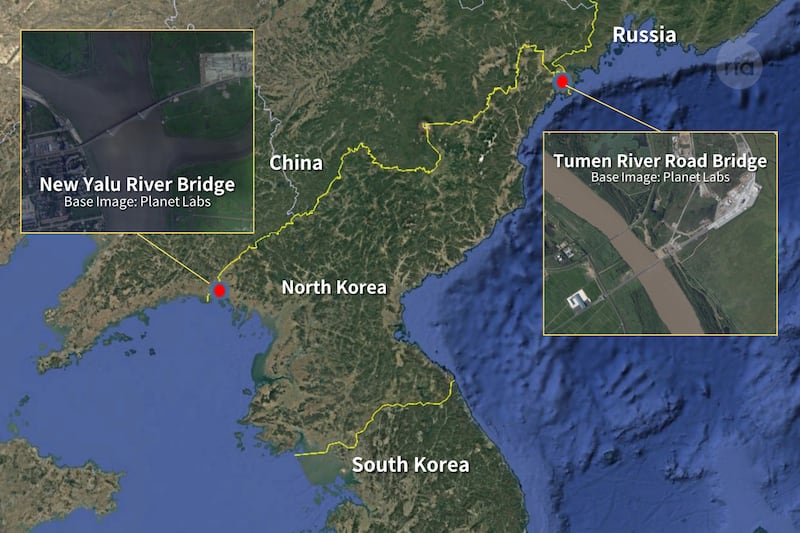 NK-Russia-China-bridges-satellite-2 Map showing the locations of the two bridges (RFA)
 RFA previously reported that experts believe the new bridges may provide a means for China and Russia to further undercut international sanctions on North Korea, meant to deprive Pyongyang of cash and resources that could be funneled into its nuclear and missile programs.
Construction accelerates
Construction on both bridges has accelerated significantly, particularly in August, the satellite imagery shows.
At the Tumen River Bridge, which connects North Korea’s northeastern city of Rason with Russia’s Khasan, the main road connecting the bridge to the Russian border checkpoint has been paved, and parking and inspection areas for cargo trucks are close to completion, including concrete and asphalt paving, Bruce Songhak Chung, a senior researcher at the Seoul-based Korea Institute for Security Strategy, told RFA.
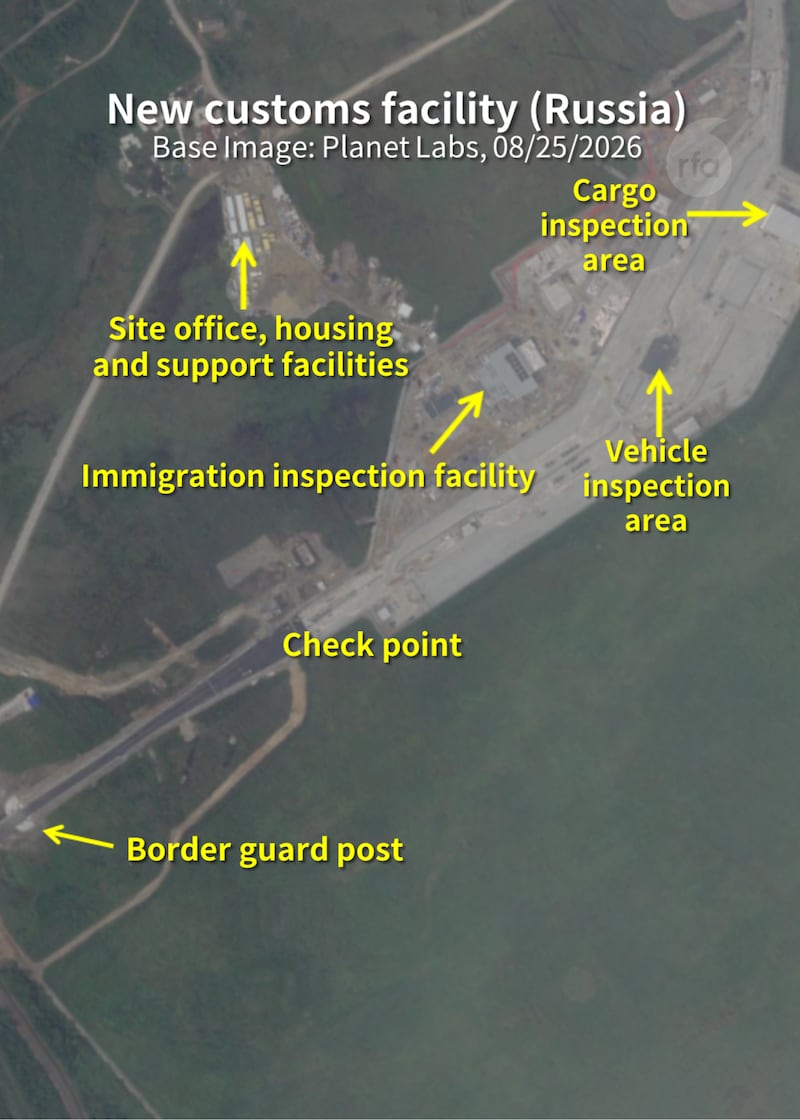 NK-Russia-China-bridges-satellite-1 Satellite imagery taken on Aug. 25 shows the main road for cargo trucks through the customs compound had been paved. Parking areas and inspection zones for large trucks also appeared to be nearing completion. (RFA)
 “The roofs and exterior work on the immigration inspection and administrative buildings appear to be nearly complete, while interior equipment and customs-related systems are likely being installed,” Chung said.
Joung Eunlee, director of the Seoul-based Korea Institute for National Unification, visited Hunchun, in China’s northeastern province of Jilin, in mid-August, a vantage point from which China, North Korea and Russia are all visible. She said construction on the Russian side appeared to be moving quickly.
“They were using heavy machinery and there were many workers on site,” Joung said. “I think the bridge will open before the end of this year, possibly in September.”
Meanwhile, construction is also rapidly progressing on customs facilities on the North Korean side of the New Yalu River Bridge, which links North Korea’s northwestern city of Sinuiju with China’s Dandong.
The bridge was completed 12 years ago but has remained unused because the two sides could not agree on financing the remaining infrastructure. Satellite imagery taken Aug. 30 shows that paving on the connecting road and customs compound is nearly finished, raising the possibility that the bridge could open by year’s end.
A new gate has been installed in front of the customs facility, while work on the exterior walls and roofs of the buildings appears to be nearing completion.
North Korea appears to be seeking to open both bridges simultaneously to establish dual land routes to Russia and China and maximize economic benefits of its ties with both countries, Im said.
“China and Russia are also encouraging the completion of the infrastructure to further strengthen their strategic ties with North Korea,” he said. “The important point is that, unlike in the past, engagement with North Korea has become both beneficial and necessary for China and Russia.”
Mutual interests
The Tumen River Bridge was designed to handle up to 300 vehicles and 2,850 people across the border per day and was originally scheduled to open on June 19, 2026, but unfinished infrastructure on the Russian side has delayed this.
The bridge is already “ready for operation,” Ivan Stepanov, head of the Khasan district administration, told Russia’s state-run Rossiyskaya Gazeta in July. He also said that officials planned to open it in early September and that he expected that even though the bridge connects North Korea and Russia, Chinese cargo would eventually traverse it, as the three countries’ borders converge near the bridge, and China’s Hunchun Border Economic Cooperation Zone lies just across from Rason and Khasan.
“Russia would gain a direct road network that could facilitate the movement of military supplies, ammunition and personnel from North Korea amid the prolonged war in Ukraine,” Im said. “Russian companies could also establish overland trucking routes, boosting trade while reducing transportation costs.”
North Korea could also use the bridge as a route for importing Russian military supplies once it opens, Ri Jong Ho, a former senior North Korean official who, while stationed in China in 2014, defected to South Korea, and who currently lives in Virginia, told RFA.
“North Korea needs Russian support to continue developing weapons, including missiles and nuclear-powered submarines, so the bridge could provide a new route for moving troops and weapons into North Korea that would face less international scrutiny than shipments by sea or rail,” Ri said.
The New Yalu River Bridge, meanwhile, could strengthen China’s economic leverage and influence over North Korea while promoting economic activity in Dandong as a regional logistics hub, Im said. Ri also said Chinese alarm at the progress on the Tumen bridge may have contributed to the recent push to complete the one on the Yalu.
“Chinese leader Xi Jinping may have pressed Kim to open the bridge, particularly as construction on the Tumen River bridge has rapidly advanced amid closer ties between Pyongyang and Moscow and the New Yalu River Bridge has remained stalled for more than 12 years,” Ri said. “However, it will be important to closely monitor whether the completion of customs facilities will actually lead to the bridge opening.”
A geopolitical message
Despite some views that the bridges may carry more symbolic than economic weight, experts say Pyongyang could use the two routes simultaneously to encourage competition between China and Russia and maximize its economic benefits.
Analysts also expect if both bridges open this year, they could accelerate economic, military and diplomatic cooperation between Pyongyang, Moscow and Beijing as well as demonstrate North Korea’s growing strategic importance in Northeast Asia.
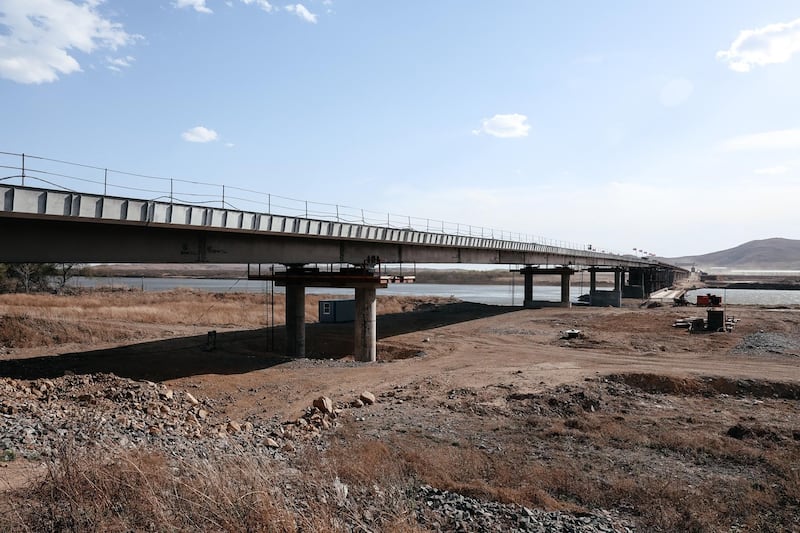 NK-Russia-China-bridges-1 A road bridge over the Tumen River connecting Russia and North Korea, April 21, 2026. (Russian Transport Ministry via AFP)
 Im said the completed bridge connections should be seen as a geopolitical message signaling the emergence of a continental triangular alliance linking North Korea, China and Russia, as well as a shift in North Korea’s diplomatic standing — a symbolic contrast with the failed 2019 summit between North Korean leader Kim Jong Un and U.S. President Donald Trump in Hanoi.
That in itself would prove advantageous should the United States and North Korea come to the negotiating table in the future, Joung said.
“The completion of the two bridges could serve as a symbolic demonstration of a closer relationship among North Korea, China and Russia, while enhancing Pyongyang’s negotiation leverage and strategic standing in the region,” Joung said.
Edited by Eugene Whong

![New Japanese convenience store rice balls taste like instant noodles [Taste test]](https://soranews24.com/wp-content/uploads/sites/3/2026/09/0_c8e809.jpg?w=1200&h=630&crop=1)
















 English (US) ·
  French (CA) ·
  French (FR) ·