

 2 months ago
60
2 months ago
60
PROTECT YOURSELF with Orgo-Life® QUANTUM TECHNOLOGY
Orgo-Life the new way to the future Advertising by AdpathwayWhen my grandmother used to tell me how she had to run down the stairs with my mother in her arms while the building’s walls tilted from a massive tremor, I never thought it would be my turn to experience it. The 1967 earthquake seemed like a distant anecdote, almost fantastical, a kind of legend. But last Wednesday, June 24, a seismic doublet changed the course of everything, and that distant tale became the reality of an entire country. Venezuela is still breathing, but not like before.
Caracas wakes up to a sunny morning three days after the grayest days of the year. Yet, the clear sky does not reflect what is happening in the streets, which are still filled with rubble, broken walls, and makeshift tents. Los Palos Grandes, one of the city’s oldest neighborhoods, was set to celebrate its 97th anniversary on Saturday; the mayor’s office had prepared an evening event where the streets would fill with neighbors drinking beer and celebrating across five previously announced stages. But instead, neighbors came out with pickaxes, shovels, and helmets.
“I live near here, so I also felt the responsibility to help,” says a resident of the neighborhood who is about to enter the affected zone alongside ten other young people. The only things differentiating his outfit from a normal day are the helmet, shovel, and gloves he is carrying. “I think organization has been the hardest part to achieve; after all, we are just regular citizens with no experience or training for this.”
The operation at the Petunia building was supervised by Cristian “Perra” Kuperbank, an Argentine rescuer and member of Los Topos (The Moles) of Mexico. “We are facing a very high demand; it’s a complicated situation and there are many areas that need attention,” says Kuperbank, who works hand-in-hand with local rescuers and volunteers. The rescue team arrived in Venezuela 48 hours after the M7.1 and M7.5 earthquakes shook the country; in the morning of June 27, they managed to recover two bodies.
“It’s very complex to be inside there,” the Buenos Aires-born rescuer comments. “A single decision can mean debris falling and putting someone at risk, it’s not that easy,” he replied to several questions regarding survivors in the building. Even so, Kuperbank clarified that there could be survivors, even seven to nine days after a collapse.
More members of the multinational crew of Los Topos of Mexico are expected to arrive in the country in the coming hours and days; at least five more rescuers are on their way by road from Brazil. Kuperbank has not yet gone down to La Guaira, the area hardest hit by the earthquake.
Some buildings barely have cracks, while others were classified as uninhabitable by civil engineers and the mayor’s office. This is the case for the Palace building, just a few meters from the Petunia, which stands completely fractured and empty. Its residents are camping in the parking lot facing the residence. “They haven’t declared it uninhabitable yet, but we know we can’t go back,” says Memé, who was trapped on the first floor after the earthquakes because her door jammed, preventing her from escaping during the tremor.
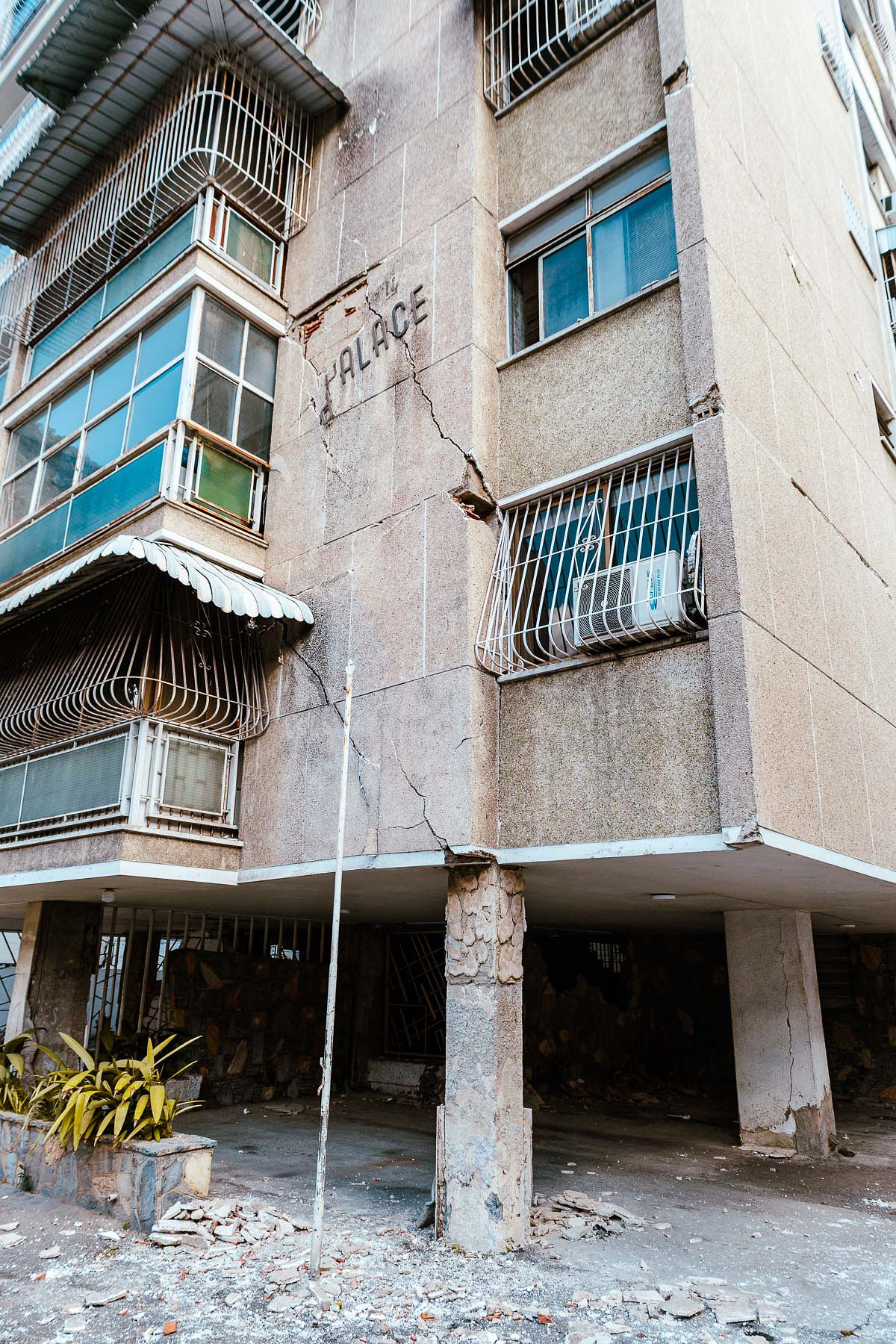 The old Palace is now too damaged to be trusted
The Palace could have been another one of the collapsed buildings in Los Palos Grandes, according to Sailyn Laguna Sarabia, a resident from the ninth floor. She goes up one by one with other owners to salvage what she can: a painting from her living room, appliances, clothes. Inside, the scene is chaotic; you walk on broken glass, and the tilted columns inspire little confidence. “Some have found other places to stay, but the rest are spending the night in the parking lot across the street,” Sailyn says.
For her, the loss is double: her other apartment, located in Guarenas, also suffered structural damage, making it uninhabitable. Amidst the loss, her voice reflects the widespread distrust regarding the emergency management: “We need audited aid, aid that truly reaches each and every Venezuelan currently affected by this.” Her gaze drifts down the street: “Resources must be managed well; even though this is a seismic neighborhood, we all have a friend in La Guaira.”
Across Caracas, we can see many collection centers, as well as people camping in squares and parking lots. Parque del Este has transformed into one of the city’s largest makeshift shelters, with displaced people from the coast and the capital. Among them is Ivis Cabello, 64, who came to the camp on her own initiative. “We come from the Santa Cruz de Baruta neighborhood; out there, the houses are packed too close together, and there are a lot of problems with hanging power wires.”
Although no building went down in her area, Cabello preferred to leave her home out of fear of the aftershocks. “I was running out of my house every five minutes; my children and I haven’t been able to sleep in peace since it happened,” says Ivis, as she prepares to face the night in her tent.
So far, official figures record 1,430 dead, over 3,000 injured, and more than 50,000 missing. Those numbers will rise to tell the story of this society that, as Kuperbank describes it, in the absence of solid institutions had to step up to save itself in order to keep this country breathing.















 English (US) ·
  French (CA) ·
  French (FR) ·