

 2 weeks ago
7
2 weeks ago
7
PROTECT YOURSELF with Orgo-Life® QUANTUM TECHNOLOGY
Orgo-Life the new way to the future Advertising by AdpathwayA standard deck of playing cards is one of the most versatile, low-cost tools for building arithmetic fluency, place value recognition, and strategic thinking. Incorporating interactive number games with a deck of cards into daily routines gives children interactive, hands-on math practice that builds confidence without feeling like a traditional drill.
You can open Table of Contents show
| Game Name | Primary Math Skill | Ideal Age Range | Player Count |
| Make 10 | Number bonds to 10 | Ages 4–7 | 1–2 Players |
| Addition War (Top-It) | Fast addition facts | Ages 5–8 | 2 Players |
| Close to 20 | Multi-digit mental addition | Ages 6–9 | 2–4 Players |
| Place Value Clash | Greater than / Less than & Place Value | Ages 6–10 | 2–4 Players |
| Memory Match Sums | Addition memory recall | Ages 5–8 | 2–4 Players |
| Subtraction Speed Race | Mental subtraction fluency | Ages 6–9 | 2 Players |
| Multiplication Array Duel | Multiplication facts & Factors | Ages 8–12 | 2 Players |
| Target 24 | Multi-operation problem solving | Ages 9–14 | 2–4 Players |
| Integer Jump | Positive and negative numbers | Ages 10–14 | 2 Players |
9 Number Games With a Deck of Cards to Try Today
(Note: Remove Face Cards—Jacks, Queens, Kings—for basic arithmetic games, or assign them fixed values: Ace = 1, Jack = 11, Queen = 12, King = 13).
1. Make 10
Remove all face cards. Lay out 9 cards face up in a 3×3 grid, holding the remaining deck in hand. Players search the grid for any two cards that add up to 10 (such as 7 and 3, or 8 and 2). When a pair is found, the player removes both cards and fills the empty spots with new cards from the draw pile. The game continues until no more combinations of 10 can be formed.
2. Addition War (Top-It)
Split a face-card-free deck equally between two players, kept face down. On the count of three, both players turn over their top two cards and call out the sum of their numbers (for example, a 6 and a 4 equals 10). The player with the higher sum wins all four cards. If both players produce identical sums, a “War” is triggered: each lays three cards face down and flips two more face up to compare the new sum.
3. Close to 20
Deal 5 cards to each player. From their hand of 5, each player selects 3 cards that add up to a number as close to 20 as possible (above or below). For example, hand cards of 7, 8, and 4 yield a sum of 19, leaving a point score of 1 (the difference from 20). After 5 rounds, the player with the lowest cumulative score wins.
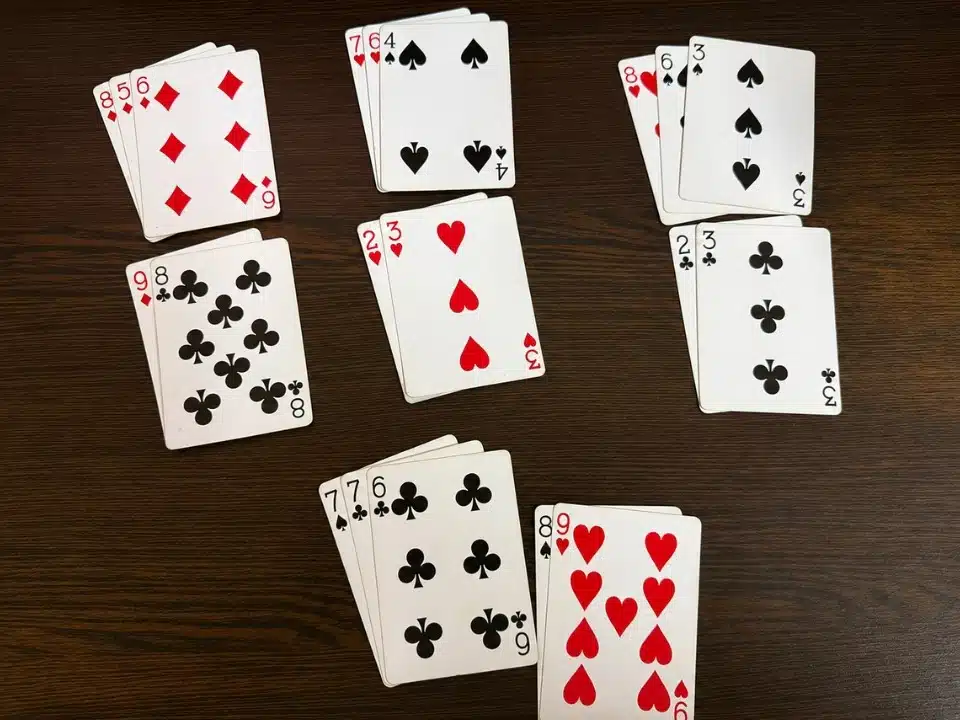 Here the hand on the bottom is the winning hand as it is the highest and closest to 20 according to the rules of Close to 20.
4. Integer Jump
Assign red cards (Hearts and Diamonds) as negative numbers and black cards (Spades and Clubs) as positive numbers. Deal two cards to each player. Players must calculate the sum of their positive and negative integers (e.g., Red 7 and Black 4 yields $-7 + 4 = -3$). The player closest to positive 10 or zero wins the hand, making this ideal for middle-school algebra prep.
5. Memory Match Sums
Lay 16 cards face down in a 4×4 grid. Before starting, choose a target sum (such as 12). Players take turns flipping two cards face up. If the two cards add up to the target sum (e.g., 8 and 4), the player keeps the pair and takes another turn. If they do not add up to the target, the cards are turned face down again, requiring players to remember card positions.
6. Subtraction Speed Race
Deal the full deck evenly between two players. Each player flips their top card simultaneously onto the table. The first player to correctly subtract the smaller number from the larger number and shout out the correct difference wins both cards. This rapid-fire game builds instant mental subtraction recall.
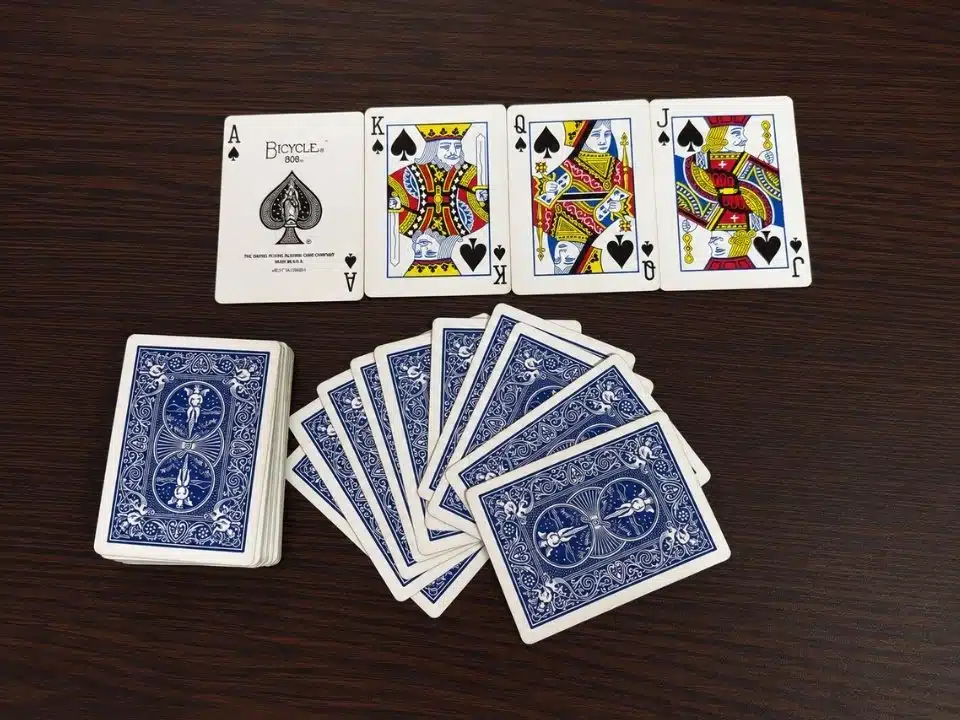 A deck of blue backed Bicycle cards displayed beside the ace, king, queen, and jack of spades.
7. Multiplication Array Duel
Using a full deck (Aces = 1, face cards removed), players draw two cards on their turn. The first card represents the number of rows, and the second card represents the number of columns. The player draws the grid (array) on graph paper and calculates the total product (e.g., 6 x 4 = 24). The player with the higher total product wins the round.
8. Target 24
Deal 4 cards face up to all players. Using addition, subtraction, multiplication, or division—and using each of the 4 card values exactly once—players race to manipulate the numbers to equal 24. For example, given 3, 8, 2, and 1: $(8 \times 3) \times (2 – 1) = 24$. The first player to figure out a valid equation claims the cards.
9. Place Value Clash
Remove 10s and face cards so only 1s (Aces) through 9s remain. Players draw a pre-agreed number of cards—such as 3 cards for hundreds, or 4 cards for thousands. Each player arranges their cards in any order to form the largest possible number. A player holding 3, 9, and 5 can arrange them into 953. The player who creates the largest multi-digit number takes the round point.
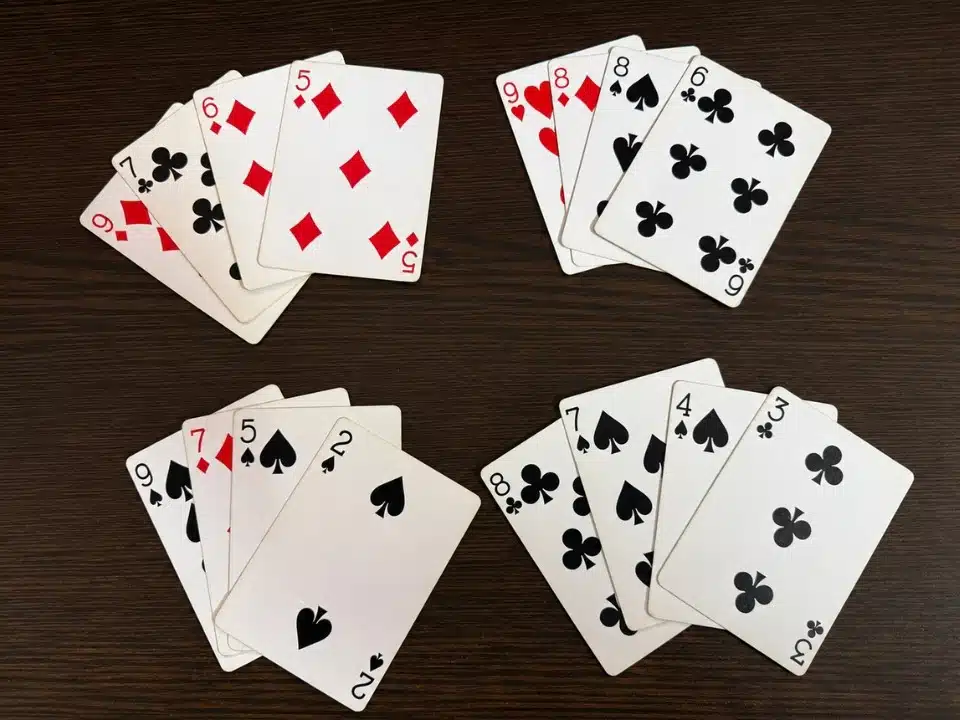 Here the hand on the top right side is the winning hand as it makes the largest number as per the rules of Place Value Clash game
A Digital Complement: Interactive Screen-Based Practice
While physical card games build mental math fluency and active problem-solving skills, interactive mobile tools can complement hands-on play by offering structured number recognition and foundational counting practice on the go.
123 Magic Number Fun
A standout option in this category is 123 Magic Number Fun on Google Play and Appstore, an early education app designed under the Edutorial venture. It translates foundational math concepts into intuitive digital exercises that reinforce the numerical skills children practice during card games.
-
Teacher Approved Status: Carries Google Play’s official Teacher Approved badge, signaling full compliance with educational design standards, safety protocols, and age appropriateness.
-
Core Skill-Building Activities: Features guided number tracing from 1 through 50, interactive counting puzzles, and numerical recognition mini-games.
-
Designed for Early Learners: Built with high-contrast visual paths and immediate prompts to encourage independent math confidence and self-paced learning.
What to Do Next
Gather a standard deck of cards and pick 1 or 2 games that match your learner’s current math focus. Start with 10-minute daily play sessions to build consistent calculation speed, and gradually increase complexity as their mental math confidence grows.
Frequently Asked Questions (FAQs) on Number Games With a Deck of Cards
What age is best to start playing math card games?
Basic counting and number matching games like Make 10 can begin as early as age 4. As children develop stronger operational fluency, you can gradually introduce multi-digit place value and multiplication games around ages 7 to 9.
How do card games help build early math skills compared to worksheets?
Card games transform abstract numerical drills into active, visual problem-solving. They foster immediate feedback, spatial reasoning, and mental calculation strategies while strengthening foundational early math skills without causing math anxiety.
How can I adapt these games for different learning levels?
You can easily scale difficulty by altering the card deck size or rules. For younger children, reduce the grid sizes or stick to single-digit operations. For advanced learners, introduce time limits, allow negative numbers, or require multiple operations per turn.





















 English (US) ·
  French (CA) ·
  French (FR) ·