

 1 week ago
6
1 week ago
6
PROTECT YOURSELF with Orgo-Life® QUANTUM TECHNOLOGY
Orgo-Life the new way to the future Advertising by AdpathwayTransforming daily neighborhood strolls into interactive math lessons helps young children connect abstract numbers to real-world objects. When parents and educators practice counting on a walk, children build one-to-one correspondence, spatial awareness, and quantity estimation without the pressure of formal flashcards.
You can open Table of Contents show
| Counting Activity | Math Concept Targeted | Primary Skill Developed | Setup Needed |
| 1. Mailbox Sequence Hunt | One-to-one correspondence | Sequential counting & pacing | None (neighborhood walk) |
| 2. Color-Coded Car Tally | Data sorting & classification | Grouping & comparative math | Chalk or small notebook |
| 3. Pavement Step Countdown | Gross motor numerical pacing | Spatial distance awareness | Sidewalk path |
| 4. Nature Treasure Bucket | Subitizing & set creation | Grouping items in sets of 5 | Small bucket or bag |
| 5. Animal Spotting Tracker | Cardinality & tracking | Cumulative sum accumulation | None |
| 6. House Number Explorer | Number symbol identification | Digit recognition & patterns | Street with visible numbers |
| 7. Crosswalk Stop & Count | Spatial timing & estimation | Rhythm & steady pacing | Pedestrian crosswalk |
| 8. Backward Hop Countdown | Reverse sequencing | Mental number line flexibility | Safe open sidewalk |
8 Fun Ways to Practice Counting on a Walk
1. The Mailbox Sequence Hunt
As you walk down the sidewalk, touch or point to each mailbox along the path while counting aloud sequentially. This physical action reinforces one-to-one correspondence, teaching children that each object receives exactly one numerical label. Following early childhood math development standards shows that physical touch combined with counting prevents children from skipping items or reciting numbers too quickly.
2. Color-Coded Car Tallying
Pick a specific car color before starting your stroll, such as red or blue. Have your child count aloud every time a vehicle of that color passes by or sits parked along the street. This activity combines quantity tracking with visual filtering, strengthening a child’s ability to categorize objects while keeping running numerical tallies.
3. Pavement Step Countdowns
Challenge your child to guess how many steps it will take to reach a target landmark, such as a large oak tree or a street lamp. Count each step aloud together as you walk toward the destination. Comparing their initial guess to the actual step count introduces basic estimation and volume perception in a tangible format.
4. Nature Treasure Subitizing Bins
Bring a small collection bag and challenge your child to gather specific quantities of natural items—for example, four acorns, three smooth stones, or five pinecones. Arranging these small collections on a park bench helps children practice subitizing, which is the cognitive skill of recognizing a small group of items instantly without counting them individually.
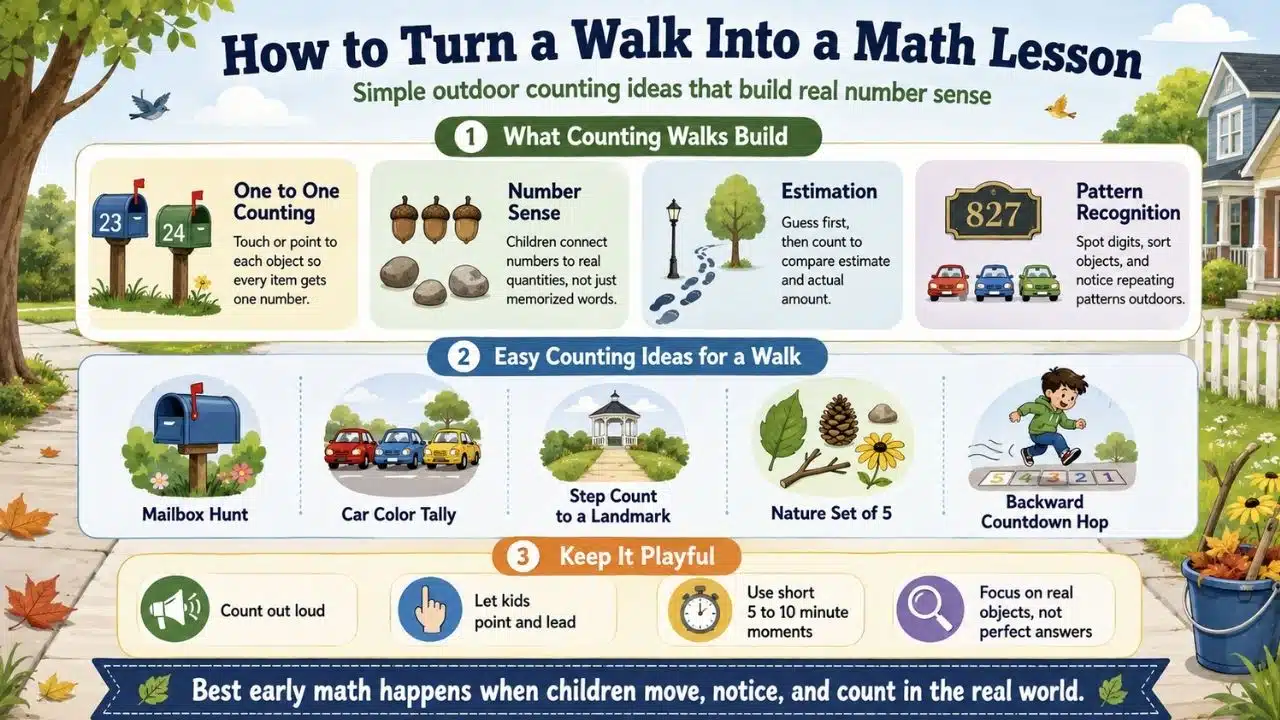 A practical guide to turning an ordinary neighborhood walk into playful early math practice using real objects and movement.
5. Neighborhood Animal & Bird Tracking
Keep a running total of living creatures spotted during your walk, including dogs, birds, squirrels, and butterflies. Re-verifying the running total every time a new animal appears reinforces cardinality, the understanding that the last number counted represents the total quantity of the group.
6. House Number Digit Spotting
Use house and building numbers to help young learners bridge spoken numbers with written digits. Have your child point out and read the digits on front porches or street signs. Incorporating interactive early learning strategies helps children understand that written symbols carry specific quantitative meanings.
7. Crosswalk Stop-and-Count Timing
While waiting safely at pedestrian intersections or stop signs, use the wait time to practice steady numerical pacing. Count slowly from 1 to 10 or 20 while watching for traffic to clear. This exercise connects math to spatial safety awareness while developing rhythmic counting control.
8. Backward Hop Countdown to Launch
Pick a safe section of sidewalk and take ten giant hops backward while counting down from 10 to 1, ending with a fun “blast off” jump forward. Counting backward forces the brain to move in reverse along an internal mental number line, laying critical cognitive scaffolding for future subtraction concepts.
Rethinking Outdoor Early Math Beyond Basic Recitation
The uncomfortable truth about early childhood education is that reciting numbers from 1 to 20 is often mistaken for true mathematical comprehension. Memorizing numerical order by rote memory is a language skill, not a mathematical one. A child can sing the number sequence perfectly while still lacking an understanding of what the number “five” actually represents in terms of physical volume or set value.
Looking forward, as screen-based digital apps continue to dominate early learning, the gap between abstract digital recognition and physical spatial math will widen. Relying entirely on touchscreen math games risks creating a “transfer deficit,” where children can tap correct answers on a glass screen but struggle to apply those concepts to physical objects.
Outdoor experiences remain irreplaceable because they force the brain to process distance, depth, texture, and movement simultaneously. The future of early math relies on keeping learning grounded in the physical world before introducing abstract digital tools.
Frequently Asked Questions (FAQs) About Practice Counting on a Walk
Why should I practice counting on a walk instead of using worksheets?
Walking connects abstract numbers to multi-sensory physical experiences. Physical movement combined with real-world objects builds deeper spatial intuition and retention than passive paper worksheets or screens.
At what age should children start counting on walks?
Children can begin informal counting walks around age two. Toddlers benefit from listening to parents count steps or items aloud, while preschoolers aged three to five can actively participate in tracking numbers and identifying digits.
What is the difference between rote counting and number sense?
Rote counting is simply reciting numbers in sequential order from memory. Number sense is understanding the actual value of those numbers, including quantity comparison, subitizing, and one-to-one correspondence.
How do outdoor counting activities help with future math skills?
Outdoor activities develop subitizing, spatial estimation, and pattern recognition. These foundational concepts prepare children for formal addition, subtraction, and geometry when they enter primary school.
How long should an outdoor math walk last for preschoolers?
Keep activities casual and brief, integrating counting for 5 to 10 minutes during a standard 20-minute walk. The goal is to keep math positive and play-based without creating mental fatigue.













![New Japanese convenience store rice balls taste like instant noodles [Taste test]](https://soranews24.com/wp-content/uploads/sites/3/2026/09/0_c8e809.jpg?w=1200&h=630&crop=1)


 English (US) ·
  French (CA) ·
  French (FR) ·