

 1 week ago
4
1 week ago
4
PROTECT YOURSELF with Orgo-Life® QUANTUM TECHNOLOGY
Orgo-Life the new way to the future Advertising by AdpathwayChildren typically show signs of phonics readiness between ages 4 and 6 once they develop basic phonemic awareness, the ability to hear, isolate, and manipulate individual sounds in spoken words. Because phonics requires connecting spoken sounds (phonemes) to visual letters (graphemes), oral language skills and visual discrimination must develop before formal instruction begins.
You can open Table of Contents show
The Core Foundations of Reading Readiness
Before introducing letter-sound relationships, a child’s brain must build an auditory foundation. Teaching phonics to a child who cannot yet distinguish spoken sounds often leads to guessing and frustration.
| Readiness Area | Observed Behavior | Role in Phonics |
| Phonemic Awareness | Isolating initial sounds (e.g., recognizing that “sun” starts with /s/) | Allows children to segment written words into individual sounds |
| Print Awareness | Holding books upright, tracking print left-to-right | Teaches that marks on a page map directly to spoken language |
| Visual Discrimination | Matching identical shapes, spotting differences in similar forms | Prepares the eyes to differentiate letters like b, d, p, and q |
| Phonological Memory | Repeating short rhymes, clapping out name syllables | Retains sound patterns long enough to blend them together |
6 Observable Signs Your Child Is Ready for Phonics
1. Isolating Initial Sounds in Conversation
When you ask your child what sound “dog” starts with, they answer with the sound /d/ rather than describing the animal. This shift shows their brain is treating words as combinations of distinct sounds rather than singular concepts.
2. Spontaneous Print Curiosity
They start noticing text everywhere, pointing at stop signs, brand logos, or food packaging. You might observe them running a finger across a line of text while making up a story, demonstrating an understanding that print holds meaning.
3. Ability to Blend Simple Spoken Sounds
If you play a verbal guessing game where you say “/k/ /a/ /t/” slowly, your child can mentally push those sounds together to say “cat.” This auditory blending skill is the exact mental mechanism used when decoding written words on a page.
4. Recognizing and Producing Rhymes
Rhyming requires tuning into word endings. A child who notices that pig and wig sound alike—or invents silly rhyming words during play is actively processing speech patterns.
5. Visual Discrimination Skill
Reading demands subtle visual analysis. Children who easily complete simple 12-piece puzzles, spot differences in picture books, or sort objects by size have developed the visual processing required to tell letters apart.
6. Listening Attention Span
Structured phonics practice requires brief periods of focused attention. Listening to a complete 5-minute picture book without significant restlessness indicates the cognitive stamina needed for guided lessons.
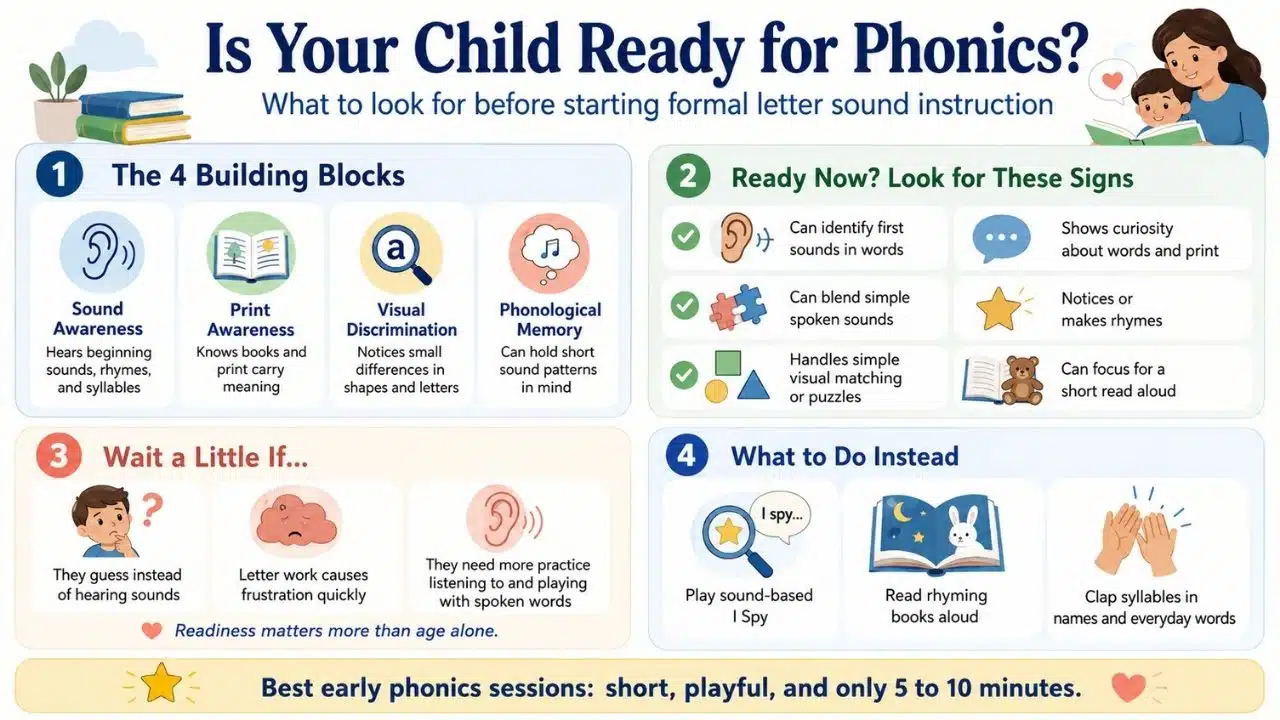 This infographic highlights the key foundations of phonics readiness, practical signs to watch for, and simple next steps for parents.
Common Misconceptions About Readiness
Singing the ABCs isn’t phonics readiness. Reciting the alphabet song is a rote memory exercise similar to singing a nursery rhyme. It does not mean a child understands that the letter shape “M” creates the /m/ sound.
Recognizing brand logos is visual memory, not decoding. Memorizing the visual look of a “Target” or “LEGO” sign uses the same mental process as recognizing a photo of a dog. It doesn’t indicate an ability to sound out unfamiliar words.
Letter names matter less than letter sounds. A child does not need to memorize all 26 letter names to start reading. Knowing just 4 or 5 letter sounds (such as m, a, s, t) allows a child to begin blending their very first words, like mat and sat.
What to Do If Your Child Isn’t Ready Yet
If these signs aren’t present, hold off on flashcards and phonics worksheets. Focus instead on playful, oral-only language games:
-
Play “I Spy” using initial sounds: “I spy something on the table that starts with /b/.”
-
Read rhyming books aloud daily, emphasizing rhythm and repetition.
-
Practice clapping out syllables in family names (Sam = 1 clap, O-li-ver = 3 claps).
Bridging Hands-On Play and Numerical Literacy
Transitioning from counting physical objects like blocks or fingers to recognizing written math symbols is a major milestone in early childhood development. Guided digital practice bridges this gap, helping young learners convert tactile counting habits into confident number recognition and penmanship.
123 Magic Number Fun
Developed by Edutorial and available on both the App Store and Google Play, 123 Magic Number Fun offers a secure, structured environment for early learners. It translates basic counting concepts into interactive touchscreen exercises that build motor control and early math skills.
-
Teacher Approved: Earned the Google Play Teacher Approved seal for meeting strict privacy, safety, and educational standards.
-
Core Skill Building: Offers guided tracing modules for numbers 1 to 50, interactive quantity challenges, and number identification activities.
-
Child-Centered Design: Features clear visual cues and encouraging feedback loops to foster independent learning and positive screen habits.
Final Thoughts on Phonics Readiness
Timing is everything when introducing early literacy skills. Waiting until you observe clear signs your child is ready for phonics creates a smooth transition from spoken language to printed text. Keep early practice brief, stress-free, and rooted in play. By following your child’s natural developmental cues, you set a strong foundation for lifelong reading confidence.
Frequently Asked Questions(FAQs) on Signs Your Child Is Ready for Phonics
What is the ideal age to start phonics?
Most children are developmentally ready between ages 4 and 6. However, biological age is far less important than auditory processing skills; some 4-year-olds are ready for basic blending, while some 6-year-olds still need time to develop phonemic awareness.
How long should early phonics lessons last?
For beginners, keep sessions to 5 to 10 minutes a day. Short, frequent, and energetic practice builds confidence without causing mental fatigue.
What is the difference between phonological awareness and phonics?
Phonological awareness is entirely auditory and can be done in the dark—it involves hearing rhymes, syllables, and sounds. Phonics brings in the visual element, connecting those heard sounds to printed letter symbols.
Starting phonics instruction at the right moment makes early reading feel like a natural extension of speech. When a child demonstrates basic phonemic awareness and print curiosity, short daily games focusing on lowercase letter sounds provide the smoothest entry point into decoding.



















 English (US) ·
  French (CA) ·
  French (FR) ·